Dutch prime minister bans wireless devices from meetings to ward off espionage
September 2, 2024 2 Comments
 THE NETHERLANDS’ NEW PRIME minister has officially banned the use of all wireless devices from cabinet meetings, reportedly to defend against espionage operations from foreign actors. The move comes following warnings by Dutch intelligence services that the country is being targeted by Russian and Chinese spies with more intensity than at any time since the Cold War.
The current Dutch government, led by the far-right Freedom Party (PVV), was formed following the general election of November 2023. Although the PVV, headed by populist Geert Wilders, emerged as the leading political force in the Netherlands with 23% of the vote, it found it difficult to form a governing coalition. In June of this year, following lengthy negotiations, a rightwing coalition was formed between the PVV, the People’s Party for Freedom and Democracy (VVD), the Farmer-Citizen Movement (BBB), and the New Social Contract (NSC).
A key feature of the agreement was that none of the individual parties’ leaders, including Wilders, could serve as prime minister. Instead, the three parties settled on Dick Schoof as a form of compromise. The 67-year-old Schoof led the Netherlands’ Immigration and Naturalization Service from 1999 until he was appointed to head the Ministry of Security and Justice in 2010. From 2013 to 2018, he became the National Coordinator for Security and Counterterrorism —the Netherlands’ main counter-terrorism unit, which operates as part of the Ministry of Security and Justice.
In 2018, Schoof was appointed director-general of the General Intelligence and Security Service (AIVD), the nation’s primary intelligence agency. The AIVD is tasked with foreign and domestic duties, as well as signals intelligence. Prior to his prime ministerial post, the culmination in Schoof’s career as a public servant came with his appointment as secretary-general of the Ministry of Justice and Security, in 2020. In 2021, after 30 years of being a member, Schoof officially left the Labor Party (PvdA), the Netherlands’ mainstream social-democratic, left-of-center political party. In subsequent public comments he appeared to endorse the PVV, but never officially joined it.
Speaking to reporters last week, Schoof said he was “taking a different approach” to security at cabinet meetings, which was “based on his former job in the intelligence community”. He added, “maybe I have a bit more experience with that sort of thing” and stressed that banning wireless devices from cabinet meetings was “a completely natural measure” for him. Members of the Dutch cabinet “agreed immediately” with the new measure, said the new prime minister.
► Author: Joseph Fitsanakis | Date: 02 September 2024 | Permalink
 THE FORMER DIRECTOR OF the Netherlands’ intelligence service has been
  THE RUSSIAN INTELLIGENCE SERVICES are “covertly mapping” the energy infrastructure of the North Sea, in preparation for acts of disruption and sabotage, according to a new report form the Dutch government. The 32-page
  As intelNews
 ON JUNE 16, THE Dutch General Intelligence and Security Service (AIVD)
  A WEEK AFTER POLAND
  ON MARCH 3, 2022, Dutch newspaper Volkskrant
 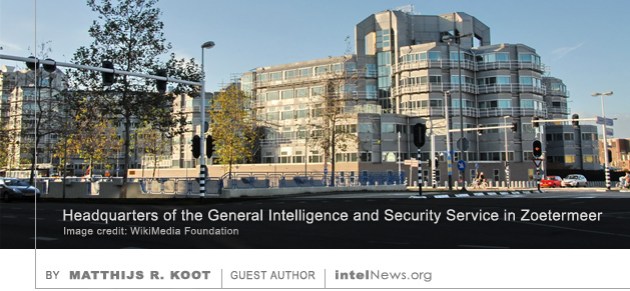 LAST WEEK, THE DUTCH General Intelligence and Security Service (AIVD) launched an awareness campaign dubbed ‘Check before connecting’. The purpose of the campaign is to inform the Dutch public about risks of foreign actors using fake accounts on social media, in efforts to acquire sensitive business information. According to the AIVD, such online campaigns frequently target and recruit employees of Dutch private sector companies. The
  A HACKER WHO TARGETED a major Dutch-based reservations website has ties to intelligence agencies in the United States, according to a new report. The claim was made on Wednesday by three Dutch investigative journalists, Merry Rengers, Stijn Bronzwaer and Joris Kooiman. In a lengthy
 A LEADING CHINESE TELECOMMUNICATIONS firm has strongly denied a claim by a newspaper that its service personnel could listen in on calls made by Dutch telephone users, including senior government officials. The report dates from 2010 and was authored by consultancy firm Capgemini on behalf of KPN, one of Holland’s largest telecommunications service providers. The Rotterdam-based firm had hired Capgemini to conduct a risk analysis on whether more equipment should be purchased from Chinese telecommunications giant Huawei. By that time the Chinese company, one of the world’s largest in its field, was already supplying KPN with hardware and software equipment.
 A WEB SERVER BASED in Holland and owned by a company registered in Cyprus is being used by the Iranian government to spy on its critics abroad, according to Dutch public radio. The information about Iranian espionage was






 intelNews.org
Dutch spy services have restricted intelligence-sharing with the United States: report
October 20, 2025 by Ian Allen 15 Comments
The joint interview was given to De Volkskrant by Erik Akerboom, director of the General Intelligence and Security Service (AIVD), and Peter Reesink , director of the General Intelligence and Security Service (MIVD)—AIVD’s
civilianmilitary counterpart.Both men stressed that inter-agency relations between Dutch and American intelligence organizations remain “excellent”. However, they added that the Netherlands has grown more selective about what it chooses to share with American intelligence agencies—particularly the Central Intelligence Agency and the National Security Agency. “That we sometimes don’t share things anymore, that’s true,” Reesink said, referring to sharing information with American intelligence agencies. Akerboom added: “sometimes you have to think case by case.” He went on to say: “We can’t say what we will or won’t share. But we can say that we are more critical.”
According to the two senior officials, Dutch spies have been intensifying intelligence cooperation and sharing with their European counterparts. This is particularly applicable to a collection of central and northern European intelligence services from countries like Scandinavia, France, Germany, the United Kingdom, and Poland, according to De Volkskrant.
► Author: Ian Allen | Date: 20 October 2025 | Permalink
Filed under Expert news and commentary on intelligence, espionage, spies and spying Tagged with AIVD (Netherlands), intelligence cooperation, intelligence sharing, MIVD (Netherlands), Netherlands, News, United States