Islamic State shuts down phones in Mosul to stop informants

Mosul, IraqBy JOSEPH FITSANAKIS | intelNews.org
The Islamic State has cut off all telephone service provision in the largest city under its control, reportedly in an effort to stop spies from passing information to Syrian, Iraqi and American intelligence services. Militants from the Islamic State, also known as the Islamic State of Iraq and al-Sham (ISIS), conquered the northern Iraqi city of Mosul in June. They encountered almost no resistance upon entering the Sunni city of over a million inhabitants, as the crumbling Iraqi military kept hastily retreating south. Today Mosul is the most populous urban center under direct Islamic State rule. In July, the group’s seldom-seen leader, Abu Bakr al-Baghdadi, used Mosul as the backdrop of his propaganda video, in which he announced the official establishment of the Islamic State, a militant Sunni caliphate that is administered strictly through sharia law. Just weeks later, on August 8, the United States military began conducting airstrikes in Mosul, targeting senior Islamic State personnel there. The precise effects of these airstrikes are under debate in strategy circles in Washington, Baghdad and elsewhere. Last Thursday, however, residents of Mosul told the Associated Press news agency that Islamic State authorities had decreed the temporary termination of all telephone provision in the city. The measure was allegedly taken in order to prevent informants in and around Mosul from tipping off adversary intelligence agencies as to the physical whereabouts of senior Islamic State commanders. The measure was reportedly announced in the evening of Wednesday, November 26, through a radio station in Mosul that acts as the official news organ of the Islamic State in the Iraqi city. The Associated Press reported scenes of “chaos” and “paralysis” in the streets of Mosul on Thursday, as businesses came to a virtual standstill following the decision by the Islamic State to terminate telephone provision throughout the city. Some observers note that this move by the Islamic State constitutes a drastic change from the group’s standard tactic so far, which has centered in the efficient provision of basic services to the Sunni populations under its control, in an effort to win over their ideological support and political allegiance. Moreover, Mosul, whose population is almost uniformly Sunni, and is viscerally opposed to the Shiite-dominated government in Baghdad, is generally believed to be an Islamic State stronghold. If the militant group is finding it difficult to ensure the allegiance of Mosul’s population, then this could be a sign of fragmentation within the ranks of its supporters in all of northern Iraq. The Associated Press said some residents of Mosul are reportedly still able to access the Internet, which operates through a network that is separate from that of the telephone system.

White House weighs increased CIA involvement in Syrian war

Syrian rebelsBy JOSEPH FITSANAKIS | intelNews.org
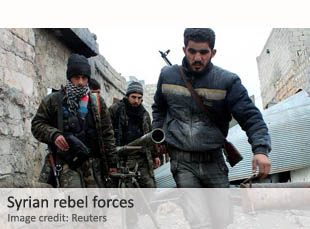
The government of the United States is considering plans to augment the Central Intelligence Agency’s clandestine role in Syria, amid fears that similar efforts by the US Department of Defense are failing. The CIA’s involvement in the Syrian civil war began in 2012, when US President Barack Obama issued a classified presidential finding that authorized Langley to arm and train opposition militias. The clandestine program was initially based in training camps in Jordan before eventually expanding to at least one location in Qatar. The CIA currently vets and trains approximately 400 opposition fighters every month with the help of commandos detailed to the Agency from the Pentagon. But the program may be about to escalate considerably, according to The Washington Post. The paper said last week that the option of expanding CIA arming and training operations in Syria was on the agenda at a recent meeting of senior national-security officials in Washington. The paper said that the proposed escalation of CIA operations in the region “reflects concern” about the slow pace of similar programs run by the US Department of Defense, which aim to train and arm anti-government militias. The latter have so far proved unable to counter the dominance of a host of al-Qaeda-inspired groups operating along the Iraqi-Syrian border. Earlier this month, a major CIA-backed armed group, known as Harakat Hazm, abandoned many of its positions in northern Syria, after it came under attack by Jabhat al-Nusra, an official al-Qaeda affiliate. Along with territory, Harakat Hazm left behind significant amounts of war material supplied to it by the US Pentagon. The Post said that other moderate opposition militias are beginning to view al-Qaeda-linked groups as their most viable option in defeating the Syrian regime of President Bashar al-Assad, something which is worrying the White House. Spokesmen for the US government refused to comment on the report of a possible increase of CIA operations in Syria, or on whether the White House had reached a decision on the matter.
Turkish prosecutor indicts 13 with tapping PM’s phone

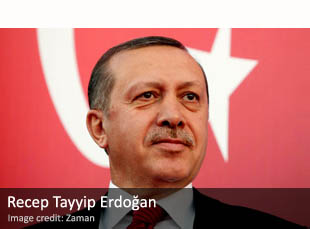
Recep Tayyip ErdoğanBy JOSEPH FITSANAKIS | intelNews.org
Turkeys’ chief public prosecutor has indicted 13 suspects with charges of wiretapping the personal telephone of the country’s former prime minister. Authorities believe the suspects are part of a broader criminal conspiracy whose members wiretapped phones belonging to senior political figures, as well journalists and government administrators, including judges and military officials. The indictment was presented on Tuesday before the 7th high criminal court in Turkish capital Ankara. It accuses the 13 suspects of conducting systematic “political and military spying”, and claims they targeted the personal telephone communications of Turkey’s President, Recep Tayyip Erdoğan, who was prime minister at the time. The charges represent the culmination of a tumultuous period of antagonism between Mr. Erdoğan and his critics in Turkey, who accuse him of absolutism and megalomania. Last July over 100 members of the country’s police force were arrested in raids that took place on all over Turkey. They were accused of illegally wiretapping the telephones of senior government figures including Mr. Erdoğan and Hakan Fidan, director of Turkey’s National Intelligence Organization, known as MİT. Hadi Salihoglu, Istanbul’s chief prosecutor, said at the time that the alleged conspirators had concocted a fake police investigation of a made-up terrorist organization called Tevhid-Selam (Al-Quds Army, in English), in order to justify the wiretapping of the officials’ phone lines. However, critics of Mr. Erdoğan noted that one of the police officers arrested in July was the former deputy chief of the Istanbul police department’s financial crimes unit, which earlier this year led an investigation into alleged corrupt practices by senior members of Erdoğan’s former cabinet. The investigation led to the exposure of corrupt practices by several cabinet members and their families, and resulted in several ministerial resignations. Several months ago, a wiretapped conversation emerged in the media, in which Mr. Erdoğan can allegedly be heard discussing with his son how to hide large sums of money. Some observers have expressed the view that the leaked telephone conversation between the two men emerged from the Tevhid-Selam investigation, which may be why Mr. Erdoğan has now decided to shut it down and arrest those behind it. The 13 suspects are expected to stand trial in Ankara once the court approves the indictment by the office of the prosecutor. Mr. Erdoğan is listed as a plaintiff in the indictment.

Russia expels Polish, German diplomats in ongoing spy row

Polish embassy in MoscowBy JOSEPH FITSANAKIS | intelNews.org
The Russian government has formally expelled several Polish and German diplomats in what appears to be a tit-for-tat move, following the removal of Russian envoys from Warsaw and Berlin on charges of espionage. The Polish government expelled a number of Russian diplomats last week, after it announced the arrest of two Polish citizens in Warsaw, on charges of spying for a foreign intelligence agency. Polish media reported that a colonel in the Polish Army had been arrested by security personnel for operating as an unregistered agent of an unnamed foreign country. Subsequent media reports said a second man, a lawyer with dual Polish-Russian citizenship, had also been arrested. According to unconfirmed Polish media reports, the two men had been recruited by the GRU, Russia’s military intelligence agency. Last Friday, Polish media reports said that four Polish diplomats stationed in Moscow had been given 48 hours to leave the country. One report suggested that the diplomats included an employee of the political section of the Polish embassy in the Russian capital, as well as three military attachés. The four had reportedly left the country by Sunday night. Authorities in Moscow said they had been forced to take the step of expelling the Polish diplomats following Warsaw’s “unfriendly and unfounded step” of ordering a number of Russian envoys to leave Poland. The four Poles were officially declared “unwanted persons” in Russia for “activities incompatible with their [diplomatic] status”, which is considered code-language for espionage. Also on Monday, the Russian Ministry of Foreign Affairs ordered the expulsion from Moscow of a German diplomat, just hours after a Russian diplomat was asked to leave the German city of Bonn by German authorities. Diplomatic sources said the German diplomat, a female employee at the German embassy in Moscow, was expelled in direct response to the earlier removal of the Russian diplomat, who was exposed as a spy following an extensive surveillance operation that lasted several months. German authorities refused to comment on the case. In Poland, Minister of Foreign Affairs Grzegorz Schetyna said simply that Warsaw “now considered the matter closed”.

Mossad’s top agent in Lebanon speaks publicly for first time

Amin al-HajjBy JOSEPH FITSANAKIS | intelNews.org
A spy for Israel, who is described as one of the Jewish state’s most valuable intelligence assets in the Middle East, has broken his 30-year silence and has accused his Israeli handlers of having “thrown him to the dogs”. Amin al-Hajj was born in 1955 into one of the Lebanese Shia community’s wealthiest and most powerful clans. In the early 1970s, al-Hajj entered the inner circle of former Lebanese President Camille Chamoun, an outspoken leader of the country’s Christian community, who subsequently played an instrumental role in Lebanon’s civil war. Al-Hajj shared Chamoun’s detestation of Lebanon’s Palestinian community, which he held as responsible for sparking the civil war that lasted from 1975 to 1990 and destroyed the country. He helped direct and train Chamoun’s bodyguards and regularly represented the Christian politician in secret meetings with officials from Israel. The latter supported Chamoun’s pro-Phalangist Tigers Militia during the civil war. It was during those meetings that the Israelis sensed al-Hajj’s hatred for the Palestinians and gradually recruited him as an asset. He went on to serve the Mossad as one of its most effective agents in the Middle East. Soon after his recruitment, al-Hajj assumed the operational codename RUMMENIGGE, after German soccer superstar Karl-Heinz Rummenigge, who was at the peak of his career in the late 1970s. Al-Hajj’s Israeli handlers claim that he consistently refused to accept money from the Israeli government, saying he wanted to help Israel because he “thought it would be the only force that could fight the Palestinians” in Lebanon. Eventually, RUMMENIGGE built an entire network of agents in Lebanon, Cyprus and elsewhere, which numbered over a dozen and included at least two senior officials in Palestinian group Fatah, who provided him with information in exchange for financial compensation. In 1987, however, the PLO began to suspect that al-Hajj was collaborating with Israel and tried to kill him. He managed to escape with his wife to Israel, where he remains today. He is currently facing no fewer than nine separate death sentences in Lebanon. However, soon after he received protection in Israel, al-Hajj’s relations with the Israeli intelligence community turned sour. Read more of this post

News you may have missed #885

Shin BetBy IAN ALLEN | intelNews.org
►►Americans’ cellphones targeted in secret US spy program. The US Justice Department is scooping up data from thousands of mobile phones through devices deployed on airplanes that mimic cellphone towers, a high-tech hunt for criminal suspects that is snagging a large number of innocent Americans, according to people familiar with the operations. The US Marshals Service program, which became fully functional around 2007, operates Cessna aircraft from at least five metropolitan-area airports, with a flying range covering most of the U.S. population, according to people familiar with the program.
►►Israel’s usually secretive spy agencies get into public spat. Israel’s domestic intelligence agency, known as the Shin Bet, has been trading barbs with the military over whether faulty army intelligence left Israel unprepared for war with the militant group Hamas in the Gaza Strip. The spat went high-profile this week when Israel’s Channel 2 aired a report featuring Shin Bet officials –-rendered in pixilated, shadowed form-– claiming the military had brushed aside the agency’s assessment, months before fighting erupted in July, that an armed conflict with Hamas was in the making.
►►Poland mulls military intelligence brigade close to Belarus border. Polish Armed Forces will make emphasis on the unfolding of reconnaissance troops and will set up a separate brigade and military command in the north-east of the country, National Defense Minister Tomasz Siemoniak said on Thursday. The region he visited is located along the border with Belarus and close to the border with Russia’s westernmost Kaliningrad region, an exclave on the south-east shore of the Baltic Sea.

High-profile US diplomat probed by FBI counterintelligence

Robin L. RaphelBy IAN ALLEN | intelNews.org
A highly experienced American diplomat, who is commonly described as “a fixture in Washington foreign policy circles”, is reportedly being investigated by counterintelligence agents of the Federal Bureau of Investigation. The Washington Post named the diplomat last week as Robin L. Raphel, who served as United States ambassador to Tunisia before being appointed as assistant secretary of state for South Asian affairs, during the administration of US President Bill Clinton. The New York Times described Ms. Raphel as one of the US Department of State’s highest-ranking female diplomats. She is considered an expert on Pakistan and until recently served as an adviser to the Department of State’s special representative for Afghanistan and Pakistan. Ms. Raphel officially retired from the Foreign Service in 2005 and joined the ranks of Cassidy & Associates, a high-powered government-relations firm based in Washington, DC, which is known to have performed lobbying assignments on behalf of the government of Pakistan. In reporting the alleged investigation of Ms. Raphel by the FBI, The Washington Post said last week that the nature of the probe was “unclear”. But it stated that FBI counterintelligence agents had searched the former diplomat’s house and office. Citing unnamed government sources, The New York Times reported that the FBI was trying to determine why Ms. Raphel had taken classified information to her house, and whether she had shared it, or planned to share it, with a foreign government. There was no mention in the article of the identity of the foreign government that may have been privy to classified information allegedly taken home by Ms. Raphel. Media reports suggested that the former diplomat had been placed on leave and stripped of all her government security clearances as part of the ongoing FBI investigation. Insiders note that it is extremely rare for such a prominent figure in Washington to become the subject of an FBI counterintelligence investigation.

UK report warns about sexual entrapment by foreign spies

UK Ministry of DefenceBy IAN ALLEN | intelNews.org
A leaked report issued by military authorities in the United Kingdom cautions British officials to be aware of attempts by Chinese and Russian intelligence services to compromise them using sexual entrapment. The London-based Sunday Times newspaper said it had acquired a copy of the document, entitled Manual of Security, authored by the United Kingdom’s Ministry of Defence for use by senior officials. The manual warns that foreign intelligence services are known to employ sexual entrapment or romantic attachment as a means of compromising their targets. The document singles out the Russian Federal Security Service (FSB) and the Chinese Ministry of State Security as two adversary agencies that are known to employ sexual entrapment on a regular basis. British officials are warned in the document that the FSB could gain classified information by exploiting “knowledge of marital infidelity or sexual activity the target may wish to hide”. The Times spoke to an unidentified “senior military official”, who told the paper he was recently approached by “a very attractive blonde woman in her early 30s” in a hotel in the Russian city of Saint Petersburg. The woman began telling him of her fascination with vintage British sports cars, which happened to be the British official’s favorite hobby. He eventually terminated the encounter after he became suspicious of the woman’s motives. But he remains puzzled as to how the woman knew details of his personal hobbies. In 2009, the British Foreign Office had to recall its deputy consul-general in the Russian city of Ekaterinberg, after he appeared in an explicit video on YouTube having a sexual encounter with two Russian prostitutes. Many speculated at the time that the video had been posted online by the FSB in an attempt to embarrass the diplomat and have him removed from Russia. Later that year, London’s former deputy mayor, Ian Clement, admitted he was lured by a female Chinese secret agent, who drugged him and ransacked his Beijing hotel room after having sex with him. Clement said he fell for what he called “the oldest trick in the book” while in Beijing to “build contacts with potential investors” for the 2012 Summer Olympics in London. Sir Christopher Meyer, a career diplomat with the Foreign Office, who served in several countries during his career, including the Soviet Union, has written about the case of Sir Geoffrey Harrison, Britain’s ambassador to Moscow from 1965 to 1968. The ambassador, said Sir Christopher, “had to leave [the Soviet capital] in a hurry, having fallen for the charms of his Russian maid –trained and targeted, of course, by the KGB”. Read more of this post

KGB officer who handled Aussie double spy is now Putin crony

Lev KoshlyakovBy JOSEPH FITSANAKIS | intelNews.org
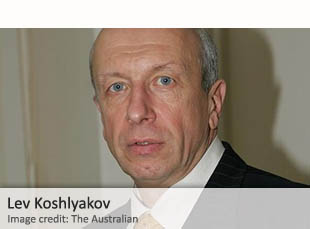
A KGB intelligence officer, who handled an Australian double spy during the closing stages of the Cold War, now holds several prestigious corporate posts in Moscow and is believed to be close to Russian President Vladimir Putin. Lev Koshlyakov, 69, is director of corporate communications for two Russian airline companies, including the state carrier, Aeroflot, and a member of the prestigious Moscow-based Council for Foreign and Defense Policy. But from 1977 until 1984, Koshlyakov served as the press and information officer for the Russian embassy in Australian capital Canberra. Intelligence sources, however, told The Weekend Australian last week that Koshlyakov’s diplomatic status was in fact a cover for his real job, which was station chief for the Soviet KGB. During his stint in Canberra, Koshlyakov is believed to have handled an especially damaging mole inside the Australian Security Intelligence Organisation (ASIO), who was allegedly recruited by his predecessor, KGB station chief Geronty Lazovik. Canberra was alerted to the existence of the mole in 1992, when the United States Central Intelligence Agency (CIA), along with Britain’s’ Secret Intelligence Service (MI6), briefed Australian officials on information acquired from Russian defectors. Soon afterwards, a government-commissioned report produced by Australian former diplomat Michael Cook described Koshlyakov as “one of the most dangerous KGB officers ever posted” to Australia. Eventually, Koshlyakov was assigned to a desk job by the KGB, after his cover was blown in Norway, where he was also serving as KGB chief of station. The Norwegians expelled Koshlyakov in 1991 after accusing him of espionage activities that were incompatible with his official diplomatic status. Since his retirement, however, Koshlyakov has done well for himself, having been appointed to senior corporate positions —some say with the personal backing of Russia’s President Vladimir Putin. As for the ASIO mole he allegedly handled in the 1980s, The Australian reports that he was forced to retire in 1992, after he was identified by the CIA and MI6. There was insufficient evidence to try him, however, so he “lived out his retirement in Australia” looking nervously over his shoulder, says the paper.

Obama in secret negotiations with Iran over ISIS threat

Iran and its regionBy IAN ALLEN | intelNews.org
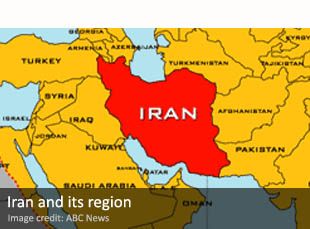
The president of the United States reportedly sent a secret letter to the supreme leader of Iran, in which he proposes cooperation against the Islamic State of Iraq and Syria (ISIS) in exchange for a nuclear deal. The New York-based Wall Street Journal newspaper reported on Thursday that Barack Obama reached out to Iranian leader Ayatollah Ali Khamenei in October. In the letter, Obama allegedly proposes a nuclear agreement between Washington and Tehran and emphasizes the common threat the two nations face from ISIS, the Sunni Islamist group also known as the Islamic State. The paper said Obama’s letter stresses that any cooperation between America and Iran against the Islamic State is directly contingent on a nuclear agreement between the two governments, which would have to be reached before November 24 of this year. If the Journal’s information is accurate, it would appear that the US president’s move is connected with the latest round in bilateral negotiations between Washington and Tehran, which is scheduled to begin on November 8. US Secretary of State John Kerry and Iran’s Minister of Foreign Affairs Javad Zarif will be leading their respective teams, as the two delegations meet in Muscat, capital of Oman, to explore ways of normalizing their diplomatic relations. If it is real, Obama’s purported letter would not mark the first instance in which the US president wrote to his Iranian counterpart. There are at least three other letters that Obama is known to have sent to various Iranian leaders since 2009, when he assumed the presidency of the US. However, if the proposal in the letter, as outlined in The Wall Street Journal article, is authentic, the move can be seen to highlight the view of the White House that Iran must inevitably be part of a solution regarding ISIS. Nevertheless, the revelation that America is seeking an alliance with Shiite Iran will undoubtedly frustrate America’s Arab allies in the region, especially Saudi Arabia, Bahrain, Kuwait, and other Sunni oil monarchies, which are participating in the ongoing international military campaign against the Islamic State. The Journal contacted the White House but officials there refused to comment on what they said was Obama’s “private correspondence”. When asked by journalists on the matter, White House spokesman Joshua Earnest said only that “the policy that the president and his administration have articulated about Iran remains unchanged”.

British spy agencies launch recruitment drive for Russian speakers

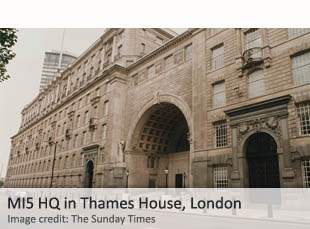
MI5 HQ Thames HouseBy JOSEPH FITSANAKIS | intelNews.org
Amid mounting tensions between Russia and the West, British spy agencies have announced an ambitious recruitment campaign aimed at hiring a new generation of Russian-language specialists. The Security Service, known as MI5, which is responsible for domestic security and counterintelligence, posted an advertisement on its website this week, alerting potential applicants that the job search for Russian-language speakers will officially launch “in mid-November 2014”. The recruitment campaign, which is described on the spy agency’s website as “an exciting opportunity to match your language skills to a position in MI5”, appears to be jointly administered with the General Communications Headquarters (GCHQ), Britain’s signals intelligence agency, which is tasked with intercepting foreign communications. The move takes place in a wider context of deteriorating relations between Moscow and Western Europe, notably in response to Russia’s ongoing invasion of southeastern Ukraine and annexation of Crimea. Some suggest that there has also been a low-intensity intelligence war taking place between London and Moscow ever since the assassination in the British capital of former KGB officer Alexander Litvinenko. In late 2012, an officer of the Royal Navy was captured during a counterintelligence sting operation while trying to sell top-secret British government documents to people he believed were Russian intelligence operatives. A few months later, the British government let it be known of its increasing annoyance by persistent allegations made in the Russian media that Denis Keefe, the UK’s deputy ambassador to Moscow, was “an undercover spy, with his diplomatic position serving as a smokescreen”. In March of 2013, Oleg Gordievsky, the Soviet KGB’s former station chief in London, who defected to the UK in the 1980s, alleged in an interview that Russia operates as many spies in Britain today as it did during the Cold War. His comments were echoed earlier this year by the former director of MI5, Jonathan Evans, who said that there had been no change in the number of undeclared Russian intelligence officers operating in Britain since the end of the Cold War. Evans said that up to 50 undeclared Russian military and civilian spies were believed to be operating in Britain at any given moment. In June of this year, intelNews reported that the crisis in Crimea had caused the British military to hurriedly reach out to hundreds of retired Russian-language analysts who left the service at the end of the Cold War, most of whom are now in their 60s.

Brazil builds direct Internet cable to Europe to avoid US spying

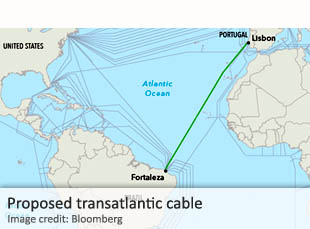
Proposed transatlantic cableBy JOSEPH FITSANAKIS | intelNews.org
The government of Brazil is to construct a transatlantic cable across the Atlantic Ocean in order to avoid having its Internet traffic to and from Europe intercepted by American intelligence agencies. According to reports, the fiber-optic cable will stretch for 3,500 miles from the northeastern Brazilian city of Fortaleza to the Portuguese capital Lisbon. It will cost the Brazilian government in excess of US$185 million, but it will allow the country’s existing Internet traffic to and from Europe to travel without going through cables owned by American service providers. According to Brazilian officials, the construction of the cable is among several steps announced by the Brazilian government aimed at disassociating its communications infrastructure from American companies. The move follows revelations made last year by American defector Edward Snowden that the US National Security Agency specifically targeted Brazilian President Dilma Rousseff’s personal communications as part of its intelligence-collection efforts targeting Brazil. In response to the revelations, Rousseff cancelled a planned official state visit to Washington and accused the US of having committed “a breach of international law and an affront” against Brazil’s sovereignty. The planned fiber-optic cable connection to Europe will be overseen by Telecomunicacoes Brasileiras SA, Brazil’s state-owned telecommunications conglomerate, known commonly as TeleBras. The company’s president, Francisco Ziober Filho, said in an interview last week that none of the $185 million that will be spent on the project will end up in the pockets of American companies. For over a year, experts have been warning that the Snowden revelations about the extent of the NSA’s global communications-interception activities might undermine the American telecommunications sector, insomuch as it could undercut America’s role and influence in global Internet governance. Many countries, Brazil included, are beginning to actively reconsider their dependence on US-managed Internet networks that host the content of social media sites, cloud computing databases, or telecommunications exchanges. Read more of this post

Are militant groups interested in weaponizing Ebola?

Ebola suffererBy IAN ALLEN | intelNews.org
Does the Ebola epidemic present militant groups, such as the Islamic State or al-Qaeda, with the opportunity to weaponize viruses and direct them against Western targets? Earlier this month, United States Homeland Security Secretary Jeh Johnson dismissed in strong terms the possibility that Ebola would be used by Islamic State militants to attack American targets. Speaking to the Association of the United States Army, Johnson acknowledged that the Islamic State is a “very, very dangerous terrorist organization”, but added that his Department had seen “no specific credible evidence that [the Islamic State] is attempting to use any sort of disease or virus to attack” the US. A few days earlier, however, Forbes magazine had quoted Al Shimkus, Professor of National Security Affairs at the US Naval War College, as saying that the Ebola outbreak presented Islamist groups with the opportunity to use a low-tech bioterrorist weapon “to attempt to wreak strategic global infection”. Shimkus added that a group like the Islamic State wouldn’t even have to weaponize the virus’ it could “simply use human carriers to intentionally infect themselves in West Africa, then disseminate the deadly virus via the world’s air transportation system”, he said. On Wednesday, a senior Spanish official told a parliamentary committee in Madrid that the government of Spain was “taking seriously” discussions in Internet forums linked to the Islamic State about using biological weapons against the West. Francisco Martínez, who is Spain’s State Secretary for Security, told the Committee of the Interior in the Spanish Congress that online commentators connected to the Islamic State have been discussing the possibility of using Ebola as a weapon against America and its Western allies. He told Committee members that the discussions had been taking place on Internet forums as recently as mid-September. He also cited “a series of tweets” from last July, in which another Islamist group, Ansar al-Islam, with roots in Iraqi Kurdistan, proposed using “deadly chemical products from laboratories” as means of launching attacks against the West. Martínez did not provide further details on the allegations.

India uncovers plot to assassinate Bangladeshi prime minister

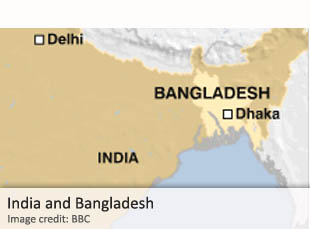
India and BangladeshBy JOSEPH FITSANAKIS | intelNews.org
Indian authorities claim to have uncovered a plot by an outlaw militant group to assassinate the prime minister of Bangladesh and launch a coup d’état in the South Asian country. The Reuters news agency quoted three “senior Indian officials” on Tuesday, who claimed that the plot was primarily aimed against Sheikh Hasina, leader of the nationalist Bangladesh Awami League, who was elected to the office of the prime minister in 2009 for the second time, after having led the country of 156 million people from 1996 to 2001. The National Investigation Agency of India (NIA) said the plot was to be carried out by members of the Jama’atul Mujahideen Bangladesh (JMB), a militant Islamist organization whose aim is to overthrow the government of Bangladesh and replace it with an Islamic theocracy based on Sharia law. The group, which maintains close ideological links with the Pakistani Taliban, is believed to have over 100,000 members throughout the country. It was officially banned by the government of Bangladesh in early 2005. But later that year the JMB conducted a massive terrorist operation that included over 500 explosive devices detonated in 300 locations around the country. Four leaders of the organization were later executed by the authorities for their role in the bombings and for organizing the assassination of two judges. Indian security officers reportedly discovered the coup plot earlier this month, when two members of JMB were killed in an explosion while building homemade bombs. The explosion took place in a house in India’s eastern state of West Bengal, which borders Bangladesh. NIA officials said the plotters were all Bangladeshis and were using West Bengal as an operations base from which to launch their attacks across the border into Bangladesh. According to one report, the plotters also planned to kill members of the Bangladeshi cabinet, as well as senior opposition leaders in the country. Read more of this post

Czechs say number of Russian spies in Prague “extremely high”

PragueBy JOSEPH FITSANAKIS | intelNews.org
The number of active Russian intelligence operatives in the Czech Republic increased notably in the past year, according to an official report by the country’s counterintelligence service. In its annual report released on Monday, the Czech Security Information Service (BIS) said the number of Russian intelligence personnel stationed in the central European country had risen dramatically since the start of the crisis in Ukraine. The crisis, which brought Russian troops in Ukraine and resulted in the annexation of Crimea by Russia, has prompted the most serious crisis in the West’s relations with Russia since the end of the Cold War. The BIS report did not reveal the precise number of alleged Russian intelligence personnel on Czech soil, but it noted that the majority of them posed as diplomats in Russia’s embassy in Czech capital Prague. It stated that “when it comes to Russia’s diplomatic mission, in 2013 the number of intelligence officers working undercover as diplomats was extremely high”. It added that significant numbers of Russian intelligence operatives were in the Czech Republic in a non-official-cover (NOC) capacity, meaning there were not officially connected with the Russian embassy there and had no diplomatic immunity. These officers “travel to the Czech Republic as individuals, posing as tourists, experts, academics and entrepreneurs”, said the report, “or settled down in the country through purchasing property”. Nearly 50,000 Russian citizens live in the Czech Republic as long-term legal residents. Relations between Moscow and Prague have been frosty in the post-communist era, and have deteriorated significantly following the Czech Republic’s entry into the North Atlantic Treaty Organization (NATO). In the summer of 2010, three Czech generals, including the head of the president’s military office and the country’s representative to NATO, resigned following revelations that one of their senior staffers had a romantic relationship with a Russian spy. Read more of this post