Leader of Ukrainian ultra-nationalists killed by security forces

Oleksandr MuzychkoBy JOSEPH FITSANAKIS | intelNews.org
A senior official of Ukraine’s largest far-right group, which played a central role in anti-government protests earlier this year, has been shot dead by security forces, according to reports. The official, Oleksandr Muzychko, was the chief coordinator in western Ukraine of the Right Sector, known locally as Pravyi Sektor. The organization, which was founded in November of 2013, operates as an alliance of far-right Ukrainian nationalist groupings, whose ideological leanings range from ultra-conservative to openly neo-Nazi. The group’s active membership is estimated at below 10,000. However, its well-organized paramilitary wing was instrumental in helping demonstrators fight against government forces in the streets of Ukraine during the Euromaidan civil unrest that toppled the government earlier this year. Despite his vocal stance in favor of the anti-government demonstrators, Muzychko, who had in the past expressed strong anti-Russian and anti-Semitic views, was viewed as an embarrassment by Ukraine’s pro-Western authorities. The latter routinely referred to him as “a criminal” and “extortionist” —referring to his sting in prison following his conviction for extortion in 1999. Earlier this month, Russian authorities issued an arrest warrant for Muzychko, whom they accuse of having been part of a group of Ukrainian ultra-nationalists that fought alongside Muslim Chechen rebels against Russian forces in the Russian Caucasus. According to Ukraine’s Ministry of Interior, Muzychko, known locally as ‘Sashko Bily’, died during a shoot-out with Ukrainian security forces in a restaurant in the northwestern Ukrainian city of Rivne, which is considered a stronghold of the Right Sector. In a press conference on Tuesday, Ukraine’s Deputy Interior Minister, Vladimir Yevdokimov, said security forces had gone to the restaurant to arrest Muzychko and “three other gang members”. According to Yevdokimov, the high-profile Right Sector official was gunned down after he opened fire at the security forces, injuring one, and then tried to escape. But Ukrainian parliamentarian Oles Doniy told journalists that Muzychko had been killed under custody, after he was kidnapped by unknown assailants. Doniy said Muzychko’s body was later found “dumped with his hands tied behind his back and two bullet wounds in his heart”. Authorities in Kiev said the three “gang members” arrested at the site of the shootout had been taken in for questioning. Meanwhile, members of the Right Sector have threatened revenge for Muzychko’s killing.

Afghan officials see foreign spy agency behind bloody hotel attack

AfghanistanBy JOSEPH FITSANAKIS | intelNews.org
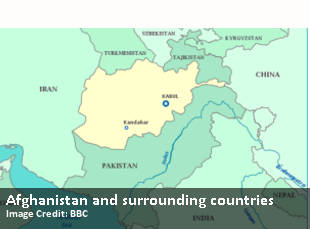
Afghanistan’s intelligence community believes a foreign spy agency was behind last week’s bloody attack on a luxury hotel that left nine people dead. Last Thursday evening, a group of young men entered the five-star Serena Hotel, located a few blocks away from the Presidential Palace and key government ministry buildings in Afghan capital Kabul. Three hours later, the men, who had hidden handguns in their shoes, entered the hotel restaurant and shot indiscriminately at patrons. They were eventually shot dead by Afghan Special Forces, but not before they had managed to shoot over a dozen people at point blank range, killing nine, including two Canadians, an American and a Paraguayan. Four children and a senior reporter with Agence France Presse were among the dead, while the wounded included an Afghan member of parliament. Many blamed the attack on the Taliban or the Haqqani network, an Islamist militant group responsible for countless high-profile attacks in Kabul and other Afghan cities. Soon afterwards, the Taliban issued a statement claiming responsibility for the attack, which they said was aimed at demonstrating the ease with which Afghan government security measures could be evaded. On Monday, however, a press release issued by the Office of the Afghan President said a “foreign intelligence service”, rather than an indigenous militant group, was behind the attack. The press release, which bore the signature of Afghanistan’s President, Hamid Karzai, said intelligence officials from the National Directorate for Security had briefed Afghanistan’s National Security Council about the findings of an investigation on the attack. In the statement, which was issued in both Pashto and English, the President’s Office said that neither the Taliban nor the Haqqani network “were even aware” that the attack at the Serena Hotel was going to take place. Instead, the operation “was a direct attack by an intelligence service outside the country”, said the statement. A subsequent announcement released by the Afghan government placed blame on Pakistani intelligence services, saying they were directly involved in the attack. It also stated that an unnamed “Pakistani diplomat” had been seen filming inside the Serena Hotel “a while ago”. Pakistan’s Ministry of Foreign Affairs rejected Kabul’s allegations, saying it was “highly disturbing that attempts are being made to somehow implicate Pakistan in this terrorist incident”.
 

Korean spy charged with forging Chinese files attempts suicide

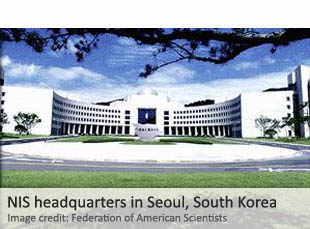
NIS headquarters in Seoul, South KoreaBy I. ALLEN and J. FITSANAKIS | intelNews.org
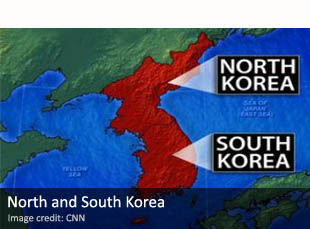
A South Korean intelligence officer, who was charged earlier this month with deliberately forging Chinese government documents, tried to kill himself inside a car on Sunday, according to local media. The officer, identified in reports only by his last name, Kwon, was fingered last week by South Korean media as the source of a set of documents used in a court case against a man accused of spying for North Korea. Yoo Woo-sung, a prominent North Korean defector living in the South, was arrested last year on charges of espionage. Government prosecutors accused Yoo of collecting information on at least 200 North Korean defectors living in the South while working for the Seoul city government. The prosecution produced a number of Chinese transit documents showing that Yoo had entered North Korea repeatedly from China, ostensibly in order to transport information to his handlers in Pyongyang. However, in a dramatic turn of events, the case against Yoo collapsed in August of 2013; this was followed by allegations that some of the documents presented to the court by the prosecutors had been forged. It now appears that the forged documents, which were travel records allegedly issued by the Chinese government, had been given to the prosecution by South Korea’s National Intelligence Service (NIS). Court documents surfaced last week identifying Kwon (named initially as ‘Kim’) as one of the sources of the forged documents. Kwon fervently denied the accusations, claiming that he too had been duped by a Chinese asset who gave him the forms. He also argued that that the asset was probably working for Chinese intelligence. On Sunday, however, Kwon apparently tried to kill himself at his home in a suburb of Seoul. Read more of this post

News you may have missed #873 (controversy edition)

Alvaro UribeBy IAN ALLEN | intelNews.org
►►German parliament confirms NSA inquiry to start in April. Germany’s four major parties have unanimously approved a parliamentary inquiry into surveillance by the NSA and its allied counterparts, like the GCHQ in the UK. Another key question for the committee will likely be whether the German intelligence agencies were either aware of, or complicit in, the gathering of people’s data. A German newspaper reported that whistleblower Edward Snowden, currently in Russia, may testify via Skype.
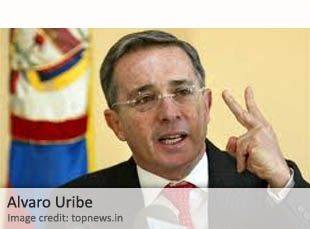
►►Former Colombia spy chief sentenced over illegal wiretapping. Carlos Arzayus, former director of Colombia’s now-defunct intelligence agency DAS was sentenced to nearly ten years in prison on Thursday for his role in the illegal wiretapping of Supreme Court justices and government critics during the Alvaro Uribe administrations during the years 2002 to 2010. Additionally, Arzayus was ordered to pay damages to the victims of the wiretapping.
►►French spies allegedly spy on Orange customer data. The French intelligence agency in charge of military and electronic spying is massively collecting data and monitoring networks of telecoms giant Orange, Le Monde newspaper reported in its Friday edition. “The DGSE can read, like an open book, the origin and destination of all communications of Orange customers”, the paper said.

South Korean spy charged with forging Chinese government records

North and South KoreaBy IAN ALLEN | intelNews.org
Authorities in South Korea have charged an intelligence officer with forging Chinese government documents that were used in a court case against a man accused of spying for North Korea. IntelNews readers will remember the case of Yoo Woo-sung, a prominent North Korean defector living in the South, was arrested last year on charges of espionage. In May of that year, court documents revealed that Yoo had been arrested following testimony from his own sister, also a North Korean defector. She had apparently been sent to the South by the North Korean intelligence services, and tasked with collecting information on North Korean defectors living across the border. Prosecutors accused Yoo of collecting information on at least 200 North Korean defectors living in the South, while he worked for the Seoul city government. Yoo maintained his innocence throughout his trial. However, his protestations appeared untenable once the South Korean prosecution produced a number of Chinese transit documents showing that he had entered North Korea repeatedly from China, ostensibly in order to transport information to his handlers in Pyongyang. However, in a dramatic turn of events, the case against Yoo collapsed in August of 2013 amidst allegations that some of the documents presented to the court by the prosecutors had been forged. It now appears that the forged documents, which were travel records allegedly issued by the Chinese government, had been given to the prosecution by South Korea’s National Intelligence Service (NIS). Read more of this post

CIA places Iran operations division chief on administrative leave

CIA headquartersBy JOSEPH FITSANAKIS | intelNews.org
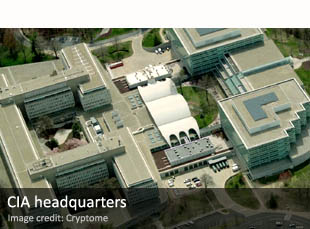
The chief of Iran operations at the United States Central Intelligence Agency has been placed on paid administrative leave, allegedly for creating a hostile work environment that ended up impeding the Agency’s output. According to The Los Angeles Times, many members of the CIA’s Iran operations division had launched an “open rebellion” against their 46-year-old chief, which the paper identified by name. In an article published on Saturday, The Times stated that the veteran intelligence officer, who has now been removed from the CIA’s headquarters in Langley, Virginia, had previously served at CIA stations in Iraq, Russia and the Balkans. The paper added that, in 2010, the CIA had to pull out the officer from Pakistan, after he was publicly named as the Agency’s station chief in Islamabad. Some American officials have identified Pakistan’s intelligence services as the source of the leak that led to the officer’s public exposure, which was allegedly intended as retribution to a series of previous drone attacks by the CIA on Pakistani soil. The Times quoted “three former officials” who accused the chief of the Iran division of exercising a divisive and abusive management style, which led many of the division’s senior employees to request to be transferred elsewhere in the CIA. One unnamed source told the paper that, as a result of the division chief’s treatment and the open rebellion by his staff, the Iran office “was not functioning”. The veteran officer was “sent home” two weeks ago, after an internal investigation by the Office of the CIA Inspector General found that he had essentially lost the trust and respect of the division’s staff. Read more of this post

Pro-Russian oligarch arrested —first sign of US sanctions on Russia?

Dmytro FirtashBy IAN ALLEN | intelNews.org
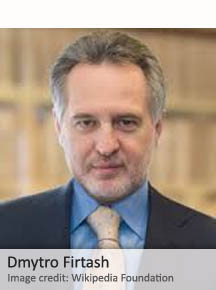
A well-connected Ukrainian oligarch, who is considered one of Russia’s most trusted energy sales intermediaries, has been arrested in Austria at the request of the United States. Some speculate that this may be a first direct sign of America’s response to Russia’s military invasion of Ukraine. In an article published last week, The Washington Post suggested that the arrest of Dmytro Firtash, a citizen of Ukraine, may be “the beginning of a US effort to inflict financial pain on Russia over its role in the Ukrainian crisis”. Firtash’s lucrative business activities are inextricably tied to Gazprom, the world’s largest extractor of natural gas and one of the most powerful corporations in existence. The company, whose activities typically account for around 10 percent of Russia’s annual gross domestic product, is one of Moscow’s primary exporters of energy and among its most important sources of foreign revenue. Throughout the last decade, Firtash’s company, RosUkrEnergo, acted as the primary mediator between Gazprom and Naftohaz, Ukraine’s national oil and gas company. The latter would import Russian natural gas from Gazprom through RosUkrEnergo, which would purchase it from the Russian company and sell it to the Ukrainians at a noticeably steeper price. Eventually, in 2009, the government of pro-Western Ukrainian Prime Minister Yulia Tymoshenko managed to remove RosUkrEnergo as a broker from the energy deals between Kiev and Moscow. But Tymoshenko, who became herself embroiled in a financial corruption scandal, was soon imprisoned. And in 2013, Gazprom approached the pro-Russian government of Ukrainian politician Viktor Yanukovych and offered to sell natural gas to Ukraine at a 33 percent discount, providing that RosUkrEnergo was permitted to return as Moscow’s natural gas distributor to Ukraine. Last Wednesday, a statement from the Ukrainian government in Kiev confirmed that the man identified only as “Dmytro F., 48” in a laconic Austrian police report was indeed Dmytro Firtash. Read more of this post

Obama comments on Senate-CIA dispute, fails to mention Feinstein

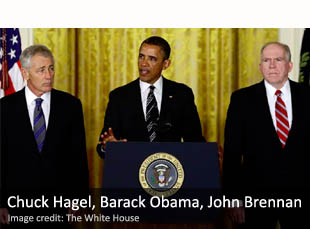
Chuck Hagel, Barack Obama, John BrennanBy JOSEPH FITSANAKIS | intelNews.org
Yesterday in a radio interview I opined that I would not be surprised if the White House stepped in to mediate the ongoing dispute between the Central Intelligence Agency (CIA) and the Senate Select Committee on Intelligence. Today, President Barack Obama broke his silence “with respect to the issues that are going back and forth between the Senate committee and the CIA”, as he said. But he refused to take sides —or did he? On Wednesday afternoon, the President responded to a question on the matter by a White House pool correspondent. The question related to the increasingly heated public spat between the CIA and the Senate Intelligence Committee. The latter is tasked, along with its sister body in the House of Representatives, with exercising legislative oversight of the Intelligence Community. Many members of the Committee, which is currently investigating the CIA’s use of enhanced interrogation against terrorism detainees, believe that, not only was the CIA’s use of harsh interrogation methods illegal, but that it also failed to generate useful intelligence. The CIA, however, denies this, and has been quite possessive of documents relating to the issue, which the Committee believes has a right to access. The Agency has now asked the Federal Bureau of Investigation (FBI) to look into whether Congressional staffers illegally removed classified documents from the CIA’s archives that were beyond the scope of the Committee’s investigation. The Committee has in turn asked the Bureau to investigate whether the CIA illegally searched the computers used by staffers to carry out their research into CIA files.

Read more of this post

IRA ‘tried to kill Queen’s husband’ during Australia visit

Prince Philip and Queen Elizabeth in 1973By JOSEPH FITSANAKIS | intelNews.org
The Provisional Irish Republican Army tried to assassinate Prince Philip, the Duke of Edinburgh and husband of Queen Elizabeth II, during an official Royal visit to Australia in the early 1970s, according to a new book. The claim is detailed in the book Shadow of a Spy, written by Warner Russell, a veteran Australian reporter and retired military intelligence officer. The alleged assassination attempt was uncovered in Sydney on March 15, 1973, during the Prince’s two-day visit to Australia. While there, the Queen’s husband attended a conservation meeting and led an official opening ceremony of a Royal Australian Air Force war memorial in capital city Canberra. According to Russell, two “crude explosive devices” were discovered in Sydney at locations that had been scheduled to be visited by the British Royal entourage. The first device was detected in a trash can in Dowling Street, in Sydney’s downtown Potts Point neighborhood. The second device was found inside a luggage locker at Sydney’s Central Station, a few miles away from the location of the first bomb. The book claims that the two other “suspicious packages” were found, one in a local government building located across the street from an officer’s club that the Prince was due to visit, and another in a trash can at Taylor Square, less than a mile from Central Station. Eventually, the two “suspicious packages” were determined to be “decoys”, says Russell. But the other two devices contained explosive material and were defused by an Australian Army bomb disposal team before being secretly taken to a forensic laboratory for examination. Russell claims that the bombs were defused just minutes before Prince Philip’s group arrived at the two Sydney locations, and Australian authorities were so nervous that they ordered the Prince’s motorcycle escort and protection team to “take evasive action” as they approached Dowling Street. Read more of this post

News you may have missed #871

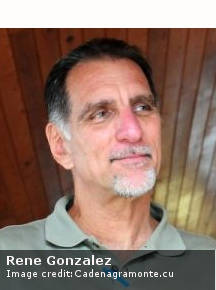
Rene GonzalezBy IAN ALLEN | intelNews.org
►►Britain denies visa for Cuban spy freed by US. Rene Gonzalez, one of the so-called “Cuban Five” intelligence agents convicted by the US of spying, has been denied a British visa to attend a London symposium. Gonzalez, who served 13 years in US prison before his release in 2011, had been invited to a two-day conference put on by “Voice for the Five”, an organization that campaigns in support of the convicted Cuban spies. The Cuban state-run newspaper Juventud Rebelde said Gonzales, 55, was denied a visa because British law prohibits entry of a person sentenced to more than four years in prison.
►►Canada fires intelligence analyst over contacts with Russians. Irina Koulatchenko, a 36-year-old who came to Canada as a Russian refugee via Cuba, has been fired by Canada’s financial-intelligence agency, known as FINTRAC. A Canadian Security Intelligence Service probe recommended she not be trusted to do that job, allegedly because “she had had several social encounters with Russian diplomats”. The latter included one she met “at a Cirque du Soleil show, another who was friends with her ex-fiancé and another she bumped into all the time at various social events”.
►►CIA suspected of spying on Congress members. The United States Department of Justice has opened an investigation into Senate aides removing documents from CIA headquarters that they reportedly “weren’t authorized to have”. It turns out, however, that the CIA found this out because they were secretly spying on members of the Senate Intelligence Committee and their staff who were working on a high-profile report on CIA torture of detainees. What is more, Democratic Senator Mark Udall has claimed US President Barack Obama knew of the CIA’s secret monitoring of the Committee.

Israeli reports accuse US of denying entry visas to Israeli spies

US Department of StateBy JOSEPH FITSANAKIS | intelNews.org
Articles in the Israeli media have accused the United States of quietly instituting a policy of denying entry visa requests from members of Israel’s security and intelligence agencies. In an article published on Tuesday, centrist newspaper Maariv cited “senior security personnel” who have allegedly been barred from entering the US. The centrist Hebrew-language daily said the past 12 months have seen “hundreds of cases” of employees in the Israeli intelligence community who have been told by US consular officials that they could not step foot on US soil. The paper said the visa rejections appear to affect mostly members of the Shin Bet, Israel’s domestic security agency, and the Mossad, which conducts covert operations abroad. Visa bans have also affected employees in Israel’s defense industries, said the article. The report suggests that the targeting of Israeli security and intelligence personnel appears to be deliberate, adding that it applies even to those Israeli intelligence or security officers that are already stationed on US soil. In what seems to be a change in policy, the latter are now being issued short-term visas, rather than multiyear entry permits. As a result, the paper says they are “forced” to cross from the US into Canada at regular intervals, in order to apply to have their visas renewed. However, many of them are now having their visa renewal applications rejected, or are made to wait “several weeks” before having their entry permits renewed by American consular staff. The paper quoted a “senior [Israeli] security expert”, who said he had been denied an entry visa to the US this past January, for the first time in his career, despite having visited the US numerous times in the past “without trouble”. He told Maariv that he had “traveled to the US dozens of times in the past for my job and never faced issues getting a visa” on time. Read more of this post

US intelligence agencies urge ‘cautious approach’ on Ukraine

Chuck Hagel, Barack Obama, John BrennanBy IAN ALLEN | intelNews.org
American intelligence agencies see Russia’s control of the Crimean Peninsula as near-complete and urge Washington to take cautious steps on Ukraine, as Moscow appears prepared “to take military action” in defense of its strategic goals. The Los Angeles Times reported on Monday that some American intelligence analysts believe Moscow is genuinely convinced that its military action in Ukraine is justified under the Budapest Memorandum on Security Assurances. The agreement was signed in 1994 by the United States, United Kingdom, and the Russian Federation. The three nuclear powers guaranteed that they would refrain from actions that would subvert the territorial integrity and political autonomy of Ukraine. Western officials have accused Moscow of violating the agreement by dispatching Russian troops to southeastern Ukraine without the consent of the Ukrainian government. But some American intelligence analysts believe the Russian Foreign Ministry is convinced that Russian forces are acting within the scope of the 1994 agreement. The latter is interpreted by Russian officials as permitting Moscow to unilaterally dispatch up to 25,000 troops to the Crimea. This may even be the predominant view at the Central Intelligence Agency (CIA), judging by a briefing given last week by the Director of the CIA, John Brennan, to an unnamed “senior lawmaker”. The Times cited “US officials who declined to be named” as saying that Brennan suggested that Russian officials genuinely believe that the number of Russian troops in Ukraine “remains well below the threshold” specified in the Budapest Memorandum. Brennan added that, although he did not personally agree with Moscow’s interpretation of the Memorandum, it would be wise for Washington to tread cautiously on the subject, given the fact that Russian policy on Crimea remains unpredictable. Read more of this post

British spies infiltrated Nazi sympathizer groups, wartime files show

Page from MI5's Jack King filesBy JOSEPH FITSANAKIS | intelNews.org
A British counterintelligence agent managed to neutralize an extensive network of Nazi sympathizers in the United Kingdom by pretending to represent the German government, newly released files show. The documents, which were released this week by the British National Archives, identify the agent only as “Jack King”, which was the operational codename given to him by his handlers in the British Security Service, commonly known as MI5. Senior officials at the agency, which is tasked with counterintelligence, described “King” as “a genius” at luring in Nazi sympathizers in the UK. The files show that “King’s” work helped MI5 identify hundreds of residents in Britain —most of them British citizens— as committed Nazis who were prepared to pass national secrets to Berlin. The MI5 operative utilized his pro-German contacts in the southeast of England and was able to infiltrate pro-Nazi circles operating in and around London. He did so by posing as an agent of the Gestapo, Nazi Germany’s secret police. He quickly gained the trust of some of the most fervent pro-German activists operating in the British Isles. These included Edgar Whitehead, Hilda Leech and Marita Perigoe, a Swedish resident of the UK, who was so fervently pro-Nazi that she once dismissed Oswald Mosley’s British Union of Fascists as “insufficiently extreme”. Many of these Nazi supporters pledged to “King” that they could be relied on to assist in the event of an invasion of Britain by Nazi forces. The files released by the National Archives show that “King” was well connected with British Nazis by 1942. Read more of this post

News you may have missed #870

Carl LodyBy IAN ALLEN | intelNews.org
►►Documents show NZ spies taught ‘honey trap’ tricks. Members of New Zealand’s Government Communications Security Bureau were briefed by counterparts from the ultra-secret Joint Threat Research Intelligence Group, a unit of the British Signals intelligence agency GCHQ, on setting honey traps and Internet “dirty tricks” to “control, infiltrate, manipulate, and warp” online discourse, documents leaked by Edward Snowden reveal. According to the slides, JTRIG conducted “honey traps”, sent computer viruses, deleted the online presence of targets and engaged in cyber-attacks on the “hacktivist” collective Anonymous.
►►Ex-CIA analyst tells how data helped catch bin Laden. A central figure in the manhunt for Osama bin Laden, Nada Bakos spoke this week as the keynote speaker at a conference in California, on how data, big and small, led to the capture of al-Qaeda founder Osama bin Laden. “You don’t want to lead the information, you want the information to lead you”, she said, and credited the agency’s innovative gathering process that institutionalized various types of intelligence analysis —opposed to solely relying on general guidelines and best practices.
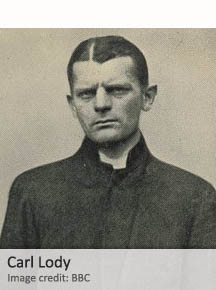
►►The story of WWI German spy Carl Lody. Towards the end of August 1914 a man checked into what is now the Balmoral Hotel in the centre of Edinburgh claiming to be an American tourist. In reality he was a German spy who had been sent to gather intelligence from the British. Carl Lody was a junior naval officer who had been forced to retire for health reasons but was looking for other ways to serve the fatherland. He was especially attractive to German naval intelligence because he had lived for years in the United States and spoke English fluently, although with an American accent.

Police ‘error’ reveals secret deal between IRA, UK government

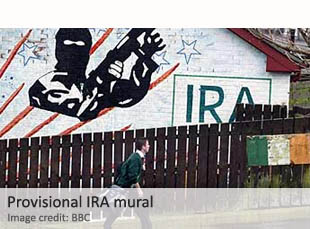
Provisional IRA muralBy JOSEPH FITSANAKIS | intelNews.org
An alleged police error, which has prompted the release from custody of a former Provisional Irish Republican Army (PIRA) volunteer accused of killing British soldiers, has revealed a secret agreement between the PIRA and the British government. British authorities have long suspected John Downey of involvement in a 1982 bomb explosion in London’s Hyde Park, which killed four British soldiers and injured scores of bystanders. But Downey was released from custody yesterday, after a judge was shown a letter that the suspect had been provided by the British government, assuring him that he was not wanted for outstanding crimes related to PIRA operations. The letter was given to Downey in 2007 by Britain’s Northern Ireland Office; it stated that the former PIRA volunteer would be able to travel outside Northern Ireland “without fear of arrest”. British authorities said that the letter had been sent “in error” and that it should have been withdrawn prior to Downey’s recent detention. But the case has exposed what appears to be a “discreet agreement” between the British government and republican paramilitaries. The agreement is undoubtedly connected to the 1998 Good Friday Agreement. The multi-party accord permitted —among other things— power-sharing between Northern Ireland’s loyalist and republican political parties, in exchange for the decommissioning of weaponry held by paramilitary groups on both sides. But it also stipulated that all prisoners held for crimes related to sectarian violence in Northern Ireland were to be freed. By 2000, most of these prisoners had been released, based on the British government’s belief that paramilitary groups on both sides were unlikely to refrain from violence while many of their members remained in prison. However, there was nothing in the Good Friday Agreement to cover the cases of those “on the run”, namely paramilitaries —most of them republican— who were at large and wanted by the British state for crimes connected with paramilitary activity. Read more of this post