Bulgaria confirms arrest of six-member spy-ring allegedly working for Russia

Russian embassy Bulgaria

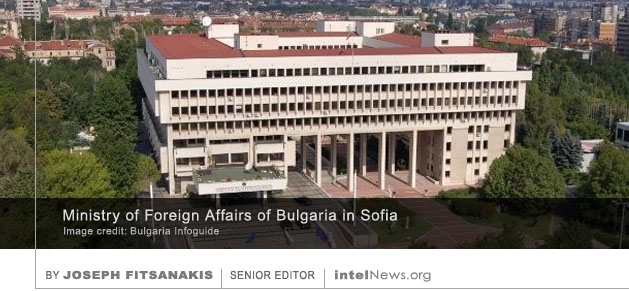
AUTHORITIES IN BULGARIA HAVE confirmed media reports aired last week, which alleged that at least six members of a spy-ring working for the government of Russia had been arrested in the capital Sofia. News of the arrests was first reported by the Bulgarian National Television, or BNT, late on Thursday, March 18. Citing “government sources”, BNT said that “several” Bulgarian citizens had been arrested in simultaneous raids by the country’s counterintelligence service.

On Friday, March 19, the Bulgarian government confirmed the BNT report, saying that six Bulgarian citizens had been charged with espionage on behalf of the Main Directorate of the General Staff of the Russian Armed Forces, known commonly as GRU. The GRU is Russia’s foremost military intelligence agency. The six alleged spies reportedly gave Moscow secrets about Bulgarian military affairs, as well as information concerning the North Atlantic Treaty Organization (NATO) and the European Union (EU). Bulgaria, a former ally of the Soviet Union, joined NATO in 2004 and the EU in 2007.

Some reports claim that the spy ring members also gave information to the Russians about the presence and operations of United States intelligence personnel in Bulgaria. The American intelligence agencies that were allegedly affected by these disclosures include the Central Intelligence Agency and the National Security Agency. The United States has not officially commented on these reports. On Friday, US Department of State spokesperson Ned Price tweeted that “Bulgaria is a friend, NATO ally, and partner”, adding that Washington was “attentively watching the Bulgarian investigation into an alleged Russian spy ring”.

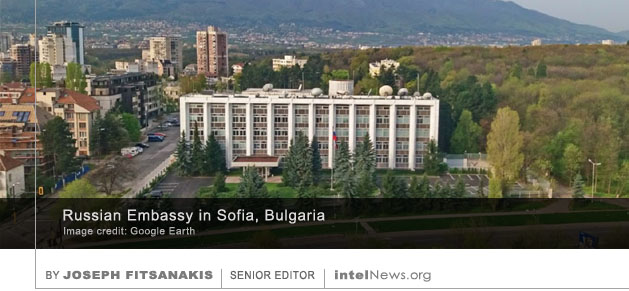
The head of the alleged spy ring is reportedly a retired senior official in the Bulgarian Ministry of Defense, who was allegedly recruited by the GRU and received training in clandestine tradecraft from his Russian handlers. Another member is a retired military counterintelligence officer, who is currently serving in a counterintelligence capacity in the Bulgarian parliament. Three other members of the spy ring are active or retired officers in the Bulgarian armed forces. According to the BNT report, the wife of the head of the spy ring, who is a citizen of both Bulgaria and Russia, operated as a courier for the spy ring. She allegedly made regular visits to the Russian embassy in Sofia, where she delivered stolen secrets in return for cash payments.

The Office of the Bulgarian State Prosecutor published a 20-minute video on Friday, which contains intercepted audio recordings of alleged conversations between members of the spy group and their Russian handlers. The video also contains surreptitiously filmed footage of alleged meetings between the members of the spy ring and their Russian handlers in public places. Some of the footage shows the exchange of documents with cash payments between assets and handlers.

Author: Joseph Fitsanakis | Date: 22 March 2021 | Permalink

Turkey and United States co-examine Russian missile system captured in Libya

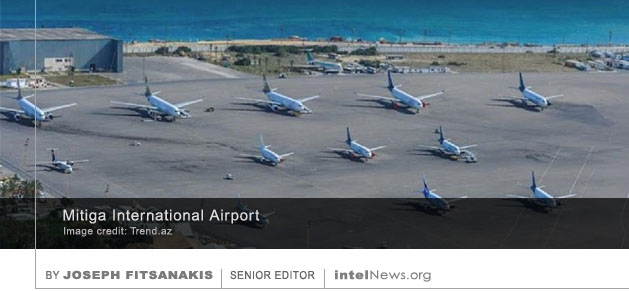
Mitiga International AirportTURKEY AND THE UNITED States, two North Atlantic Treaty Organization (NATO) allies with a checkered relationship, have agreed to jointly examine a Russian missile system that was captured by fighters in Libya. Turkish troops are present on the ground in Libya, where they are fighting in support of the United Nations-backed Government of National Accord (GNA) in Tripoli. The United Arab Emirates and Russia support the Tobruk-based Libyan National Army (LNA) of General Khalifa Haftar.

Last year, General Haftar led the LNA in a major offensive aimed at capturing Tripoli and ending the conflict between the two sides, which has raged for nearly a decade. He was supported by Emirati advisors and Russian troops, which are ostensibly in Libya as private security contractors, but are commonly thought to receive directions from the Kremlin. In a surprise move, Turkey sent troops to assist in the defense of Tripoli. These troops were instrumental in beating back the LNA, and effectively terminating General Haftar’s ambitions.

In the process of beating back General Haftar’s’s offensive, GNA fighters took over the LNA’s airbase in Al-Watiya, 100 miles southwest of Tripoli, which LNA forces abandoned in haste. Among the looting was a Russian-built Pantsir missile defense system —reportedly captured in pristine condition. This is the Russian armed forces’ state-of-the-art self-propelled anti-aircraft system, which fires medium-range surface-to-air missiles. It had reportedly been given to the LNA by the Emiratis.

The captured Pantsir system disappeared for a few weeks, and eventually reappeared in the hands of a local militia in the town of Zawiya. The militia is commanded by Mohamed Bahroun, a Libyan warlord with links to the Islamic State. Turkish troops struck a deal with Bahroun, whose forces agreed to deliver the Pantsir to the Turkish-controlled Mitiga International Airport on the outskirts of Tripoli. Shortly afterwards, the United States warned Turkey that it was prepared to forcibly take control of the missile system, fearing that it could fall in the hands of the Islamic State. Washington also wanted to get its hands on Russia’s state-of-the-art anti-aircraft system.

According to reports, the two countries reached a deal in recent weeks. The United States sent a C-17 Globemaster cargo plane to Mitiga airport from its AFRICOM base in Germany, and collected the Pantsir. It then delivered it to Ankara, where it is now being examined by a joint team of Turkish and American weapons experts. Some weapons specialists suggest that this development could significantly affect Russia’s ability to counter NATO military systems, given that the Pantsir’s technology will now be compromised.

Author: Joseph Fitsanakis | Date: 03 March 2021 | Permalink

Analysis: Without fanfare, FBI places Putin’s right-hand man on most wanted list

Yevgeny PrigozhinWITHOUT MUCH FANFARE LAST week, the Federal Bureau of Investigation placed on its most wanted list Yevgeny Prigozhin, who is one of Russian President Vladimir Putin’s closest collaborators. Known as “Putin’s chef”, for providing catering services to the Kremlin, Prigozhin was indicted in February 2018 by United States prosecutors for his alleged role in Russia’s meddling in the 2016 presidential elections. According to the Special Counsel investigation, led by Robert Mueller, Prigozhin bankrolled the Internet Research Agency (IRA), which in turn played a central coordinating role in the effort to influence the outcome of the elections.

But it is one thing to be indicted by the US government, and quite another to be placed on the FBI’s most wanted list. What does this mean? And why did the FBI wait three years to place Prigozhin on its list of infamy?

With characteristic flamboyance, Prigozhin boasted victory against the FBI back in March of 2020, when US federal prosecutors requested that the Mueller-era criminal case against Concord Management and Consulting (CMC) be dismissed. Founded in 1995, CMC is Prigozhin’s flagship company. According to the US government, CMC was used to fund the IRA’s activities in the run-up to the 2016 US elections. Although some were surprised by that decision, it made sense from an intelligence point of view. US federal prosecutors said at the time that it would not be possible to prove the allegations against CMC due to a “classification determination”. The term basically meant that the US government could not prove the claims made against CMC without revealing “methods and sources”. The term refers to witnesses that have probably been recruited as US government assets, as well as to methods of surveillance that the government wishes to keep secret.

Even though the individual indictment against Prigozhin was never dropped, the flamboyant Russian boasted at the time that the dismissal of the case against CMC proved that he was not implicated in the US election meddling affair. He became even more boastful after September of last year, when Interpol removed his name from its international alert list. He reportedly began traveling outside Russia again, something that he had stopped doing after his 2018 indictment, out of an abundance of caution. At that time, everyone assumed that US prosecutors would eventually drop the case against Prigozhin too, for the same reason they had dropped the CMC case —namely a “classification determination”. Read more of this post

Sweden charges consultant with spying for Russia, expels Russian diplomat

ScaniaA SWEDISH MAN HAS been charged with spying for Russia, after he was apprehended while meeting with a Russian diplomat stationed at the Russian embassy in Stockholm. Neither the Swedish man nor the Russian diplomat —who is believed to have been expelled from Sweden— have been named. Swedish government officials reportedly expelled the Russian diplomat following the incident, accusing him of working as an intelligence officer under diplomatic cover.
Government prosecutors said the Swedish man is 47 years old and worked as a consultant for numerous Swedish manufacturers. His employers included the car manufacturer Volvo, as well as Scania, a company that builds commercial vehicles, such as buses and trucks. According to Sweden’s public broadcaster, SVT, the man was arrested two years ago, in February 2019, while he was meeting in Stockholm with an accredited Russian diplomat. According to news reports, during the meeting the Swedish man gave the Russian a bag containing commercial secrets. In return, he received an envelope containing 27,800 Swedish kronor (US$3,350). These were confiscated by Swedish counterintelligence.

The indictment states that the 47-year-old Swede spied for Russia “for a number of years”, during which he routinely “transferred commercial secrets from his work computer to his home computer”. He would then transfer the files to USB memory sticks and pass them on to his Russian hander. Eventually, when his employer installed security software that monitored employees’ use of USB memory sticks, the consultant resorted to photographing material appearing on his work computer screen. He now faces “a lengthy sentence” if convicted, according to SVT.

Author: Joseph Fitsanakis | Date: 24 February 2021 | Permalink

Irish officials raise espionage concerns about expansion of Russian embassy in Dublin

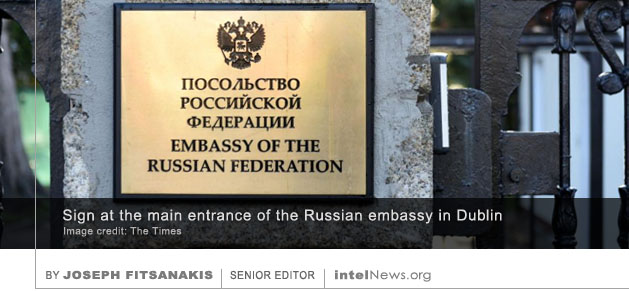
IRELAND’S COUNTERINTELLIGENCE SERVICE HAS launched an investigation into an expansion project at the embassy of Russia in Dublin. According to sources cited by The Times newspaper, the Irish government is concerned that the expansion project is part of a secret plan by Moscow to turn its embassy in Dublin into a major espionage hub in Europe.
The two nations had no diplomatic relations until September 1973, when the Republic of Ireland officially recognized the Soviet Union, and the two countries proceeded to establish embassies at each other’s capitals. Since then, the Russian embassy in Dublin has been located on Orwell Road, in the southern suburb of Rathgar. For at least three decades, the embassy has been considered by Western intelligence a hub of Russian intelligence collection operations in Europe. Some claim that the tranquil environs of the Irish capital, coupled with Ireland’s relatively relaxed counterintelligence posture, have encouraged Moscow to use its Dublin embassy as a support base for espionage activities throughout much of Western Europe.

But the Irish government changed its stance in 2018 when, in a surprising move, it introduced emergency legislation aimed at stopping a previously approved expansion of the Russian embassy complex. The government reportedly feared that the initial plan, which proposed to add 86,000 sq ft of structures to the embassy’s existing 21,000 sq ft of building space, threatened Ireland’s national security. The Russians had little choice but to comply with the restrictions imposed by the Irish government. Now, however, the Irish government is reportedly concerned that Moscow was able to proceed with the establishment of an “intelligence hub”, despite the reduced size of the embassy’s expansion.

According to The Times, the Irish government’s concerns center on a building inside the Russian embassy compound, “whose design appears to incorporate military security features”. Another issue concerns an underground car park built by the Russians at the southern rear of the embassy complex, which can accommodate up to 23 vehicles. Apparently, Irish officials cannot explain why the Russians would go to the added trouble —and expense— of building an underground car park, when there appear to be sufficient car parking spaces above ground inside the embassy compound.

The paper reports that the new review of the Russian embassy compound is being led by the Directorate of Military Intelligence and the National Crime and Security Intelligence Service of the Garda, Ireland’s national police and security service. These two entities are expected to brief the National Security Committee in the coming weeks. Known also as “Cabinet Subcommittee F”, the National Security Committee is Ireland’s highest executive decision-making body, which is led by the prime minister.

Author: Joseph Fitsanakis | Date: 12 February 2021 | Permalink

Norwegian intelligence warns of new types of nuclear weapons developed by Russia

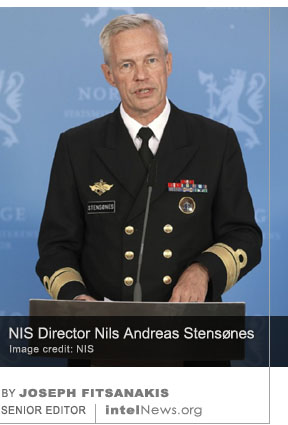
NIS NorwayTHE RUSSIAN MILITARY IS developing powerful new types of nuclear weapons, which cannot be contained in the framework of existing arms control treaties, according to a new report by Norwegian intelligence. The report, published on Monday by the Norwegian Intelligence Service (NIS), comes on the heels of a last-minute extension of the New START nuclear reduction treaty between the United States and Russia. On February 3, just days prior to its formal expiration, Washington and Moscow announced an emergency extension of the treaty, which will now last until February 2026.

But according to Focus 2021, the NIS’ annual assessment of ongoing security challenges, the New START treaty is insufficient to cover some of the new nuclear weapons that are being developed by the Russian Armed Forces. In an interview with The Barents Observer, NIS Director Vice Admiral Nils Andreas Stensønes, warned that, among other notable changes, the new Russian nuclear weapons “fly low or travel underwater”. This makes them extremely difficult to be detected by existing missile defense systems, he said.

The NIS report notes that the new Russian nuclear weapons are not yet operational. However, the Russian military is currently testing and developing them across military bases situated in northern Russia, some of which are located near Norwegian territory. Among these weapons is the Poseidon, which is described as a “nuclear-powered, nuclear-tipped underwater mega-drone”. Another concern for the NIS is the Burevestnik, a nuclear-powered cruise missile, which is reported to have global reach and is said to be able to evade existing missile defense systems.

Author: Joseph Fitsanakis | Date: 09 February 2021 | Permalink

Colombia and Russia expel diplomats over espionage allegations

SVR hqCOLOMBIA EXPELLED TWO RUSSIAN diplomats earlier this month, without publicly explaining why, according to news reports. Several Colombian news outlets reported on Tuesday that the two Russians were expelled after they were found engaging in espionage. Also on Tuesday, Colombian officials confirmed earlier reports that Moscow had expelled two Colombian diplomats in a tit-for-tat response.
At a press conference held in Bogota on Tuesday December 22, officials from Colombia’s Ministry of Foreign Affairs revealed that two Russian diplomats had been expelled from the Colombian capital on December 8. However, they refused to provide the reasons for the expulsions, other than to claim that the two Russians had “engaged in violations” of the Vienna Convention on Diplomatic Relations. In a separate interview, Colombian President Ivan Duque said that “to reveal more information at this moment would not correspond with the principal of continuing bilateral relations” between Colombia and Russia.

However, several leading Colombian newspapers, including El Tiempo and Semana claimed that the two Russians had engaged in espionage that targeted Colombia’s energy and minerals industry in the city of Cali. An urban center of 2.2 million inhabitants, Cali is known as southern Colombia’s leading economic hub, and is among Latin America’s fastest-growing local economies.

El Tiempo named the two Russians as Alexander Paristov and Alexander Belousov. Also on Tuesday, Colombia’s W Radio alleged that Paristov is an officer in the Russian Foreign Intelligence Service, which is the Russian equivallent of the United States’ Central Intelligence Agency. It added that Belousov is an officer in the Main Directorate of the Russian Armed Forces’ General Staff, which is known as GRU.

The Russian Ministry of Foreign Affairs and the Russian embassy in Bogota did not respond to questions by Colombian media about the diplomats’ expulsions.

Author: Joseph Fitsanakis | Date: 24 December 2020 | Permalink

Holland expels two Russian diplomats, summons Kremlin envoy to issue protest

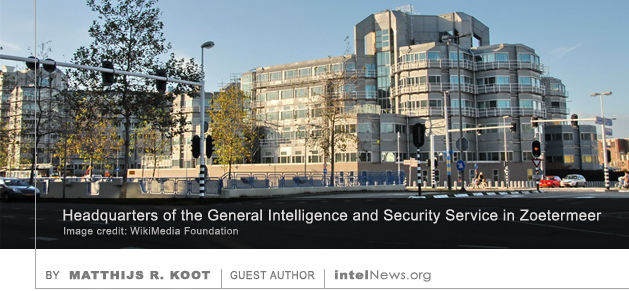
AIVD HollandOn 10 December 2020, the Dutch Minister of the Interior and Kingdom Relations, Kajsa Ollongren, sent a letter to the House of Representatives to inform them about the disruption of a Russian espionage operation in the Netherlands by the Dutch General Intelligence and Security Service (AIVD).
In connection with Ollongren’s revelations, two Russians using a diplomatic cover to commit espionage on behalf of the Russian Foreign Intelligence Service (SVR) were expelled from the Netherlands. The Russian ambassador to the Netherlands was summoned by the Dutch ministry of Foreign Affairs, which informed him that the two Russians have been designated as persona non grata (unwanted persons). In an unusual move, the AIVD also issued a press statement about this incident in English. The AIVD also released surveillance footage (see 32nd minute of video) of one of the two Russian SVR officers meeting an asset at a park and exchanging material.

The two expelled persons were officially accredited as diplomats at the Russian embassy in The Hague. Minister Ollongren says one of the two SVR intelligence officers built a “substantial” network of sources working in the Dutch high-tech sector. He pursued unspecified information about artificial intelligence, semiconductors, and nano technology that has both civilian and military applications. The Netherlands has designated “High Tech Systems and Materials” (HTSM) as one of 10 “Top Sectors” for the Dutch economy.

In some cases the sources of the SVR officers received payments for their cooperation. According to Erik Akerboom, Director-General of the AIVD, said the agency had detected “relatively intensive” contact between sources and the SVR officers in ten cases. The case involves multiple companies and one educational institute, whose identities have not been revealed. The minister states in her letter that the espionage operation “has very likely caused damage to the organizations where the sources are or were active, and thereby to the Dutch economy and national security”.

The minister announced that the Immigration and Naturalization Service (IND) will take legal action against one source of the two Russians, on the basis of immigration law. The minister also announced that the government will look into possibilities to criminalize the act of cooperating with a foreign intelligence service. Currently, that act on and by itself is not a punishable offense. Under current Dutch and European law, legal possibilities do exist to prosecute persons for violation of confidentiality of official secrets or company secrets.

This newly revealed espionage operation follows other incidents in the Netherlands, including a GRU operation in 2018 that targeted the Organization for the Prohibition of Chemical Weapons in The Hague, and a case in 2015 involving a talented Russian physicist working on quantum optics at the Eindhoven University of Technology. In the latter case, no information was made public about what information the physicist sold to Russian intelligence services. And in 2012, a senior official of the Dutch Ministry of Foreign Affairs was arrested for intending to sell classified official information to a Russian couple in Germany who spied for Russia. He was eventually given an eight year prison sentence.

Author: Matthijs Koot | Date: 14 December 2020 | Permalink

UK spy agency to launch offensive cyber operation against anti-vaccine propaganda

GCHQ

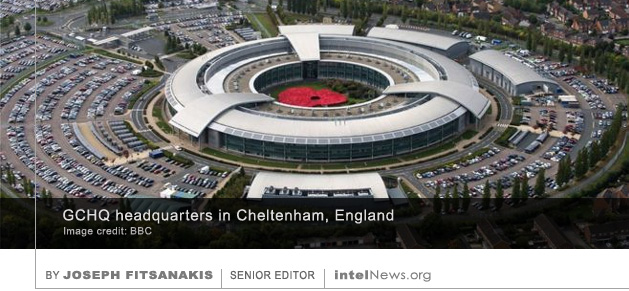
BRITAIN’S SIGNALS INTELLIGENCE AGENCY is preparing to launch a major offensive cyber operation against state-sponsored propaganda aimed at undermining research on the COVID-19 vaccine. According to the London-based Times newspaper, which published the information about the purported cyber operation, it will be aimed mostly against disinformation campaigns coming out of Russia.

The alleged disinformation campaigns appear to be targeting research taking place at Oxford University, which seeks to create an effective vaccine against the novel coronavirus. A main theme in these campaigns promotes the claim that the vaccine will turn those who take it in to chimpanzees. Dozens of memes around this theme are said to have flooded Russian social media websites, with English-language translations making the rounds on Facebook, Twitter and Instagram.

The Times reports that the British government considers shutting down the alleged Russian disinformation campaign a strategic priority, which grows in significance the closer British scientists get to their goal of creating a successful vaccine against the pandemic. London has therefore ordered the British Army’s 77th Brigade, which specializes in information operations, to launch an online campaign that will counter deceptive narratives about a potential vaccine against the coronavirus.

Whitehall has also mobilized the Government Communications Headquarters (GCHQ), Britain’s signals intelligence agency, which focuses on cyber-security, to launch offensive operations against the sources of the disinformation, says The Times. The paper cites a government source as saying that the spy agency will be using tools originally developed to monitor and incapacitate websites and other online platforms used by the Islamic State for recruitment.

According to the paper, the operational mandate of the 77th Brigade and GCHQ prevents them from tackling disinformation and misinformation originating from ordinary social media users, rather than state agencies. Additionally, the offensive cyber campaign cannot target websites that are based in Britain’s so-called Five Eyes allies, namely Australia, New Zealand, Canada and the United States. Instead, British spies are required to notify their Five Eyes counterparts, so they can take action instead.

Author: Joseph Fitsanakis | Date: 09 November 2020 | Permalink

United States charges six Russian intelligence operatives with hacking

US Department of Justice

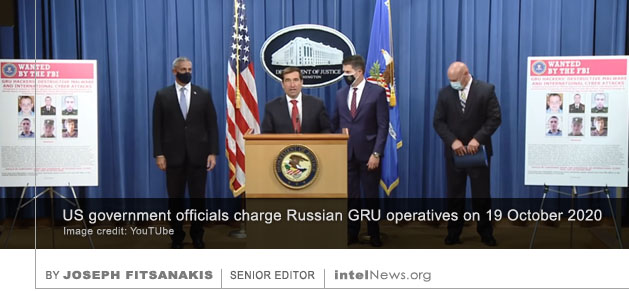
THE UNITED STATES DEPARTMENT of Justice has unsealed charges against six members of Russia’s military intelligence agency for allegedly engaging in worldwide computer hacking against several countries. The charges, announced in Pittsburgh on Monday, represent in a rare move that targets specific intelligence operatives and identifies them by name and visually. According to the US government, the six Russian operatives were instrumental in some of the most destructive and costly cyber-attacks that have taken place worldwide in the past five years.

The indictment alleges that the six Russian intelligence operatives were members of a hacker group named “Sandworm Team” and “Voodoo Bear” by cybersecurity experts. In reality, however, they were —and probably still are— employees of Unit 74455 of the Russian Armed Forces’ Main Intelligence Directorate, known as GRU. Their cyber-attacks employed the full resources of the GRU, according to the indictment. They were thus “highly advanced”, and were carried out in direct support of “Russian economic and national objectives”. At times, the group allegedly tried to hide its tracks and connections to the Russian government, by making it seem like its cyber-attacks were carried out by Chinese- and North Korean-linked hackers. However, according to the US government, its operations and targets were carried out “for the strategic benefit of Russia”.

The hacker group has been active since the end of 2015, and is alleged to have continued its operations until at least October of 2019. Alleged attacks include a major assault on the power grid of Ukraine in December of 2015, which left hundreds of thousands without electricity and heat. Other alleged attacks targeted the government of Georgia and the French national elections of 2017. The charges include alleged attacks on Western chemical laboratories that examined the toxic substance used in 2018 against former GRU officer Sergei Skripal in England.

Finally, some of the group’s alleged efforts centered on sabotaging the 2018 Winter Olympics in Pyeongchang, South Korea. Russian athletes were barred from the games, after the Russian government was accused of participating in wholesale doping of its Olympic team. Notably, none of the attacks connected with the group’s operations appeared to have directly targeted the United States —though some of the viruses that were allegedly unleashed by the group affected some American companies.

Author: Joseph Fitsanakis | Date: 21 October 2020 | Permalink

Russian dissident sues US government to force release of records on alleged poisoning

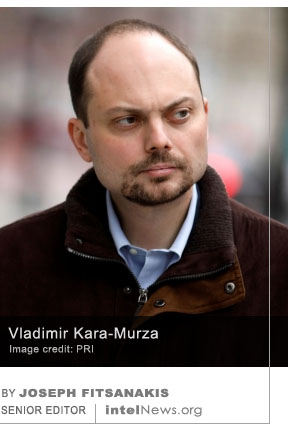
Vladimir Kara-MurzaA United States-based Russian opposition activist, who claims he was poisoned twice by the Kremlin, is suing the United States government to force the release of records about his case, but is being met with resistance. The plaintiff is Vladimir Kara-Murza, 38, a senior figure in the Open Russia Foundation, a political pressure group founded by Mikhail Khodorkovsky. Khodorkovsky, an ultra-wealthy Russian businessman living in self-exile in Switzerland, is one of Vladimir Putin’s arch-enemies.
Kara-Murza rose to prominence in 2013, when he became a member of a network of Putin critics who helped organize opposition protests in Moscow and Saint Petersburg. He also co-authored a number of reports accusing the administration of Russian President Vladimir Putin of corruption. For several years now, Kara-Murza, his wife and three children have been living in the United States. But he frequently travels back to Russia to meet with opposition activists and other organizers. During one of those visits in 2015, he was hospitalized with acute respiratory symptoms and was diagnosed with “kidney failure in connection with poisoning”. He claimed that his hospitalization resulted from an assassination attempt against him by people in power who wanted to silence him. He was also hospitalized in 2017 in Moscow with similar symptoms.

Earlier this year Kara-Murza filed a Freedom of Information Act (FOIA) request, seeking access to all documents held by the Federal Bureau of Investigation relating to his alleged poisonings. After six months, the Russian dissident sued the Department of Justice, arguing that the Department was in violation of law by withholding documents about his case. On August 10, the court handling Kara-Murza’s case received a notice from the Department of Justice, stating that 400 pages would be released within a month, and another 1,100 pages would be released by October 15.

The 400 pages released earlier this month show that the FBI monitored Kara-Murza’s case closely, and that it sought the assistance of toxicologists and other experts to determine whether the Russian dissident had been the target of assassination attempts. The documents also show that FBI Director Christopher Wray was personally involved in the investigation and that, according to the Voice of America, the Bureau’s findings “reached the top levels of the White House”.

However, the Department of Justice recently communicated with the court handling Kara-Murza’s lawsuit, to announce that it would be unable to release the remaining 1,100 pages by October 15. Instead, it said it would do so by November 15 instead. Kara-Murza’s lawyer, Stephen Rademaker, said his client will challenge the Department of Justice’s request. The Department of Justice, the White House and the FBI have not issued any statements about Kara-Murza’s case.

Author: Joseph Fitsanakis | Date: 01 October 2020 | Permalink

Bulgaria expels two Russian diplomats for espionage, Russia vows to respond in kind

Russian embassy BulgariaBulgaria, a once close Soviet ally, which is now a member of the European Union and the North Atlantic Treaty Organization, has expelled two Russian diplomats whom it accuses of conducting military espionage. This raises to five the number of Russian diplomats who have been expelled from Bulgaria for espionage in the past year.

In a hastily announced press conference on Wednesday, a spokesman for the Ministry of Foreign Affairs told reporters in the Bulgarian capital Sofia that the ministry had “declared two Russian diplomats personae non grate”, a Latin term meaning unwanted persons. He added that the Bulgarian government had notified the Russian embassy of its decision with an official diplomatic note. The two Russian diplomats, who have not been named, were given 72 hours to leave the country, said the spokesman.

In addition to the expulsion of the two diplomats, it was later reported that the Bulgarian government had denied an earlier request by Moscow to provide diplomatic accreditation to Russia’s new military attaché to the country, who was expected to assume his post in Sofia this coming December. It is believed that this action by the Bulgarian government is connected to the alleged espionage case involving the two Russian diplomats.

Bulgarian government prosecutors allege that the two Russians have engaged in espionage activities in Bulgaria since 2016. Their goal, according to the Bulgarians, was to obtain classified information about the technological modernization of the Bulgarian Armed Forces, which is ongoing. They had allegedly already made contacts with Bulgarian officials who were privy to such information, and in some cases had already provided them with money in exchange for secrets. The two diplomats are believed to be working for the Main Directorate of the Russian Armed Forces’ General Staff, which is commonly referred to as GRU.

The Russian Embassy in Sofia confirmed late on Wednesday that it had received a telephone call from the Bulgarian Ministry of Foreign Affairs, informing it of the expulsion order issued for the two diplomats. It added, however, that it had not been given proof of acts of espionage by the two diplomats. In the same statement, the Russian Embassy said the two diplomats would leave Bulgaria as instructed, but warned that Moscow reserved the right “to a response in kind”.

Author: Joseph Fitsanakis | Date: 24 September 2020 | Permalink

French lieutenant-colonel serving with NATO arrested for spying for Russia

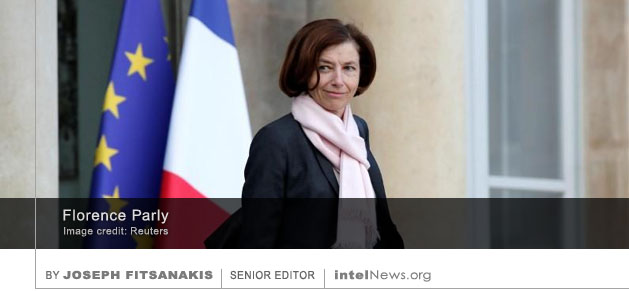
Florence ParlyFrench authorities are reportedly investigating a senior military officer, who is serving with the North Atlantic Treaty Organization in Italy, for spying on behalf of Russia, according to a news report from France. On Sunday, France’s Minister of the Armed Forces, Florence Parly (pictured), gave a press conference in Paris, during which she provided limited information about the ongoing investigation. Parly said she could confirm that “a senior officer” in the French military was undergoing “legal proceedings” relating to a “security breach”. She refused to provide specific details on the case.

Later on Sunday, however, French radio station Europe 1 reported that the military officer was a lieutenant-colonel who is currently serving at a NATO facility in Italy. The officer is believed to speak Russian and is considered a specialist on Russian military affairs, said the station. It added that French authorities began investigating him after he was spotted in Italy with a man who was later identified as an intelligence officer with the Main Directorate of the General Staff of the Russian Armed Forces, known commonly as GRU. According to Europe 1, the French military officer was arrested by the General Directorate for Internal Security (DGSI), France’s counterintelligence and counterterrorism agency.

At the time of his arrest, the unnamed man was making preparations to return to his NATO post in Italy, after holidaying in France, according to the radio station’s report. He is currently in detention in the French capital on suspicion of having supplied classified military documents to Russian intelligence. Europe 1 cited an unnamed source who said the officer would be prosecuted for “collecting [and] sharing information with a foreign power” that “harms the fundamental interests of the [French] nation” and “harms national defense”.

Author: Joseph Fitsanakis | Date: 31 August 2020 | Permalink

Putin says US and Ukrainian intelligence ‘lured’ Russian mercenaries into Belarus

Belarus KGBRussian President Vladimir Putin said in an interview that a group of Russian paramilitary contractors, who were arrested in Belarus last month, were lured there as part of a joint American-Ukrainian spy operation. On July 29, Belarussian secret services announced the arrest of 33 Russian citizens, who were employees of Wagner Group, a private Russian military company that some believe operates as a private paramilitary wing of the Russian Armed Forces.

The Investigative Committee, Belarus’ primary investigating authority, determined that the 33 had entered the country as part of a 200-strong group of Russians working for Wagner, in order to destabilize the country in the run-up to the presidential election. The election resulted in the return to office of Belarus’ authoritarian leader, Alexander Lukashenko, for a record sixth term. According to Belarussian state television, the 33 Russians were found in possession of Sudanese currency and a Sudanese smartphone card. Sudan is believed to be one of Wagner Group’s most active areas of operation, and in the past the company has used Belarus as a transit center from which it coordinates its operations in the African continent.

On Thursday, however, Russian President Vladimir Putin claimed that the 33 Russians were arrested as part of a joint American-Ukrainian intelligence operation, which lured the Wagner employees into Belarus. Speaking to state-owned Rossiya 24 television, Putin said the alleged operation was “carried out jointly by Ukrainian and American special services. The Russians, he said, had been hired “for absolutely legal work in Latin America and the Middle East” by an employer who “dragged them into Belarus”. The men were then “presented as a ‘strike force’ to destabilize [Belarus] during the presidential campaign”, said the Russian strongman.

Putin’s statement follows reports earlier this month in the Russian media, which claim that the 33 Russians were given forged passports as part of the alleged joint American-Ukrainian operation, in order to enable them to leave Russia undetected. However, neither the Russian media nor the Russian leader have provided evidence for these claims. Meanwhile Belarus expelled 32 of the 33 Russians a few days following their arrest. One remains in prison in the Belarussian capital Minsk.

Author: Joseph Fitsanakis | Date: 28 August 2020 | Permalink

Russia expels Austrian diplomat in tit-for-tat move involving espionage claims

Russian embassy in AustriaRussia has expelled a diplomat stationed at the Austrian embassy in Moscow, just hours after the Austrian Ministry of Foreign Affairs expelled a Russian diplomat from Austria, allegedly for engaging in espionage. Austrian officials reportedly gave the unnamed Russian diplomat until Tuesday, September 1, to leave Austrian soil, in a move that surprised observers, given the close relations between Austria and Russia in recent years.

The Russian diplomat is accused by the Austrian authorities of engaging in “behavior that violated the Vienna Convention on Diplomatic Relations”. The Austrian Ministry of Foreign Affairs did not elaborate on the accusations against the diplomat, and refused to name him. However, the Vienna-based Kronen Zeitung newspaper, said on Monday that the Russian diplomat had carried out “industrial espionage” for several years. According to the paper, the Russian had recruited an Austrian citizen who worked for a technology firm to spy for Moscow. Austrian authorities arrested the man, who promptly identified the Russian diplomat as handler. The paper also said that, according to some sources, the man turned himself in to the authorities.

Later on Monday, the Russian Foreign Ministry summoned Johannes Aigner, Austria’s ambassador to Russia, and “strongly protested the unjustified course of action to cancel the accreditation of a Russian diplomat and order him to leave Austrian soil”. Moscow said in a statement its decision to expel an Austrian diplomat was “guided by the principle of reciprocity”. It is not known at this time how this incident will affect bilateral relations between Russia and Austria, which have been among Moscow’s warmest with a Western country in recent years.

Author: Joseph Fitsanakis | Date: 25 August 2020 | Permalink