Leaked documents reveal plans for extensive Russian influence campaign in Israel

2023 Israeli judicial reform protestsLEAKED INFORMATION PUBLISHED BY leading German media outlets has revealed Russia’s plans for an influence campaign targeting Israel. The information was leaked earlier this month by the German newspaper Süddeutsche Zeitung and German television stations Norddeutscher Rundfunk (NDR) and Westdeutscher Rundfunk (WDR), as well as by Israeli news outlets. It allegedly came from Social Design Agency (SDA), a Moscow-based firm hired by the Kremlin, which operates in Israel and several countries in the West.

Founded in 2017, the SDA is reportedly one of a host of firms and organizations that are collaborating with Russian intelligence in its efforts to influence public opinion worldwide. Earlier this year, the United States imposed sanctions on SDA, “for providing services to the government of Russia in connection with a foreign malign influence campaign”. The SDA’s founder is Ilya Gambashidze, who is said to be in direct contact with Russian President Vladimir Putin and other Kremlin officials.

Israel has been a central target of SDA’s Russian influence campaign. The country’s internal situation, with mass demonstrations against the legal reform is “perfect for launching a campaign to influence public opinion”, an SDA document from 2023 reads. The document accurately describes the political and social situation in Israel and names a number of influential Russian expatriates whose activities should be monitored.

According to the leaked documents, the purpose of the planned campaign was to raise support for Russia in its war against Ukraine, and strengthen the proportion of Israelis who espouse anti-Ukrainian sentiments. Another central goal was to ensure that no party in the Knesset —the IsraeliQ Quote parliament— would support a possible transfer of military aid to Ukraine.

From the documents, it appears that the conclusions formulated by the SDA were infused into around 50 cartoons distributed every month on social networks, around 20 fictitious articles appearing on websites pretending to be legitimate, and many reactions on various social networks. Among other things, the company distributed through paid ads on Facebook cartoons showing Ukrainian President Volodymyr Zelensky burning the Israeli flag, as well as cartoons accusing Israeli leftists of supporting Hamas.

One of the main revelations of the recent leaks is that the Arab community in Israel constitutes a target of the Russian influence campaign. For example, a fake Arabic-language article that was circulated online claimed that Israel did not have in its possession enough precision weapons, because it had given them to Ukraine. The article went on to claim that the lack of such weapons would lead to failures on the battlefield. “The good news should be heard by all believers living under occupation”, the article states. “The policy of the occupation government will soon lead to its defeat. We will wait for a spark to ignite our war of liberation, in which the entire Muslim world will support us”. The purpose of the article appears to be to prompt the Israeli-Arab population to turn against the Israeli government based on Israel’s alleged weakness, and to support Israel’s enemies. Read more of this post

At least four Russians released in prisoner exchange with West are verified ‘illegals’

SVR hqAT LEAST FOUR OF the eight Russians released by the United States and its allies last week, in exchange for 16 people held in Russian prisons, are verified ‘illegals’ —the term used to describe Russian non-official-cover intelligence personnel. All four operated using third country identity documents, including passports. In every case but one, these identity documents had been illegally acquired.

In intelligence parlance, the term ‘illegals’ emerged during the Cold War to describe Russian intelligence personnel who operated without any formal association with Russian diplomatic facilities. In many cases, these operatives used third country passports. This enabled them to operate with an unusual degree of flexibility and evade the attention of rival intelligence services. At the same time, however, the absence of diplomatic credentials prevented these operatives from claiming diplomatic immunity if caught. It thus exposed them to the possibility of lengthy prison terms upon discovery.

THE TWO GRU ILLEGALS

Among the prisoners exchanged last week was Pavel Alekseyevich Rubtsov. Rubtsov was born in the Soviet Union as the grandson of a Spanish evacuee, who had been taken to Moscow as a child by the leftist Spanish Republic during the Spanish Civil War. At the age of 9, Rubtsov moved with his mother to Spain, where he had his name legally changed to Pablo González Yagüe and grew up in Catalonia and the Basque Country. He was arrested in Poland in 2022 and charged with participating in foreign intelligence activities against Poland on behalf of the Main Directorate of the Russian Armed Forces’ General Staff, which is commonly known as GRU.

IntelNews has previously reported on the case of Mikhail Valeryevich Mikushin, who was also released and returned to Russia on Thursday. Mikushin lived for several years in Canada and Norway using a Brazilian passport under the name of José Assis Giammaria. When he was arrested by Norwegian authorities, Mikushin was working as a researcher on arctic security affairs for the Arctic University of Norway. Among other things, Mikushin was a volunteer researcher for a UiT GreyZone, a scholarly project that studies contemporary hybrid threats and grey zone warfare. Like Yagüe, Mikushin is also believed to have been employed by the GRU.

THE TWO SVR ILLEGALS

Arguably the most unusual case of illegals among those unveiled last week is that of Artem Dultsev and Anna Dultseva. The couple moved from Argentina to Ljubljana, the capital of Slovenia, in 2017. They brought with them their two young children, a boy and a girl, both of whom appear to have been born in Argentina. Artem Dultsev’s Argentinian passport bore the name Ludvig Gisch, born in 1984 in the West African country of Namibia. Dultsev posed as an information technology executive. His wife, Anna Dultseva, who operated an art gallery, used the cover name Maria Rosa Mayer Munos and went by Mayer. Read more of this post

Russia uses merchant navy fleet for intelligence operations in North Sea, study reveals

undersea telecommunications cable

HUNDREDS OF RUSSIAN MERCHANT ships have been utilized by the Kremlin for over a decade to carry out intelligence operations in the North Sea, a major new investigation has revealed. Belgian newspaper De Tijd and the investigative journalism website Follow the Money (FTM) carried out the joint investigation, using data provided by Global Fishing Watch, a Google-based international nonprofit organization that gathers information on commercial fishing activities worldwide.

Encompassing 220,000 square miles, the North Sea lies between France, Belgium, the Netherlands, the United Kingdom, Norway, Denmark, and Germany. It hosts many of the world’s major shipping lanes, an extensive network of energy pipelines, as well as key undersea communication cables. The development of large-scale offshore energy production has further-augmented the significance of the North Sea for the security of Europe in recent years. The strategic value of the North Sea has become even clearer since the onset of the Russo-Ukrainian war in 2014.

According to the De Tijd/FTM study, the Russian government has been highly active in the North Sea through a variety of stealthy means –primarily by deploying civilian vessels to collect intelligence and possibly even carry out sabotage operations. The study focused on 1,012 Russian-flagged non-military vessels that have been active in the North Sea since 2014. These consist of oil tankers, scientific research vessels, fishing boats, cargo ships, and even privately owned yachts.

The study identified 60,000 loitering events involving these Russian vessels. In the shipping domain, the term ‘loitering event’ refers to vessels that deviate from their normal route, reduce speed for no obvious reason, drift aimlessly, or circle around a location that may initially appear arbitrary. Loitering and other such peculiar behavior by merchant ships makes no economic sense, as it requires more fuel and results in added compensation for crews. Notably, close to 1,000 loitering events by nearly 170 different Russian ships were found to have taken place within less than a mile from an underground cable or energy pipeline. Read more of this post

France arrests Russian-Ukrainian dual national with fake passports following explosion

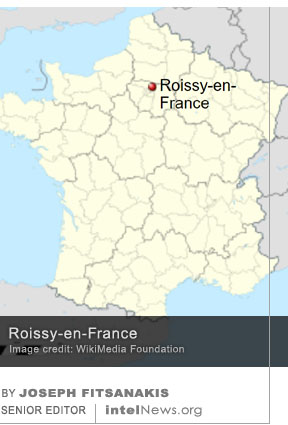
Roissy-en-FranceAN INVESTIGATION HAS BEEN launched in France after a Ukrainian-born Russian national reportedly detonated explosives in a hotel room near Paris, suffering severe burns in the process. Sources from France’s National Anti-Terrorism Prosecutor’s Office (PNAT) said the incident occurred on Monday in a hotel in Roissy-en-France, a small bedroom community located 15 miles northeast of downtown Paris.
At the scene of the explosion police found a severely burned man, who was later identified as a 26-year-old from the Donbas region of eastern Ukraine. Most of the Donbas region has been under Russian military occupation since 2014. The man is reportedly a Russian speaker and holds both Ukrainian and Russian nationalities. He is currently in hospital receiving treatment for severe burns, and is formally under arrest.

The PNAT and the General Directorate for Internal Security (DGSI), France’s counterterrorism and counterespionage agency, are investigating the suspect’s background and activities. According to media reports, the suspect’s hotel room contained “substances and materials intended for the manufacture of explosive devices”. A number of guns and forged passports were also found in the room.

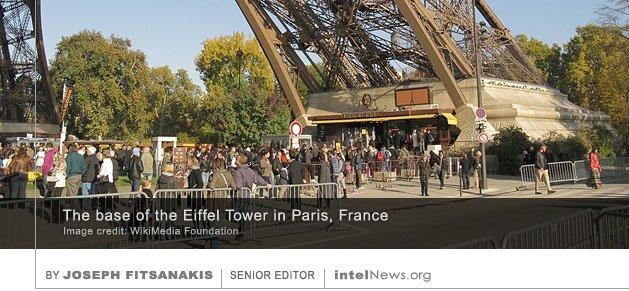
As intelNews reported earlier this week, French police arrested a Bulgarian, a Ukrainian and a German national, who deposited five coffins, draped in French flags, at the base of the Eiffel Tower. The flags reportedly bore the inscription “Dead French Soldiers of Ukraine”. While the investigation is ongoing, French authorities are said to have classified the incident as a Russian psychological operation aimed at affecting French public opinion. It is not known whether the two cases are in any way connected.

Author: Joseph Fitsanakis | Date: 06 June 2024 | Permalink

French police arrest foreign nationals in suspected Russian influence operation

Eiffel TowerFRENCH POLICE ARRESTED THREE foreign nationals on Monday, accusing them of having deposited five coffins draped in French flags at the foot of the Eiffel Tower. The flags bore the inscription “French Soldiers of Ukraine”, while the coffins were found to contain sacks of plaster, according to media reports. The reports quoted French intelligence officials as saying that the stunt was likely a Russian operation aimed at influencing French public opinion against a potential military involvement in Ukraine.
Close circuit television footage led French police to the driver of a van that carried the coffins to the Eiffel Tower at 9:00 a.m. local time on Saturday. The 34-year-old driver, identified as “Georgi F.”, is believed to be a Bulgarian national. He told police he had arrived in Paris from Bulgaria on Friday and had been paid €40 by two other men to help transport the coffins to the iconic Paris monument. The two men, who allegedly paid the Bulgarian national, were arrested shortly afterwards while they were preparing to board a bus to Germany. One of them is believed to be a German national, while the other is said to hold Ukrainian citizenship.

The two men allegedly told French police they had been paid €400 to transport the coffins. French authorities reportedly believe the stunt was “organized from abroad” and that “Russian agents” may be behind it. There are allegations that the individual who paid the men may have been the same person who organized a similar stunt in May. In the early hours of May 14, someone defaced the Wall of the Righteous at the Mémorial de la Shoah, which includes the Holocaust museum in Paris’ 4th arrondissement. The names of nearly 4,000 people who helped save Jews in France are inscribed on that wall.

Last November, French authorities accused Russia of being behind stenciled images of Stars of David that had mysteriously appeared in the streets of Paris in late October. At least two of those arrested in the ensuing days were Moldovan nationals. The Paris prosecutor said at the time that the culprits had been in contact with a Russian-speaking individual who had offered to pay them in exchange for graffitiing the stars. Some reports speculated that the graffiti may have been part of a campaign by a “foreign actor trying to undermine French social cohesion”.

Author: Joseph Fitsanakis | Date: 04 June 2024 | Permalink

Poland and Germany charge Russian operatives with assassination, sabotage plots

Rzeszów-Jasionka AirportAUTHORITIES IN GERMANY and Poland have charged three individuals with working on behalf of Russian military intelligence in planning acts of sabotage and assassination on European soil. One of the plots allegedly involved an effort to assassinate Ukrainian President Volodymyr Zelenskyy. Another aimed to sabotage commercial airport facilities that are being managed by the United States military.

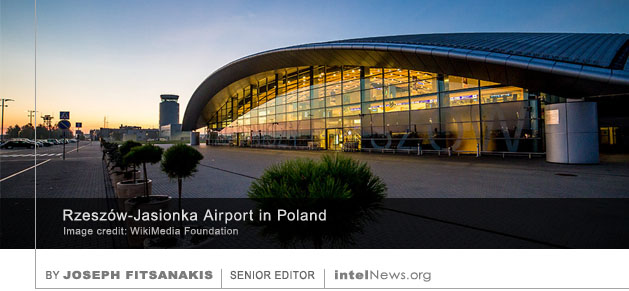
Polish and Ukrainian authorities announced last week the arrest of Paweł K., a Polish citizen, who is believed to have been engaged in collecting information about the security of the Rzeszów-Jasionka Airport. Located in southeastern Poland, Rzeszów-Jasionka is a relatively small provincial airport. Its proximity to the Ukrainian border has made it central to efforts by Kyiv’s allies to supply it with war materiel following the expansion of Russia’s occupation of Ukraine in February 2022. Military supplies are transported to Rzeszów-Jasionka from across the world and then transferred across the Ukrainian border with trucks. Additionally, many high-level meetings between Ukrainian and Western officials take place at the airport. The United States military is currently providing security at the Rzeszów-Jasionka Airport.

Polish authorities said last week that Paweł K. was part of a Russian intelligence collection operation that was “intended to assist in the planning of a potential assassination of a foreign state leader”, namely President Zelenskyy. The Security Service of Ukraine (SBU) said it informed its Polish counterpart agency about the assassination plot, which had been foiled “as a result of the close co-operation” between Ukrainian and Polish intelligence. Paweł K. is not a diplomat and thus has no immunity from prosecution in Poland. If convicted, therefore, he could face up to eight years in prison.

In a seemingly unconnected development, police in the southeastern German state of Bavaria arrested two dual German-Russian nationals, who have been charged with planning to sabotage military and industrial facilities on German soil. The plot appears to be part of broader Russian efforts to disrupt the production and delivery of military aid to Ukraine. At least one of the locations that the suspects are accused of targeting is a local military base under the command of the United States. The two suspects have been identified as Dieter S., 39, and Alexander J., 37. Both were arrested in the small city of Bayreuth.

Germany’s Federal Foreign Office, led by Minister Annalena Baerbock, summoned Sergei Nechayev, Russian Ambassador to Berlin, shortly after the arrest of Dieter S. and Alexander J. Some media reports noted the “unusually hasty” way Nechayev was summoned, which may indicate that German authorities have acquired “unequivocal proof of the link between the plot and the Kremlin”. An announcement made by the Russian embassy in Berlin confirmed that Nechayev had been summoned in connection to the arrests, but added that the ambassador had been presented with “no proof” that the two suspects were connected with Russian intelligence or that they had planned acts of sabotage.

Author: Joseph Fitsanakis | Date: 22 April 2024 | Permalink

Opinion: Fumbling Russian spies fail to stop ISIS-K attack, despite warnings from U.S.

Crocus City Hall attackNO COUNTRY HAS BETTER intelligence on the Islamic State-Khorasan Province (known as ISIS-K) than the United States. American forces have faced ISIS-K almost from the moment the group was founded in 2015 in Pakistan, just a few miles from the Afghan border. It was there that a group of disaffected members of the Tehreek-e-Taliban-e-Pakistan (TTP, commonly referred to as the Pakistani Taliban) began turning their backs on al-Qaeda, which they saw as a failing brand, and joined the Islamic State of Iraq and Syria (ISIS).
By 2017, ISIS-K had begun to draw to its ranks hundreds of fighters from central and south Asia, who were inspired by the group’s goal of establishing an Islamic caliphate in the lands of the greater Khorasan. The term refers to a historical region that extends from eastern Iran and Turkmenistan, to the mountains of Kyrgyzstan, containing all of present-day Afghanistan, most of Uzbekistan, and even some parts of the Russian Caucasus. Like the Islamic State of Iraq and Syria (ISIS) during its heyday, ISIS-K aspires to establish control over a territorially unified entity and then use perpetual war to expand its influence in central Asia and beyond.

Until 2021, the biggest obstacle to ISIS-K’s plan for regional domination was the U.S. By some accounts, American forces and Western-trained Afghan commando units had managed to eliminate more than half of ISIS-K’s 4,000-strong base in northeastern Afghanistan. Since the hurried U.S. withdrawal from the country in 2021 (which was marred by an ISIS-K suicide bombing that killed nearly 200 people, including 13 U.S. troops), ISIS-K has expanded its reach beyond all prior measure. The group has since claimed responsibility for attacks in Afghanistan, Pakistan, Iran, and now Russia, that have killed over 600 people and injured thousands.

A primary reason for the proliferation of ISIS-K’s terrorist activity is that the U.S., which has more intelligence than anyone on the group, issues warnings that are not being taken into consideration by the group’s primary targets, namely Afghanistan, Iran, and Russia. Indeed, despite the Washington’s best efforts, its warnings about pending ISIS-K attacks have been ignored by the group’s primary targets. A few days after an ISIS-K attack killed nearly 100 people in Kerman, Iran, The Wall Street Journal claimed the U.S. government had provided Tehran with “a private warning” of an imminent terrorist threat from ISIS-K. If that is true, then the Iranians clearly did not heed Washington’s warning.
It now appears that, once again, Washington had considerable intelligence insight into ISIS-K’s plans to strike inside Russia. On March 7, the U.S. embassy in Russia warned on its website that “extremists have imminent plans to target large gatherings in Moscow, to include concerts”. The warning provided no specifics. However, seeing how U.S. authorities issued private warnings to Iran, a country with which the U.S. has no diplomatic relations, then it is highly likely they provided similar information to Russia, which at least hosts American diplomats and intelligence officers on its soil. Yet, not only did the Russians ignore these warnings, but they openly dismissed them. Read more of this post

Russian intelligence services intensify efforts to ‘liquidate’ defectors: report

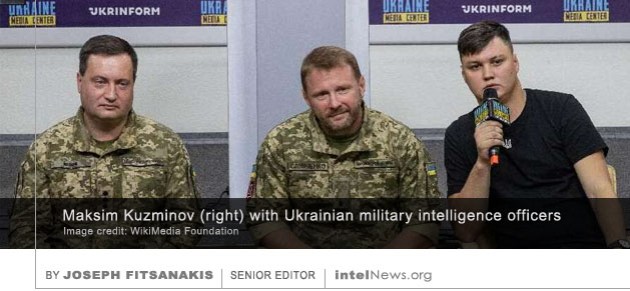
Maksim KuzminovTHE RUSSIAN INTELLIGENCE SERVICES have been “bolstering the[ir] architecture” aimed at stopping potential defectors and “liquidating” those who have already defected and are living in exile, according to a new report. In a leading article published on Sunday, The Wall Street Journal said that the list of “unsolved deaths” of the Kremlin’s Russian critics is “lengthening” and may have surpassed 50, according to some accounts.
Since the current phase of the invasion of Ukraine, which began in February 2022, Russian defectors and other critics of Russia’s ongoing war have “died in unusual circumstances on three continents”, according to the New York-based newspaper. Most deaths have occurred inside Russia, but several have occurred in countries such as India, France, and Spain. In the most recent case, Maksim Kuzminov, a Russian helicopter pilot, who defected to Ukraine in August 2023, was gunned down in Villajoyosa, Spain, last month, in what The Journal described as a “mafia-style assassination”.

The paper notes that very few of these killings or suspicious deaths can be directly attributed to the Kremlin. It adds, however, that the Russian government has ordered a redoubling of coordinated anti-defector operations by the country’s three main intelligence agencies —the Federal Security Service (FSB), the Foreign Intelligence Service (SVR), and the Main Intelligence Directorate of the General Staff of the Russian Armed Forces (GRU). In their effort to prevent defections and punish defectors, these agencies have blurred their operational boundaries,  “making it more difficult to know which is responsible” for anti-defector operations, says The Journal.

Russian anti-defector operations are also increasingly involving third-country nationals —operatives who have no official connection with Russia, or with the country in which they are operating on behalf of Russian intelligence. In one recent example from last August, authorities in Britain arrested three Bulgarian citizens with spying for Russia. According to British government prosecutors, the suspects possessed forged passports and identity cards for Spain, France, the United Kingdom, Croatia, Italy, Greece, Bulgaria, the Czech Republic, and Slovenia.

Author: Joseph Fitsanakis | Date: 04 March 2024 | Permalink

Ireland halts issuances of Russian diplomatic visas due to espionage concerns

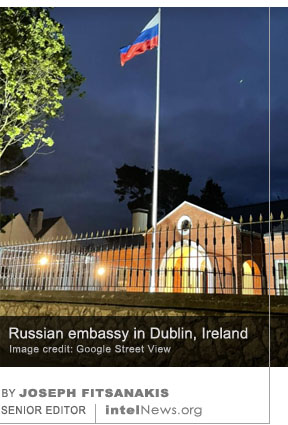
Russian embassy IrelandAUTHORITIES IN IRELAND ARE systematically “freezing” applications for Russian diplomatic visas from Moscow over concerns that the Kremlin is using its embassy in Dublin as a base for espionage activities. In 2018, the Irish government introduced emergency legislation that canceled a previously approved expansion of the Russian diplomatic compound in the Irish capital, allegedly due to concerns about espionage activities by Russian diplomats. Three years later, reports emerged that Irish government officials were concerned about the expanding size of Russia’s diplomatic presence in Dublin.
In April 2022, Ireland expelled four Russian diplomats, which it claimed were undercover intelligence officers. A subsequent report by the London-based Times newspaper alleged that a major reason Dublin had expelled the diplomats was their “efforts to cultivate contacts with dissident republicans and loyalist paramilitaries” in the Republic of Ireland and in Northern Ireland, which is British soil. The report added that at least one of the four expelled Russian diplomats was believed to be an intelligence officer for the Main Intelligence Directorate of the General Staff of the Russian Armed Forces —widely known by its Cold War-era initials, GRU.

On February 10, The Irish Times alleged that the Irish government was “refusing to allow Russia to replace diplomats assigned to its Dublin embassy […] due to concerns over espionage”. The article went on to claim that Russia’s diplomatic presence in Ireland had “dropped by half” and was causing a “tense standoff” between Ireland and Russia. It also quoted a spokesman from the Russian embassy in Dublin, who decried Ireland’s “unacceptable visa and accreditation policy”. The Russians told the paper that their embassy was staffed by just eight administrative staff and six diplomats.

On February 17, The Irish Times said it had corroborated the Russian officials’ claims by speaking with Micheál Martin, Ireland’s Deputy Prime Minister and Minister for Foreign Affairs. Martin was approached by the newspaper’s reporters in Germany, where he attended the Minich Security Conference. Martin told The Irish Times that the Irish Department of Foreign Affairs was  carefully “scrutinizing” every new application for a diplomatic visa by the Russian government. The reason for the careful scrutiny, said Martin, was a number of advisories issued by Ireland’s intelligence services, suggesting “that other activities were underway” at the Russian embassy and that some embassy staff “were not actually diplomats but were performing intelligence functions”. Martin added that the Irish government had determined “15 diplomats should be adequate for [Russia’s] needs” in Ireland.

Author: Joseph Fitsanakis | Date: 18 February 2024 | Permalink

Alleged Afghan-born Russian spy tries to regain revoked British citizenship

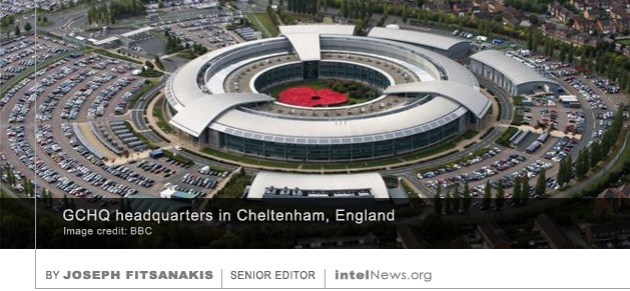
GCHQAN AFGHAN-BORN MAN, who became a naturalized British citizen and worked for British intelligence for over a decade, is attempting to regain his British citizenship, which was revoked after he was accused of being a Russian spy. The man, who is identified in court documents only as “C2”, was born in Afghanistan and grew up under the Soviet occupation in the 1980s. When the Soviets withdrew from Afghanistan he left the country alongside the Russian forces and resettled in Russia, where he attended university and married a Russian woman.

By 2000, when he entered the United Kingdom as an Afghan asylum seeker, he was in possession of Russian citizenship due to his marriage to a Russian citizen. He was eventually granted asylum in Britain and began to work as an interpreter for the Foreign Office and the Government Communications Headquarters (GCHQ), Britain’s signals intelligence agency. His fluency in Russian, Dari, and Pashto, made him invaluable to British intelligence as the United States-led ‘war on terrorism’ escalated in Afghanistan. In the late 2000s, the British Foreign Office sent C2 to Afghanistan, where he worked to build ties between the nascent post-Taliban Afghan government and the British diplomatic corps stationed in the country.

It was in Afghanistan, according to Britain’s Security Service (MI5), that C2 began to develop contacts with Russian intelligence officials. The agency claims that two Russian military attaches stationed in the Afghan capital Kabul, identified in court documents as “Boris” and “Dimitri”, recruited C2 on behalf of the Main Directorate of the Russian Armed Forces’ General Staff, which is commonly known as GRU. The British government claims that, following his recruitment by GRU, C2 traveled to Russia at least six times and once to Cyprus, where he continued to hold regular meetings with his Russian handlers.

On 2019, after he had left government service, MI5 began to question C2 about his alleged connection to Russian military intelligence. He consistently denied that he was a Russian spy. Eventually, MI5 took him “to the roof of a hotel” in London, where he was administered a polygraph examination. A few weeks later, by which time he had returned to his base in Kabul, C2 was informed that his British citizenship would be revoked due to his espionage work for the Russians.

Ironically, the British government evacuated C2 from Afghanistan in 2021 as part of Operation PITTING, during which 15,000 Afghan nationals were transported to the United Kingdom as the Taliban descended on Kabul. Upon arriving in the United Kingdom, C2 was arrested and eventually released on bail. Last week he formally appealed against the British government’s decision to strip him of his citizenship. His case was heard in secrecy at a special hearing of the United Kingdom’s Special Immigration Appeal Commission (SIAC). The SIAC is expected to rule in March or April.

Author: Joseph Fitsanakis | Date: 12 February 2024 | Permalink

India arrests Moscow embassy security employee for spying for Pakistan

Embassy of India in RussiaAUTHORITIES IN INDIA HAVE arrested a security employee at the Indian High Commission in Russia, accusing him of spying for Pakistani intelligence. The embassy of India in Moscow is one of its largest in the world and is viewed as critical to New Delhi’s strategic relations with Russia. Employees that staff the Moscow embassy are highly vetted and typically represent the cream of the crop of India’s Ministry of External Affairs. It follows that news of the arrest of a Moscow embassy security employee on espionage charges must have raised eyebrows in India.

The employee in question has been identified in news reports as Satendra Siwal, a resident of the village of Shahmahiuddinpur, located in the Hapur district of Uttar Pradesh. He is believed to have been employed as an India-Based Security Assistant (IBSA) at the Indian embassy in Moscow since 2021. Siwal reportedly belongs to the embassy’s Multi-Tasking Staff (MTS), a broad job title that encompasses a variety technical support specialists working at India’s diplomatic facilities worldwide.

According to reports, Siwal was arrested by members of the Anti-Terrorist Squad (ATS) in the northern Indian city of Meerut, 250 miles northeast of New Delhi. He was charged with participating in “anti-India activities”, which included providing government secrets to Pakistan’s Inter-Services Intelligence (ISI) Directorate. According to the ATS, the secrets given to the ISI by Siwal included information about strategic planning by the Indian Ministry of Defense, the Ministry of External Affairs (Siwal’s direct employer), and the Indian military. Siwal allegedly spied for the ISI in exchange for financial compensation.

Indian authorities said the case against Siwal was built with the help of “electronic surveillance” and other “evidence collection”, but did not provide details. In a statement issued on Monday, the ATS said Siwal had allegedly “confessed to his crime” during questioning. The espionage suspect is now facing charges under India’s Official Secrets Act.

Author: Joseph Fitsanakis | Date: 5 February 2024 | Permalink

Italy investigating suspicious cash withdrawals by Russian embassy staffers in Rome

Embassy of Russia in ItalyAUTHORITIES IN ITALY ARE investigating a series of suspicious cash withdrawals that were made from accounts belonging to the Russian embassy in Rome, according to reports in the Italian press. On November 14, the Rome-based daily La Repubblica reported that the Financial Intelligence Unit (UIF) of the Bank of Italy had launched a probe to uncover out exactly who made the cash withdrawals and who the money might have gone to.

According to the Italian newspaper, Russian diplomatic personnel withdrew nearly €4 million ($4.35 million) in cash from two accounts belonging to the Russian embassy in Rome. Russian embassy staffers reportedly withdrew the €4 million on 21  separate instances, sometimes in portions amounting to €100,000 at a time. The withdrawals drew the attention of the UIF, which is now reportedly investigating the withdrawals.

La Repubblica said that UIF investigators are anchoring their probe on several hypotheses. These include the possibility that the cash withdrawals were meant to bypass the progressively stricter financial sanctions that the European Union has been imposing on Moscow. The bulk of these sanctions began shortly February 2022, when Russia launched its full-scale invasion of Ukraine. Notably, Russian embassy staffers started to withdraw the funds almost immediately after Russia’s full-scale invasion of Ukraine began.

The correlation between the Russian invasion of Ukraine and the cash withdrawals has led Italian authorities to entertain another hypothesis, namely that Rome embassy staffers have been using the cash to pay Russian intelligence personnel working without a diplomatic cover in Italy and elsewhere in Europe. A third hypothesis is that Russian intelligence personnel have been using the cash to support information operations that target European audiences. According to La Repubblica, the cash could have been used for “paying influencers to espouse the Kremlin’s cause in Italy, thus influencing public opinion”.

Author: Joseph Fitsanakis | Date: 20 November 2023 | Permalink

France accuses Russia of disinformation campaign using Star of David graffiti in Paris

Star of David graffitiTHE FRENCH GOVERNMENT HAS accused Russia of carrying out a disinformation campaign using stenciled images of Stars of David that mysteriously appeared in the streets of Paris late last month. The stars, between 60 and 80 in number, were found in the 14th arrondissement of the French capital, as well as in several Parisian suburbs in the early hours of October 31. The stars (see accompanying picture) are all blue and all have the same size. They appear to have been hurriedly stenciled and have no accompanying text.


A statement issued on November 8 by the prosecutor for the city of Paris, Laure Beccuau, said that police had identified and arrested a man and a woman in connection with the graffiti. Referencing surveillance camera footage, Beccuau’s statement said the two suspects had stenciled the stars overnight, working in unison with a third individual who took photographs of the graffiti. The statement added that the alleged perpetrators of the graffiti may have contacts with another couple, consisting of an unnamed 28-year-old Moldovan woman and a 33-year-old Moldovan man. Police had arrested the Moldovans in Paris on October 27, for painting the same stenciled Start of David on a building in Paris.

The statement by the Paris prosecutor alleges that both couples had been in contact “with the same third party”, a Russian-speaking individual who had offered to pay them in exchange for graffitiing the stars. “It therefore cannot be ruled out that the tagging of the blue Stars of David in the Paris region was carried out at the explicit request of a person living abroad”, the statement concludes. Some reports speculated that the graffiti may have been part of a campaign by a “foreign actor trying to undermine French social cohesion”.

Last Thursday, the French Ministry for Europe and Foreign Affairs openly accused Russia for carrying out a disinformation campaign aimed at amplifying the Star of David graffiti on social media, allegedly in order to discredit France. The ministry said the disinformation campaign reflected “a persisting opportunistic and irresponsible strategy of using international crises to create confusion and tensions in the public debate in France and in Europe”. Later on the same day, the Embassy of the Russian Federation in Paris issued a statement on social media, condemning France’s “groundless attempts to seek out a ‘Russian connection’ in events having no connection with our country and pin responsibility on Russia with the sole aim of discrediting it”.

Author: Joseph Fitsanakis | Date: 13 November 2023 | Permalink

Ex-Russian spy can sue British government for revealing his identity, court rules

High Court UKA FORMER SOVIET KGB officer, who now lives in the United Kingdom under witness protection, can sue the British state for revealing his identity to Latvian authorities, which may have put his life in danger, a judge has ruled. Boris Karpichkov, 64, joined the Soviet KGB in 1984, but became a defector-in-place for Latvian intelligence in 1991, when the Soviet Union disintegrated.

He then allegedly spied on Latvia for one of the KGB’s successor agencies, the Federal Security Service, before switching sides again and spying on Russia for the Latvians. He also claims to have spied on Russia for French and American intelligence. In 1998, carrying two suitcases filled with top-secret Russian government documents, and using forged passports, he arrived with his family in Britain, where he has lived ever since. Shortly after he was granted asylum, the British government issued Karpichkov with a new identity to protect him from the Russian security services. In 2018, Karpichkov claimed that, despite the British government’s efforts to protect him, Russian intelligence had tried to kill him three times since 2006.

Since Karpichkov’s relocation to the United Kingdom, Latvian authorities have twice attempted to have him extradited there. A High Court judge rejected the first extradition request, ruling that Karpichkov’s life would be in danger if he were to be handed over to Latvia. But in 2018 the Latvian authorities issued a follow-up request for Karpichkov’s extradition. At that time the United Kingdom’s National Crime Agency (NCA), which manages the UK Protected Persons Service, shared information about Karpichkov’s protected identity with the Latvians. A judge later quashed that extradition request too, warning that the former KGB intelligence officer had “an abundance of dangerous enemies in both Latvia and Russia”.

Karpichkov claims that the information that the NCA shared with the Latvians during the extradition negotiations, resulted in him receiving death threats from his enemies abroad. The NCA claims it was under a European Arrest Warrant legislation mandate to disclose Karpichkov’s protected identity to the Latvian authorities. On Friday, however, a High Court judge ruled that Karpichkov had the right to sue the NCA for unlawfully disclosing Karpichkov’s details in violation of data protection rules. This means Karpichkov is now entitled to file a lawsuit against the British government for allegedly misusing his private information.

Author: Joseph Fitsanakis | Date: 30 October 2023 | Permalink

Ukraine’s spy services are using assassinations as weapons or war, report claims

Security Service of Ukraine SBUTHE GROWING LIST OF assassinations of prominent Russians and Ukrainian separatists shows that the Ukrainian intelligence services are using “liquidations” as a weapon of war, according to The Washington Post. Citing “current and former Ukrainian and United States officials”, the paper said on Monday that funding and training by the Central Intelligence Agency (CIA) explains much of the success of Ukraine’s covert operations against Russia. However, the CIA is not involved in Ukraine’s state-sponsored assassination efforts at the operational level, and some US officials are uneasy about these activities.

A CIA Spy Directorate in Ukraine

In 2014, when Russia invaded Crimea, Ukrainian intelligence services were in an almost paralytic state. Like most of Ukraine’s state sector, the intelligence agencies were endemically bloated and closely resembled Soviet-style bureaucracies in sluggishness and corruption. More importantly, they were “riddled with Russian spies, sympathizers and turncoats”, according to observers. Few were surprised when, almost as soon as Russia annexed Crimea, the local head of the domestic security agency, the Ukrainian Security Service (SBU) defected to Russia.

According to The Washington Post, immediately after the Russian invasion of Crimea, the CIA sought to prevent further Russian encroachment in Ukraine. That is why in 2015 it built the SBU’s Fifth Directorate. That entirely new directorate was —and today remains— insulated from the rest of the SBU. The CIA also reportedly built a new division, complete with a brand-new headquarters building, inside Ukraine’s Main Directorate of Intelligence (GUR), which operates as the intelligence wing of the Ministry of Defense.

Active-Measures Training

Seeing the GUR as a more agile and flexible agency than the SBU, the CIA began to train GUR paramilitary “spetsnaz” divisions in “active measures” —a term that describes methods of political warfare, ranging from propaganda, sabotage operations, and even assassinations. However, The Washington Post claims that the CIA training focused on “secure communications and tradecraft” with an eye to enabling GUR teams to operate covertly behind enemy lines using clandestine maneuvers. Targeted assassinations were not included in the training. Read more of this post