Analysis: Crimea crisis brings Russian military spies back in the game
July 9, 2014 Leave a comment
 By IAN ALLEN | intelNews.org
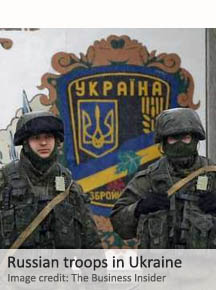
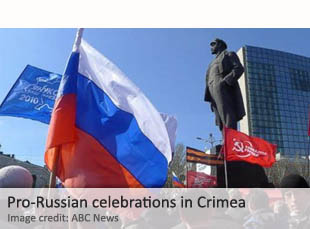
The recent crisis in Ukraine, which resulted in Russia assuming control of Crimean Peninsula, marks the post-Soviet resurgence of Russia’s military intelligence apparatus and points to “a new playbook” in Moscow’s foreign policy strategy, according to a seasoned Russia analyst. In an article published on Monday in Foreign Policy, Mark Galeotti, Professor of Global Affairs at New York University, who specializes in Russian security affairs, said Russia’s military intelligence agency is now “back in the global spook game”. He was referring to Russia’s Main Intelligence Directorate of the General Staff, known commonly as GRU, which he said the Kremlin will be employing increasingly in the years to come as a major foreign-policy tool. It is no secret that, despite its significant role in Cold War intelligence operations, the GRU has been in decline in the post-Soviet era. Its substandard performance in the 2008 Russo-Georgian War convinced Russian President Vladimir Putin that the agency was “unfit” for operations in what Russians call the “near-abroad” —the regions of the former Soviet Republics. In 2003, in addition to facing what Galeotti calls “a savage round of [budget] cuts”, the GRU saw its near-abroad functions taken over by the FSB, Russia’s Federal Security Service. The FSB descends from the domestic component of the Soviet-era KGB, the agency that employed Vladimir Putin before he entered politics (as an aside, the SVR, which is the post-Soviet reincarnation of the KGB’s external intelligence directorates, is legally prevented from operating within the Commonwealth of Independent States). As late as last year there was even a discussion about whether the GRU should be demoted from a main directorate under the Russian Armed Forces’ General Staff to a simple directorate, a move that would have fatally diminished its institutional stature. But in the recent Crimea crisis, says Galeotti, the GRU was able to turn the tables on Kiev by deploying its battle-ready Vostok Battalion, whose members cut their teeth in Chechnya. Read more of this post













 intelNews.org

Russia to reopen electronic listening command post in Cuba
July 17, 2014 by Joseph Fitsanakis Leave a comment
The government of the Russian Federation has reached an agreement with the authorities in Cuba to reopen an electronic communications listening base that was built by the Soviets during the Cold War. Russian newspaper Kommersant said on Wednesday that the agreement between the two nations was struck late last week during a visit to the communist-run island by Russian President Vladimir Putin. The agreement centers on the Lourdes signals intelligence (SIGINT) facility, located just outside Cuban capital Havana. Situated approximately 100 miles from the United States mainland, the facility was used throughout the last two decades of the Cold War to provide intelligence for Soviet military and civilian spy agencies, while also operating as an overseas communications hub for the Soviet Navy. It was regarded at the time as the most formidable Soviet electronic listening post located anywhere outside Soviet territory. Cuban authorities once bragged that Lourdes provided Moscow with 75 percent of its actionable intelligence on its American adversary —though some experts consider the statement an exaggeration. At its peak, in the late 1970s, Lourdes hosted approximately 3,000 technical specialists and support personnel, over half of whom were Soviet. Initially, the Cuban government permitted Moscow to make use of Lourdes free of charge. However, in 1992 Havana introduced an annual rental fee, which by 2001 had risen to $200 million. Under the bilateral agreement, Russia was paying the rental fee in kind, by supplying the Cuban government with food products and fuel, as well as military equipment. But in 2001, the administration of President Putin withdrew from the agreement, citing the high cost of maintaining the base. Moscow said at the time that it was financially impossible to keep up a SIGINT complex located 6 thousand miles away from Moscow. Read more of this post
Filed under Expert news and commentary on intelligence, espionage, spies and spying Tagged with Cuba, Lourdes (Cuba), Lourdes SIGINT Station, News, Russia, SIGINT