News you may have missed #816

Kim Jong-namBy IAN ALLEN | intelNews.org |
►►Danish minister vows more control over spy agency. Following the uproar created by the revelations from former Danish secret service (PET) agent Morten Storm, Denmark’s Minister of Justice, Morten Bødskov, is now calling for parliament to have more control over the domestic intelligence agency. In an interview with Berlingske newspaper, Bødskov said that he is seeking increased powers for parliament’s Kontroludvalg, a committee established in 1964 to oversee PET. The move comes in response to the many questions that have arisen about PET’s actions following Storm’s decision to contribute to a series of articles in Jyllands-Posten newspaper that chronicled his time as a PET double-agent.
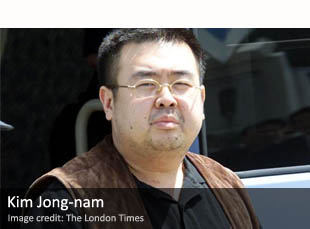
►►South Korea jails alleged North Korean assassin. A South Korean court has jailed an unidentified North Korean spy reportedly ordered to attack Kim Jong-nam, the eldest son of late North Korean leader Kim Jong-il. Kim Jong-nam, who is believed to have fallen out of favor with Kim Jong-il in 2001, was thought to have been living in Macau, but media reports indicate he may have moved to Singapore. South Korean media said the alleged assassin had spent a decade in China tracking down North Korean defectors before coming to the South, and that he had admitted trying to organize “a hit-and-run accident” targeting Kim Jong-nam.
►►US Pentagon to double the size of its worldwide spy network. The Defense Intelligence Agency (DIA), the US Pentagon’s military intelligence unit, is aiming to recruit 1,600 intelligence collectors —up from the several hundred overseas agents it has employed in recent years. The DIA’s new recruits would include military attachés and others who do not work undercover. But US officials say that the growth will be driven a new generation of spies who will take their orders from the Department of Defense. The project is reportedly aimed at transforming the DIA into a spy service more closely aligned with the CIA and elite military commando units.

News you may have missed #815 (analysis edition)

Polygraph testBy IAN ALLEN | intelNews.org |
►►Should polygraph tests be trusted?  US federal polygraph programs have flourished, targeting a growing number of private contractors with more intensely personal questions than ever before. More than 70,000 people are now screened yearly in the US. Yet thousands of people a year could be identified as lying in polygraph screenings when they are not, according to statistical models by the National Academies, which advises the federal government on scientific matters. Under the current system, many of them would have no way to legally challenge polygraphists’ conclusions, especially in the intelligence world.
►►Why the US does not need another law against intelligence leaks. Leonard Downie Jr., vice president at large of The Washington Post, warns that the 2013 Intelligence Authorization Act “would make it a crime for career intelligence officers to provide almost any type of information to the news media, whether the information is classified or not”. He argues that the proposed legislation would “end contacts that often benefit both the government and the public by allowing the exchange of accurate information about vital national security issues and intelligence activities, including abuses requiring attention”.
►►The preventable decline of British defense intelligence. Defense intelligence refers to something rather different from ‘military intelligence’. It takes place at the topmost levels of defense coordination and decision-making and draws together participation from all of the armed services with civilian subject-matter and technical experts and produce consolidated assessments for senior civil servants, ministers and the service chiefs of staff. Philip Davies, director of the Brunel Centre for Intelligence and Security Studies in the United Kingdom, argues that, in Britain, defense and military intelligence remains “something of a poor cousin in the intelligence community, the eternal Peter robbed to pay the Paul of other, seemingly more urgent, defense expenditure and policy priorities”.

Illegal spy agency operated in West Germany, new book claims

Willy BrandtBy JOSEPH FITSANAKIS | intelNews.org |
Conservative politicians in Cold-War West Germany set up an illegal domestic intelligence agency in order to spy on their political rivals, a forthcoming book claims. In Destroy After Reading: The Secret Intelligence Service of the CDU and CSU, German journalist Stefanie Waske exposes what she says was an elaborate plot to undermine West Germany’s rapprochement with Soviet-dominated Eastern Europe. The book, which is scheduled for publication in February of 2013, claims that the illegal intelligence agency, known as ‘the Little Service’, was set up by politicians from Germany’s conservative Christian Democratic Union (CDU) and its sister organization, the Christian Social Union of Bavaria (CSU). The two parties allegedly founded ‘the Little Service’ in 1969, in response to the election of Willy Brandt as German Chancellor in 1969. Brandt, who was leader of the center-left Social Democratic Party of Germany (SDP), was elected based on a program of normalizing West Germany’s relations with Eastern Europe. Under this policy, which became known as ‘Neue Ostpolitik’ (‘new eastern policy’), Brandt radically transformed West German foreign policy on Eastern Europe. In 1970, just months after his election, he signed an extensive peace agreement with the Soviet Union, known as the Treaty of Moscow, which was followed later that year by the so-called Treaty of Warsaw. Under the latter agreement, West Germany officially recognized the existence and borders of the People’s Republic of Poland. Brandt’s Neue Ostpolitik, which continued until the end of his tenure in the Chancellery in 1974, earned him the Nobel Peace Prize for his efforts to achieve reconciliation between West Germany and the countries of the Soviet bloc, primarily East Germany. But Brandt’s policy of rapprochement alarmed the CDU/CSU coalition, says Waske, which quickly set up ‘the Little Service’ by enlisting former members of Germany’s intelligence community. Read more of this post

Did US spies hack French government computers using Facebook?

The Palais de l'ÉlyséeBy JOSEPH FITSANAKIS | intelNews.org |
A sophisticated computer virus discovered at the center of the French government’s secure computer network was planted there by the United States, according to unnamed sources inside France’s intelligence community. Paris-based magazine L’Express, France’s version of Time magazine, says in its current issue that the alleged American cyberattack took place shortly before last April’s Presidential elections in France. It resulted in the infection of the entire computer system in the Palais de l’Élysée, which is the official residence of the President of France. The French magazine cites unnamed sources inside the French Network and Information Security Agency (ANSSI), which is responsible for cybersecurity throughout France. The sources claim that the snooping virus allowed its handlers to gain access to the computers of most senior French Presidential aides and advisers during the final weeks of the administration of French President Nicolas Sarkozy, including his Chief of Staff, Xavier Musca. The article claims that the virus used a source code nearly identical to that of Flame, a super-sophisticated version of Stuxnet, the virus unleashed a few years ago against the computer infrastructure of the Iranian nuclear energy program. Many cybersecurity analysts believe that the US and Israel were instrumental in designing both Stuxnet and Flame. IntelNews understands that the alleged virus was initially directed at employees of the Palais de l’Élysée through Facebook. The targets were allegedly befriended by fake Facebook profile accounts handled by the team that operated the virus. The targets were then sent phishing emails that contained links to phony copies of the login page for the Palais de l’Élysée intranet website. Read more of this post

News you may have missed #813 (CIA edition)

CIA headquartersBy IAN ALLEN | intelNews.org |
►►Who is leading the CIA for now? Acting CIA Director Michael J. Morell, who has worked for the CIA for 32 years, served a stint as acting director last year and his will be one of several names considered by US President Barack Obama for the permanent job. Starting as an analyst tracking international energy issues, Morell worked for 14 years as an analyst and manager on East Asia, rising to director of the Directorate of Intelligence’s Office of Asian Pacific and Latin American Analysis in 1999. In May 2010, Morell succeeded Stephen Kappes, who had resigned suddenly and without explanation, as deputy director of the CIA, serving under Directors Leon Panetta (February 2009-June 2011) and David Petraeus (September 2011-November 2012).
►►No perfect choice to fill Petraeus vacancy at CIA. President Barack Obama needs a quick, no-drama solution to a sensational personnel problem. But the vacancy left at the top of the Central Intelligence Agency by David Petraeus’s abrupt departure amid a headline-grabbing sex scandal calls for a particularly complex skill set. It requires a charismatic chief to oversee the large, notoriously tough-to-manage intelligence apparatus. It needs a leader who has a strong relationship with the president. And most of all, it calls for a politically savvy operator who understands how to interact with Congress —and can assuage some of the current anger on Capitol Hill that lawmakers were kept in the dark about the probe.
►►CIA climate-change unit is shut down. Republican lawmakers in the US began criticizing the Central Intelligence Agency’s Center on Climate Change and National Security before it was even established, calling it a “misguided defense funding priority”. Concerted resistance by conservative lawmakers did not allow the program to stand on solid ground, and it now looks like the Center has actually closed down, having lost its most important supporter, former CIA Director Leon Panetta.

Analysis: Should the CIA kill less and spy more?

CIA headquartersBy JOSEPH FITSANAKIS | intelNews.org |
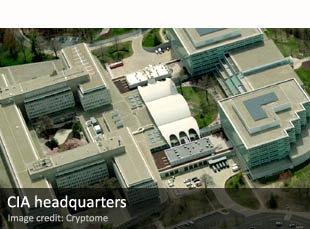
The Central Intelligence Agency’s awkward silence about the recent resignation of its Director, General David Petraeus, is indicative of an organization that remains distinctly uncomfortable with publicity. The added layer of the sexual nature of Petraeus’ impropriety has increased exponentially the degree of unease at Langley. Yet sooner or later the news media will move on to something else and General Petraeus will fade into the distance. For seasoned intelligence observers, however, the question of the CIA’s future will remain firmly in the foreground. In an interview earlier this week with Wired magazine, former CIA Director General Michael Hayden (ret.) opined that Petraeus’ resignation presents the Agency with the opportunity to return to its operational roots. Hayden, who led the CIA from 2006 to 2009, said that the Agency has been “laser-focused on terrorism” for many years. Consequently, much of its operational output “looks more like targeting than it does classical intelligence”, he said. His views were echoed by the CIA’s former Acting Director, John McLaughlin, who told Wired that the most significant challenge for the post-Petraeus CIA “may be the sheer volume of problems that require [good old-fashioned] intelligence input”. Yesterday, meanwhile, saw the publication of two opinion pieces by two of America’s most experienced intelligence watchers. In the first one, The Washington Post’s Walter Pincus urges United States President Barack Obama to pause and think about the role of America’s foremost external intelligence organization before appointing a successor to General Petraeus. For over a decade, argues Pincus, the CIA’s focus has been to fulfill covert-action tasks in the context of Washington’s so-called “war on terrorism”. But through this process, the Agency “has become too much of a paramilitary organization” and has neglected its primary institutional role, which is to be “the premier producer and analyst of intelligence for policymakers, using both open and clandestine sources”. Read more of this post

Opinion: When Did Obama Know About CIA Director’s Affair?

David Petraeus and Paula BroadwellBy JOSEPH FITSANAKIS | intelNews.org |
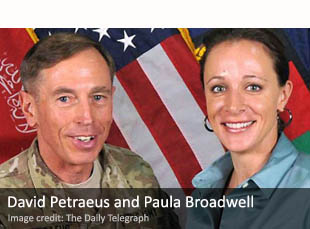
The standard reaction to last week’s resignation of Central Intelligence Agency Director David Petraeus, following the revelation of his extramarital affair, has been stunned silence. Not so much because of the affair itself —what is one more affair in the slippery world of Washington politics?— but because it involved the eminent figure of Petraeus. Former aides to the retired General have been confiding to journalists that “never in a million years” would they have thought that the high-achieving CIA Director would have risked his career and reputation in such a reckless fashion. Many thought that the relationship between him and his biographer, Paula Broadwell, had grown suspiciously close in recent years; but Petraeus had a general way of seeming beyond reproach.

It is worth pointing out that much of this unfolding story is so far based on hearsay, as opposed to concrete, verifiable information. It is suggested that Petraeus’ extramarital tryst was accidentally discovered by agents of the Federal Bureau of Investigation, who were looking into a seemingly unrelated case. Some news outlets, mostly in the UK, suggest that a female employee of the US military’s Joint Special Operations Command contacted the FBI after receiving threatening messages from Broadwell, warning her to “stay away from [her] man” —allegedly Petraeus. While investigating the Gmail account from which the threatening messages were allegedly sent, the FBI allegedly discovered “thousands” of messages exchanged between the CIA Director and Broadwell, some of which were sexually explicit. Read more of this post

News you may have missed #810 (Petraeus resignation edition)

David PetraeusBy JOSEPH FITSANAKIS | intelNews.org |
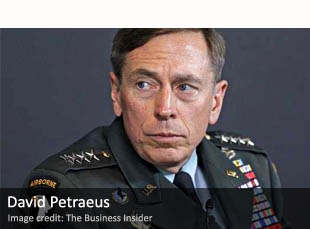
►►How did Petraeus’ affair come to light? CIA Director David Petraeus resigned after a probe into whether someone else was using his email. The probe eventually led to the discovery that he was having an extramarital affair, according to The Wall Street Journal, which cites “several people briefed on the matter”. An FBI inquiry into the use of Petraeus’s Gmail account led agents to believe the woman or someone close to her had sought access to his email. An extramarital affair has significant implications for an official in a highly sensitive post, such as that held by Petraeus, because it can open an official to blackmail.
►►Who did Petraeus have an affair with? The woman with whom General David Petraeus was having an affair is Paula Broadwell, a West Point graduate and the author of a recent hagiographic book about him, entitled All In: The Education of General David Petraeus, co-written with Vernon Loeb. Slate‘s Fred Kaplan reports that “it had long been rumored that something was going on between Petraeus and Broadwell. When she was embedded with him in Afghanistan, they went on frequent 5-mile runs together. But Petraeus went on 5-mile runs with many reporters, and few people who knew him took the rumors seriously”.
►►Who is leading the CIA now? With General David Petraeus stepping down as director of the CIA, following reports of an extra-marital affair, the agency’s current deputy director will take over as director on an interim basis. His name is Michael Morell, and he was a senior CIA aide in the White House to President George W. Bush. Morell had served as deputy director since May 2010, after holding a number of senior roles, including director for the agency’s analytical arm, which helps feed intelligence into the President’s Daily Brief. He also worked as an aide to former CIA Director George Tenet.

Afghan intelligence officials ‘missing’ in the United States

Alibaba GhasheeBy IAN ALLEN | intelNews.org |
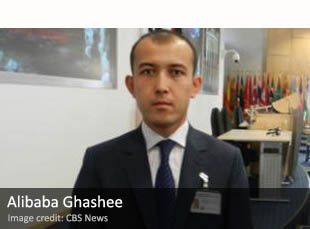
On November 2, the Federal Bureau of Investigation announced that two highly trained Afghan intelligence officers had gone missing in the United States. IntelNews hears that American authorities are still looking for the two Afghans, who seem to have disappeared without trace. The two missing officers work for Afghanistan’s main domestic intelligence agency, the National Security Directorate (NDS), which was founded following the 2001 US invasion of Afghanistan and is mostly funded by Washington. The missing officers are Captain Alibaba Ghashee (pictured), Deputy Director of the NDS’ American and European Department, and Major Mohd Farooq Ghanizada, who directs agency’s Counterterrorism and Organized Crime Department. Both offices disappeared while in Washington, DC, for a high-level executive training program run jointly by the American and German governments. The 10-week intensive course, taught as part of the George C. Marshall Center Advanced Security Studies program, trains elite members of security and intelligence agencies from NATO member-states and other Western-allied countries. Although headquartered in Germany, the program involves a trip to Washington, DC, where participants are briefed by officials from —among other agencies— the FBI and the Defense Intelligence Agency. The two Afghans were supposed to meet their American government escorts on October 22 in downtown Washington, before heading to the airport for their return flight to Afghanistan. However, they never appeared, nor did they show up for their flight at Washington Dulles International Airport. Read more of this post

News you may have missed #809 (Obama-Iran edition)

Iran and its regionBy IAN ALLEN | intelNews.org |
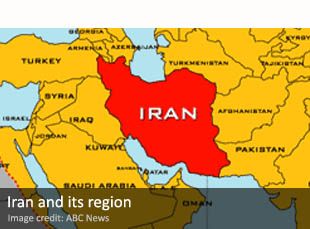
►►Will re-elected Obama take a new line on Iran? Barack Obama returns to office after an election campaign in which Iran’s nuclear program often dominated foreign-policy debates. Mitt Romney frequently accused him of taking too soft a line toward Tehran. Now, as Obama begins a second term, the question is how much he has been stung by such criticism. Will Obama retain confidence in his dual strategy of squeezing Iran with economic sanctions while also extending offers of rapprochement? Or will the fact that Iran keeps building centrifuges and enriching uranium despite Obama’s efforts persuade the White House it needs to try something new?
►►Obama’s victory vindicates his Iran policy. President Barack Obama’s re-election victory represents an important vindication of his approach to Iran and its potential nuclear ambitions —and, for the world, a new face of American policy in the Middle East that will relegate the aggressive policies of George W. Bush into the distant past. The election confirmed what polls have clearly shown, that while Americans are deeply concerned about the prospect of an Iranian nuclear weapon, they also view addressing the problem through vigorous diplomatic engagement and sanctions as the most appropriate exercise of American power and leadership.
►►Iranians see reduced risk of war in Obama’s reelection. In Iran, there is a sense of relief these days, as concerns of a military attack by US and Israeli forces over Iran’s nuclear energy program if Mitt Romney were elected, had become widespread. While there continues to be no official response from Iran’s leadership about US election results, Iranian media is still heavily focused on covering American polls. Commenting on one of Iran’s most popular political Web sites, Asriran, one reader wrote, “At least we know we won’t be going to war during the next four years”. And Iran’s state-run English language television channel, Press TV, carried a live and uninterrupted broadcast of President Barack Obama’s acceptance speech.

News you may have missed #808 (Obama-Netanyahu edition)

Benjamin Netanyahu and Barack ObamaBy IAN ALLEN | intelNews.org |
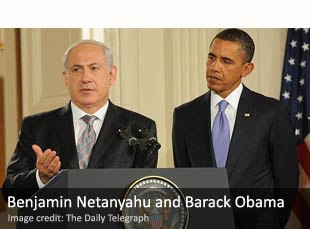
►►The other concession speech: Netanyahu congratulates Obama. At least there was no pretending. In the language of diplomacy, the greeting Israeli Prime Minister Benjamin Netanyahu extended to Barack Obama on the occasion of his re-election was “correct” and nothing more. “Prime Minister Netanyahu congratulates US President Barack Obama on his election victory,” read the public statement issued early Wednesday in Jerusalem. The next word out of Balfour Street, where Netanyahu mulled the returns, was a warning to members of his Likud party to shut up about how they figure the premier might really feel. By then, the deputy speaker of the Knesset had already called Obama “naïve” and vowed Israel would not “surrender” to him.
►►Netanyahu rushes to repair damage with US President. Over the past several years, Prime Minister Benjamin Netanyahu has on several occasions confronted or even undercut US President Barack Obama, taking his message directly to the Israel-friendly United States Congress, challenging Mr. Obama’s appeal to the Arab world, and seeming this fall to support his opponent, Mitt Romney. Mr. Netanyahu woke up Wednesday to find not only that his Republican friend had lost, but also that many Israelis were questioning whether he had risked their collective relationship with Washington.
►►Barack Obama victory spells trouble for Israel’s Netanyahu. Israeli Prime Minister Benjamin Netanyahu faces an even more awkward time with Washington and re-energized critics at home who accused him on Wednesday of backing the loser in the US presidential election. With Iran topping his conservative agenda, Netanyahu will have to contend with a strengthened second-term Democratic president after four years of frosty dealings with Barack Obama and a rift over how to curb Tehran’s nuclear program.

News you may have missed #807

Noor Inayat KhanBy IAN ALLEN | intelNews.org |
►►Britain to unveil statue of female SOE spy of Indian origin. Born in Moscow to an Indian father and an American mother, Noor Inayat Khan was in Paris when it fell to Nazi occupation. She immediately returned to London to volunteer for the war effort, joined the Women’s Auxiliary Air Force and was recruited by the Special Operations Executive (SOE). She was sent into France on a secret mission in June 1943, but was betrayed and captured a few months later. She was shot by the Nazis in Dachau in September 1944, aged 30, and was posthumously awarded the George Cross as well as the Croix de Guerre by France. She was one of only three women in the SOE to be awarded the George Cross.
►►US intelligence spending falls or second year in a row. The US government’s total spending on intelligence activities fell in 2012, the second year in a row of declining numbers after years of soaring security spending since the September 11 attacks in 2001. The Office of Director of National Intelligence, the top US intelligence authority, announced on Tuesday that total funding appropriated for the National Intelligence Program, covering activities of the CIA and high-tech spy agencies such as the National Reconnaissance Office, was $53.9 billion in Fiscal Year 2012, which ended on September 30. That was down from the $54.6 billion appropriated during Fiscal Year 2011, according to government officials and figures published by the private Federation of American Scientists.
►►Russia wants to park spy planes on French base. France has been asked by Moscow to allow two Russian spy planes to be deployed at a French base in Djibouti to help track down pirates. Russian Defense Minister Anatoly Serdyukov said last week that the Ilyushin Il-38 naval reconnaissance planes would improve Russia’s ability to spot pirates plaguing waters off the coast of Somalia. Djibouti is at the juncture of the Red Sea and the Gulf of Aden. The French base is home to several thousand French service members and a number of military aircraft.

News you may have missed #806

Mohammed DahabiBy IAN ALLEN | intelNews.org |
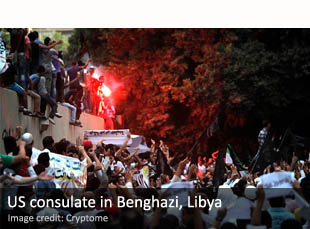
►►Most staff at US consulate in Libya were CIA personnel. Most of the personnel attached to the US diplomatic mission in Benghazi, the Libyan city where a US consulate was attacked ending with the deaths of four Americans, including Ambassador Christopher Stevens, were spies, according to The Wall Street Journal. The paper said 23 of the 30 Americans evacuated from Benghazi in the wake of the September 11, 2012, attack were employees of the CIA. Tyrone Woods and Glen Doherty, two of the men killed that day, and later publicly identified as contract security workers with the State Department, were in fact under contract with the CIA, said the paper.
►►India accuses Pakistan of printing counterfeit banknotes. The Central Economic Intelligence Bureau in India says that the Pakistani spy agency, the Inter-Services Intelligence Directorate (ISI) is printing counterfeit Indian and Bangladeshi currencies from the state-owned security printing presses “under special arrangement” and circulating the same through a well-organized network, which is coordinated by senior ISI officials. This is not the first time that the Indian government has accused Pakistan of counterfeiting Indian currency.
►►Jordan court to announce ex-spy chief’s sentence on November 11. A Jordanian criminal court has postponed a verdict in the case of Mohammed al-Dahabi, who ran the General Intelligence Department between 2005 and 2008 and is on trial for alleged embezzlement of public funds, money laundering and abuse of office. Presiding judge Nashaat Akhras said in court Sunday that the verdict will be pronounced November 11, without giving a reason. Dahabi was arrested in February, when inspectors from the Central Bank of Jordan suspected transactions worth millions of dollars had gone through his bank account.

News you may have missed #805 (analysis edition)

US consulate in Benghazi, LibyaBy IAN ALLEN | intelNews.org |
►►Should the US be wary of Huawei? Regular readers of intelNews know that this blog has been covering the subject of Chinese telecommunications hardware manufacturer Huawei for several years now. During the past few weeks, the United States Congress has flagged the company as being too closely associated with the Chinese intelligence establishment. Other countries have done so as well. But not everyone agrees. New York-based newspaper The Wall Street Journal said recently that “bashing Chinese companies on national security grounds seems like a risk-free strategy” for US politicians and added that, unlike Congress, American governors and mayors are eager to promote investment by Chinese companies. Moreover, Wired‘s Marcus Wohlsenemail suggests that, spies or no spies, US telecommunications companies should fear Huwaei, which is here to stay.
►►Should CIA share some of the blame for Benghazi? For the last month, the US media and Congress have been grilling the State Department for the security failures during the deadly assault on a US compound in Benghazi, Libya. But what if the State Department is the wrong target of scrutiny? According to a counter-theory advanced recently by The Washington Post‘s Dana Milbank, the CIA, not the State Department, bears some responsibility for the security lapse that led to the death of Ambassador Chris Stevens and three other Americans, but is flying under the radar due to the classified nature of its activities in Libya.
►►Could unmanned drones go rogue? Unmanned aerial vehicles, commonly known as drones, have been in the news a lot lately: the US Congress has given the green light for their use by state and local law enforcement, academic researchers, and the private sector. UAVs are rapidly becoming a new tool in patrolling US borders and in NATO military operations in Afghanistan and Pakistan. But non-state actors, including organized criminal gangs and drug cartels, may also be seeing the benefits of UAVs before too long. Read an interesting analysis piece that includes comments by intelNews‘ own Joseph Fitsanakis.

MI5 official’s diaries reveal tensions between UK, US spy agencies

Guy LiddellBy JOSEPH FITSANAKIS | intelNews.org |
Newly declassified personal diaries belonging to a senior British intelligence official reveal tensions between British and American spy agencies in the years immediately following World War II. The National Archives, an executive agency operating under the United Kingdom’s Secretary of State for Justice, released the diaries on Friday. They belong to Guy Maynard Liddell, a longtime British intelligence operative who rose to the post of Deputy Director General of MI5, Britain’s domestic intelligence agency. Liddell meticulously kept a diary during most of the 1940s and 1950s, in which he detailed both personal information and details of his work at MI5. Two volumes of his diaries (from 1939 to 1945, edited by Nigel West) have already been published. Now a third installment has been declassified by the National Archives, containing Liddell’s diary entries from the late 1940s and 1950s. The diaries project what some intelligence historians describe as “a certain friction” between postwar British and American intelligence services. Even though the two countries were largely viewed as allies in the immediate postwar period, their respective intelligence agencies did not always see eye to eye. In one instance, Liddell describes his American colleagues as “utterly incapable […] of seeing anybody’s point of view except their own” and accuses them of being “quite ready to cut off their noses to spite their faces”. He also comes across as skeptical of the then-newly established Central Intelligence Agency, which, he writes, “someday” may be able to produce information that would be “worth disseminating, evaluating, or coordinating”. In 1947, shortly after the CIA’s founding, Liddell wrote with a degree of uncertainty that “in the course of time, [the Agency] may produce something of value”. Further on he relayed the opinion of CIA Deputy Director Edwin Kennedy Wright, who apparently told British intelligence officials that in American intelligence organizations “500 people were employed to do what 50 people would do” in the UK. Read more of this post