News you may have missed #531 (US edition)

  • US spy agencies looking into cloud computing. In-Q-Tel, the investment arm of the US intelligence community, recently sunk money into a cloud-based storage company called Cleversafe. The CIA has emerged as one of the US government’s strongest advocates of cloud computing, but some US intel insiders are not so hot on the idea.
  • Obama administration drops most CIA torture probes. So, this is how one of the darkest chapters in US counterterrorism ends: with practically every instance of suspected CIA torture dodging criminal scrutiny. Wired’s Danger Room blog calls it “one of the greatest gifts the Justice Department could have given the CIA as David Petraeus takes over the agency”.
  • US report shows increase in authorized wiretaps. US federal and state applications for orders authorizing or approving the interception of wire, oral or electronic communications increased 34 percent in 2010, compared to the number reported in 2009.

News you may have missed #529 (analysis edition)

  • Analysis: US Senate backs Petraeus for CIA chief. The US Senate Intelligence Committee on Tuesday unanimously approved General David Petraeus’s nomination to head the CIA. But, asks, The Washington Post‘s Walter Pincus, which Petraeus will arrive at the CIA? The officer or the gentleman?
  • Analysis: US spies can’t stop buying face microchips from China. US military officials have known since 2005 that they have a quality control problem with the microchips they’ve been buying from China. Already, thousands of fake Chinese microchips are crashing American military networks. Last week, the US government finally announced that they want to find a way to spot “trojan horse” chips. What took them so long?
  • Analysis: Has the CIA penetrated Hezbollah? Hezbollah’s admission that it has seized three spies in its ranks, two supposedly recruited by the CIA, is a serious blow to the Iranian-backed movement’s prestige soon after it took control of Lebanon’s government for the first time. On the other hand, it is worth noting that, in recent years, the Lebanese Shiite group has proven near-impenetrable to both the CIA and the Mossad.

News you may have missed #528

News you may have missed #527

  • Has Microsoft broken Skype’s encryption? The US Congress has finally discovered Skype. But the timing may be bad, since there are rumors that Microsoft has found a way to break the encryption behind Skype communications, rendering all Skype calls potentially open to surveillance by governments. The company (Microsoft) has even filed a related patent application. Communications interception experts have been trying for some time to achieve this.
  • Ex-CIA agent loses legal battle over ‘unauthorized’ book. A former CIA deep-cover operative, who goes by the pseudonym ‘Ishmael Jones’, may have to financially compensate the Agency for publishing a book without the CIA’s approval, after a US judge ruled against him. Jones maintains that the CIA is bullying him because of his public criticism of its practices.
  • Family of accused Australian spy seeks support. The family of Australian-Jordanian citizen Eyad Abuarga, who has been charged with being a technical spy for Hamas, have called on the Australian government to do more to help him, with less than a month before he is due to face trial in Israel.

News you may have missed #526

  • Russia convicts colonel of exposing US spy ring. Colonel Alexander Poteyev has received a (relatively lenient) 25-year sentence for exposing a Russian ‘sleeper cell’ network in the United States. The sentence was delivered in absentia, as Poteyev is believed to have defected to the US, where he probably lives under an assumed identity. As he was fleeing Russia in June 2010, he texted his wife: “try to take this calmly: I am leaving not for a short time but forever. I am starting a new life. I shall try to help the children”. Here is the most detailed recent account the Poteyev’s case in English.
  • Libyan defector holed up in luxury hotel. Moussa Koussa, Libya’s former intelligence chief and foreign minister, faced calls last night to return to Britain for prosecution after he was tracked down to a penthouse suite at the Four Seasons Hotel in Doha, the capital of Qatar, where he has been living under the protection of the Qatari security services.
  • New NZ SIGINT spy agency boss named. The government of New Zealand has appointed Simon Murdoch as the acting chief executive and director of the Government Communications Security Bureau (GCSB) intelligence agency.

US helped France go nuclear to keep Europe divided, documents show

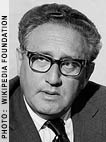
Henry Kissinger

Henry Kissinger

By JOSEPH FITSANAKIS| intelNews.org |
The government of the United States secretly helped France expand its nuclear arsenal, in order to promote its rivalry with Britain, according to newly declassified documents. The clandestine assistance to France, which tested its first nuclear bomb in Africa in 1960, began during the Richard Nixon administration, and was actively directed by Henry Kissinger, Nixon’s senior National Security Advisor. The documents, which were obtained by researchers at the George Washington University and the Woodrow Wilson International Center for Scholars, include a 1973 memorandum authored by Kissinger, in which he writes: “We want to keep Europe from developing their unity as a bloc against us. If we keep the French hoping they can get ahead of the British, this would accomplish our objective”. Toward that goal, the US ought to provide the French with information that will make them “drool but doesn’t give [them] anything but something to study for a while”. By doing so, Washington would be able to force Britain to stop “behaving shitty” and conform to American foreign policy objectives: “if they know we have another option, they might buck up”, writes Kissinger. Read more of this post

News you may have missed #523

  • Archbishop of Canterbury branded ‘subversive’ by MI5. A senior officer of MI5, Britain’s domestic intelligence agency, labeled Rowan Williams ‘a subversive’ in the 1980s, over his involvement with a group of leftwing campaigners.
  • Pakistan ambassador defends arrest of bin Laden informants. Pakistan Ambassador to the United States Husain Haqqani has defended his country’s decision to round up more than 30 people, some of whom may have helped US intelligence track down Osama bin Laden. Meanwhile, the US government is still bankrolling the Pakistani intelligence services. No changes there.
  • US weighs harsher penalties in wake of CIA/FBI hacker attacks. Under a new White House proposal, the 10-year maximum sentence for potentially endangering national security would double, and so would the five-year sentence for computer thefts up to $5,000. Also, the one year maximum for accessing a government computer —either to deface it or download an unimportant file— could become a three-year sentence.

Chinese telecoms manufacturer denies spying claims (again)

Huawei HQ

Huawei HQ

By IAN ALLEN| intelNews.org |
Huawei Technologies is one of China’s fastest-rising corporations. Founded in 1988 to import Western office telephone systems to China, the company today has become one of the country’s leading exporters, producing all kinds of hi-tech communications hardware equipment, ranging from routers to cell towers and undersea cables. But, as intelNews has indicated on several instances, Huawei’s export growth has been hampered in recent years by widely circulated suspicions that the company maintains close ties to the Chinese military and intelligence establishments. In 2009, the Australian Security Intelligence Organisation (ASIO) investigated one of Huawei’s Australian-based subsidiaries for links to Chinese intelligence operations. In the following year, the Indian government barred the company from operating in India, citing its allegedly “strong links with the Chinese military”. In August of 2010, several American senators called for an investigation into a proposed collaboration between Huawei and US-based Sprint-Nextel, arguing that the Chinese hardware manufacturer is “effectively controlled by China’s civilian and military intelligence establishment”. Further controversy erupted in the United States in February of this year, when another group of American Congress members accused Huawei of having supplied telecommunications equipment to Iran and the Afghan Taliban. The controversy around Huawei, which currently employs over 110,000 people in China and beyond, centers partly on its founder and chief executive owner, Ren Zhengfei. A former Director of the People’s Liberation Army’s Engineering Corps, Zhengfei founded Huawei a few years after retiring from his government job. His critics claim that he never truly retired from the PLA, and that he maintains routine links with the Communist Party of China, of which he is a member, as well as Chinese military intelligence. Read more of this post

News you may have missed #522 (European Union edition)

News you may have missed #521 (Israel edition)

  • Lebanese officer gets 20 years for spying for Israel. Mansour Diab’s sentence marks the first time a Lebanese officer was convicted of spying for Israel. Meanwhile, Lebanon’s militant Shiite group Hezbollah has arrested several of its own members on suspicion of spying for Israel. Last weekend the Kuwaiti daily Al-Rai al-Aam reported that the group “was dumbfounded over the Israeli infiltration”, which appears to have been substantial.
  • Israel pressures US to temporarily release jailed spy. Several Israeli leaders on Sunday urged the United States to allow jailed Jewish-American spy Jonathan Pollard to attend his father’s funeral, after he was not granted permission to join him at his bedside before he died.
  • Israel seeks prisoner exchange for Ilan Grapel. Israel is pursuing a prisoner exchange for Ilan Grapel, a 27-year-old American-Israeli dual citizen, who was arrested by Egyptian state security officers at his downtown Cairo hotel last Sunday on charges of spying for Israeli intelligence. Meanwhile, both the US and Israel insist Grapel is no spy.

US Senate to review allegations CIA tried to smear professor

Juan Cole

Juan Cole

By IAN ALLEN | intelNews.org |
The Intelligence Committee of the United States Senate will review allegations, made on Friday by a former CIA officer, that the spy agency tried to gather derogatory information about an American university professor who is critical of the ‘war on terrorism’. According to its chairwoman, Senator Dianne Feinstein, the Committee may “take further action”, depending on its preliminary findings. The allegations surfaced last Friday in an article by New York Times reporter James Risen. Acting on a tip by an unnamed source, Risen spoke to former CIA officer Glenn L. Carle, who confirmed that the Agency “at least twice” displayed an interest in gathering discrediting information about University of Michigan history professor Juan Cole. Dr Cole, who specializes in Middle Eastern history and speaks fluent Arabic, Persian, and Urdu, has been consistently critical of US foreign policy in the Middle East through his writings on his influential blog, Informed Comment. Carle, who made the allegations to The New York Times, retired from the CIA in 2007, after a career that spanned two decades in the Agency’s National Clandestine Service. In the last few years of his public service, Carle was a senior counterterrorism official at the US National Intelligence Council, which operates under the Office of the Director of National Intelligence. Read more of this post

News you may have missed #520

  • CIA director returns from Pakistan empty-handed. CIA Director Leon Panetta’s surprise visit to Pakistan last week yielded little, according to US officials. Panetta bypassed the protocol of first meeting with the president and prime minister, and instead met with Pakistan’s military and intelligence directors.
  • Chinese spying devices found in Hong Kong cars. A Hong Kong newspaper has alleged that the Chinese authorities have been secretly installing spy devices on all dual-plate Chinese-Hong Kong vehicles since July of 2007. Photographic evidence is here.
  • NSA releases over 50000 pages of documents. The US National Security Agency has announced that it has declassified and released to the US National Archives and Records Administration over 50,000 pages of historic records, covering a time-frame from before World War I through the 1960s.

News you may have missed #519

  • Australian ex-spy wins right to compensation. The former spy, known only as FXWZ, worked for the Australian Security Intelligence Organisation for almost 15 years before leaving it in 1979. Now at 67, he has won the right to compensation claiming that his work for ASIO induced a mental disorder.
  • Eritrea releases UK citizens detained for espionage. The four British men, two of whom are former Royal Marines, were arrested in Eritrea last December on suspicion of espionage, after they were caught in possession of arms including 18 different types of snipers, ammunition and night vision equipment. They have been released after a months-long diplomatic row between Eritrea and Britain.
  • Pakistan to deport US national suspected of spying. Twenty-seven year-old Matthew Craig Barrett has been arrested for allegedly scouting nuclear facilities near the Pakistani capital Islamabad, and is expected to be deported soon.

Massive IMF cyberattack ‘was state-backed’, say sources

International Monetary Fund seal

IMF seal

By JOSEPH FITSANAKIS | intelNews.org
A massive and sophisticated cyberattack that targeted the computer systems of the International Monetary Fund last month was “linked to a foreign government”, according to sources familiar with the incident. The IMF, an international institution which oversees financial crises around the world, revealed the security breach in an internal email sent last week, but has yet to make a public announcement about the incident. Although the cyberattack was not publicly announced, it was revealed last weekend by The New York Times, which cited a “security expert […] familiar with the incident”. The paper notes that IMF’s computer databases function as “a repository of highly confidential information about the fiscal condition of many nations”, and that they contain “potentially market-moving information”. British daily The Independent adds that “internal political opponents and foreign intelligence services could […] find [in the IMF databases] explosive information about government dealings with the fund”. Intriguingly, the attack occurred in the weeks prior to the arrest of the Fund’s Director, Dominique Strauss-Kahn, who was detained on American soil on charges of sexually assaulting a female worker at his luxury New York hotel. Read more of this post

News you may have missed #518

  • Pakistan to intensify intel collaboration with China. Pakistan has assured China of full co-operation in providing intelligence about the activities of the East Turkestan Islamic Movement (ETIM), which aims to separate Xinjiang, an autonomous region, from China.
  • US spy community launches ‘Analytical Olympics’. This new competition for analysts to see who makes the best predictions, was outlined in a recent report by the US National Research Council, which suggests practical ways to apply insights from the behavioral and social sciences to the intelligence community.
  • UAE mercenaries say they have no Blackwater contacts. Michael Roumi, president of Reflex Responses, a company training foreign mercenary troops for the United Arab Emirates, has told the US State Department and members of Congress that Erik Prince, the former head of the security firm Blackwater Worldwide, plays no role in operating the business.