US political operative convicted for illegal lobbying has CIA links, newspaper claims
April 12, 2021 Leave a comment
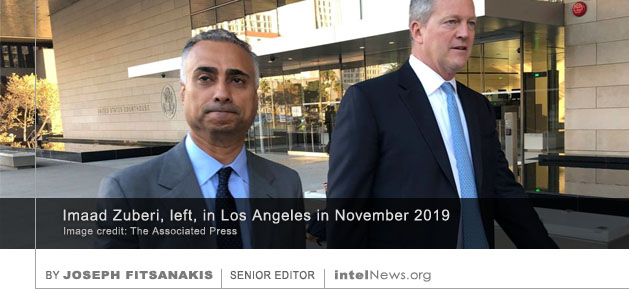
A HIGH-FLYING AMERICAN political operative, who was convicted earlier this year for operating as an unregistered foreign agent, violating campaign-finance laws and large-scale tax-evasion, may have been an informant for the United States Central Intelligence Agency, according to a new report. In February of this year, a court in the US state of Virginia sentenced Imaad Zuberi, a 50-year-old Pakistani-born entrepreneur, to 12 years in prison, for —among other things— lobbying US politicians on behalf of foreign governments, giving illegal financial donations to both American political parties, hiding sources of income from the Internal Revenue Service, and obstructing justice. In addition to his long prison sentence, he is required to pay the US government nearly $18 million in back taxes and fines.
Prior to his conviction, Zuberi was mostly known as a high-level political fundraiser and donor, who had contributed millions to the election campaigns of both Democratic and Republican politicians, including those of Donald Trump, Barack Obama, Hillary Clinton and Joe Biden. After he was arrested and criminally charged in October of 2019, Zuberi quickly confessed to working as a foreign agent and hiding his lobbying activities from the US government. Among his clients were, according to the Associated Press, the governments of Sri Lanka and Turkey, as well as eastern European oligarchs with alleged ties to the Kremlin. According to government prosecutors, Zuberi would receive money from foreign government officials and tycoons in order to introduce them to influential American political figures.
In March of this year, Zuberi’s links to the CIA were discussed in a detailed account of his case by SpyTalk‘s veteran intelligence editor Jeff Stein. After reviewing “confidential case information” and speaking to intelligence insiders, Stein concluded there were “strong suggestions” that Zuberi “may indeed have carried out extremely sensitive operations against major U.S. adversaries for the CIA over the past 15 years”. Stein alleges that, among other things, “Zuberi paid off foreign politicians on the CIA’s behalf” in order to sabotage a foreign oil project by “a major US adversary”.
According to The Wall Street Journal, Zuberi’s legal team is now preparing to challenge his prison sentence in an appeal that will rest primarily on his alleged work for the CIA, detailed by Stein. The Journal claims to have seen Zuberi’s legal filing, which suggests that he has cooperated with the CIA for over a decade. Based on court documents, and sources that the paper described as being “familiar with the businessman’s defense”, it appears that Zuberi’s began cooperating with the CIA as an informant. Eventually, however, his role “grew to involve more formal tasks and missions”, according to the article. The paper did not elaborate on the nature of Zuberi’s alleged work for the spy agency.
The article claims, however, that Zuberi’s alleged links with the CIA were discussed at length during a closed-door hearing in court, under a law that is used in rare instances to protect government-sanctioned intelligence sources and methods. Since that time, Zuberi’s legal team has allegedly secured the assistance of two former CIA officials, who are willing to testify as witnesses in his appeal. The Wall Street Journal said it contacted the CIA for comment, but was told to reach out to the Department of Justice. When contacted by the paper, the Department of Justice said it had no comment to make on Zuberi’s case.
► Author: Joseph Fitsanakis | Date: 12 April 2021 | Permalink



















High-security trial of neo-Nazi group that wanted to spark civil war begins in Germany
April 14, 2021 Leave a comment
AMIDST EXTREMELY TIGHT SECURITY, the trial of 12 members and supporters of a secretive neo-Nazi group that planned to destabilize society and spark a nationwide civil war has begun in the German city of Stuttgart. According to the indictment, the goal of the group, which calls itself “Gruppe S”, was to “shake and ultimately topple the state and social order” in Germany, in order to “spark a civil conflict”.
In accordance with German law, the accused have been identified in the media by their first names and last name initials only. All are German citizens, between the ages 32 and 61. It is worth noting that one of them is a police officer in the state of North Rhine-Westphalia. He is accused of supporting the group by offering €5,000 (nearly $6,000) for them to purchase weaponry in the illicit market. Another member of the group, who has not been arrested and remains at large, is being tried in absentia.
According to authorities, Gruppe S members had around 30 firearms in their possession, which they were using to train in preparation for war. All firearms were reportedly unlicensed. Shortly prior to their arrest in February of last year, Gruppe S members were reportedly preparing to purchase a Kalashnikov assault rifle and at least one Uzi submachine gun, as well as thousands of rounds of ammunition and several hand grenades.
It is believed that the investigation that led to the arrest of Gruppe S members begun after an informant came forward and alerted the authorities. This person is now believed to be the government’s chief witness, and is living under police protection. The trial is being conducted inside the Stammheim super-maximum security prison complex in Stuttgart, which is the same prison that housed the leading members of the Red Army Faction urban guerrilla group in the 1970s. The Gruppe S trial is scheduled to conclude in August.
► Author: Joseph Fitsanakis | Date: 14 April 2021 | Permalink
Filed under Expert news and commentary on intelligence, espionage, spies and spying Tagged with Germany, Gruppe S, lawsuits, neo-Nazis, News, rightwing extremism