Britain knew of Saudi plan to target journalist, warned Saudis against it

Jamal KhashoggiBritish intelligence had prior knowledge of a plot by the Saudi government to target Jamal Khashoggi, the dissident journalist who was killed in the hands of Saudi intelligence officers in Istanbul on October 2, and allegedly warned Riyadh not to proceed with the plan, according to a report. Khashoggi was a former Saudi government adviser who became critical of the kingdom’s style of governance. He is believed to have been killed by a 15-member Saudi hit squad while visiting the Saudi consulate in Istanbul. He went there for a scheduled appointment in order to be issued a document certifying his divorce from his former wife in Saudi Arabia. After vehemently denying any role in Khashoggi’s killing, the Saudi government admitted last week that the journalist was killed while inside the Saudi consulate in Istanbul. It has pledged to punish those responsible and reform the Kingdom’s intelligence services. But critics accuse Riyadh of ordering the dissident’s murder.

Now a new report claims that Britain’s external intelligence agency, the Secret Intelligence Service (MI6), was aware of a plot by the Saudi government to kidnap Khashoggi in order to silence him. British newspaper The Sunday Express says it has evidence from “high ranking intelligence sources” that MI6 was in possession of communications intercepts containing conversations about Khashoggi. The conversations were between Saudi government officials and officers of the General Intelligence Directorate (GID), the Kingdom’s primary spy agency. In the intercepts, a member of the Saudi royal family is allegedly heard giving orders for the GID to kidnap Khashoggi from Turkey sometime in early September. He also instructs the GID to secretly transport the dissident journalist to Saudi soil where he could be interrogated. During the conversation, a discussion took place about the possibility that Khashoggi would physically resist his abductors. At that point in the conversation, the high ranking intelligence source told The Express, the royal family member “left the door open for alternative remedies […] should Khashoggi be troublesome”.

The paper reports that MI6 “became aware” of the arrival of a 15-member Saudi hit squad in Istanbul on October 1, a day before Khashoggi went missing. According to the paper’s source “it was pretty clear what their aim was”, so MI6 contacted the GID directly and warned the Saudi spy agency to “cancel the mission”, said the source. However, the source added, “this request was ignored”.  On October 10, The Washington Post, the newspaper that employed Khashoggi, said that American intelligence agencies had evidence that the Saudi royal family tried to lure The Washington Post journalist Jamal Khashoggi back to Saudi Arabia, in order to capture him.

Author: Joseph Fitsanakis | Date: 29 October 2018 | Permalink

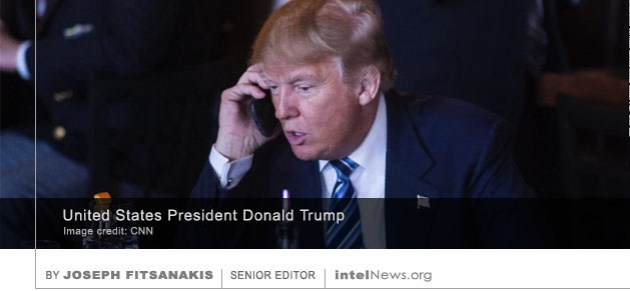
Trump’s use of unsecured iPhone worries White House officials

Donald TrumpOfficials in the White House are concerned about President Donald Trump’s insistence on using an unsecured iPhone to communicate with friends and associates, despite warnings that foreign spies may be listening in. Prior to being elected president, Trump used an Android phone, made by Google, which the NSA advised him to abandon due to security concerns. That is when he switched to using iPhones. Since his election to the presidency, Trump has routinely used three iPhone cell phones. He uses one of them to access a limited list of authorized applications, including Twitter. He uses the second iPhone for phone calls, but cannot use it to send texts, take pictures, or download and install applications. Both of these iPhones have been vetted and secured by the National Security Agency (NSA).

But The New York Times said on Wednesday that, despite the advice of the NSA, the US president continues to use a third iPhone, which is his personal device. The newspaper cited “current and former American officials” who said that the president’s third iPhone has not been secured by the NSA, and is thus “no different from hundreds of millions of iPhones in use around the world”. Trump uses that third iPhone to call many of his old friends and associates. The president has been repeatedly warned, sources said, to abandon the use of his unsecured third iPhone. Moreover, US intelligence agencies have confirmed that Chinese, Russian, and possibly other spy agencies have been “routinely eavesdropping” on the US president’s calls made on his personal iPhone.

To some extent, Trump has heeded the advice of his intelligence agencies in recent months and has begun to rely on his secure White House landline to make important calls, thus avoiding cell phones altogether. But he refuses to give up use of his iPhones, despite repeated warnings by the NSA, sources told The Times. They added that “they can only hope [Trump] refrains from discussing classified information when he is on them”. The president’s use of unsecured phone devices adds to what sources described as “frustration” with his “casual approach” to communications security. In July of this year, Nada Bakos, a 20-year veteran of the Central Intelligence Agency, said in an editorial that President Trump’s “Twitter feed is a gold mine for every foreign intelligence agency”. The CIA veteran described Trump’s use of social media is too impulsive and potentially dangerous from a national-security perspective.

Author: Joseph Fitsanakis | Date: 25 October 2018 | Permalink

French government report says thousands approached by Chinese spies on LinkedIn

LinkedInA French government report warns of an “unprecedented threat” to security after nearly 4,000 leading French civil servants, scientists and senior executives were found to have been accosted by Chinese spies using the popular social media network LinkedIn. The report was authored by France’s main intelligence agencies, the General Directorate for Internal Security (DGSI) and the General Directorate for External Security (DGSE). According to the Paris-based Le Figaro newspaper, which published a summary of the classified report, the two intelligence agencies presented it to the French government on October 19.

The report describes Chinese efforts to approach senior French scientists, business executives, academics and others, as “widespread and elaborate”, and warns that it poses an “unprecedented threat against the national interests” of the French state. It goes on to state that nearly 4,000 carefully selected French citizens have been approached by Chinese intelligence operatives via the LinkedIn social media platform. Of those nearly half, or 1,700, have leading posts in French industry, while the remaining 2,300 work in the public sector. In their totality, those targeted are involved nearly every area of industry and government administration, including those of nuclear energy, telecommunications, computing and transportation, said the report. According to Le Figaro, those targeted were approached online by Chinese spies who employed fake identities and identified themselves as headhunters for Chinese corporations, think-tank researchers or consultants for major companies. They then invited targeted individuals to all-expenses-paid trips to China for conferences or research symposia, or offered to pay them as consultants.

The DGSI-DGSE report concludes that most of those targeted displayed shocking levels of “culpable naivety” and a “completely insufficient” awareness of online espionage methods. To address this, French intelligence agencies have produced guidelines on detecting and evading attempts at recruitment or luring from intelligence operatives using social media, said Le Figaro. French civil servants are now being informed of these guidelines through a concerted campaign by the French intelligence community, said the paper. The report, however, did not say whether similar efforts were taking place in the French private sector.

Author: Joseph Fitsanakis | Date: 24 October 2018 | Permalink

Russian espionage reaching ‘intolerable levels’ say Swiss officials

Jean-Philippe GaudinRussian espionage activities in Switzerland are increasing and are crossing long-established “red lines”, according to senior Swiss defense and intelligence officials who spoke at a news conference last week. The claims were made by Guy Parmelin, head of Switzerland’s Federal Department of Defense, and Jean-Philippe Gaudin, director of the Swiss Federal Intelligence Service (NDB). The two men spoke on Friday before reporters in Bern. Following the news conference, Gaudin spoke with reporters from the Reuters news agency.
Gaudin, who assumed the post of NDB director three months ago, told Reuters that Russian espionage activities in Switzerland have been increasing steadily in recent years. He refused to provide details, but said that “it is clear we have more activities than before”. Additionally, Moscow had more active spies in Switzerland than in previous years, said Gaudin. He refused to provide numbers, saying that he would “share that with [his] colleagues elsewhere and not with the media”. The NDB chief noted that Switzerland had always been a target of Soviet and Russian espionage because it hosts the headquarters of a large number of international and non-governmental organizations. However, what is different today, he said, is that Moscow is targeting Switzerland’s “sensitive infrastructure”, which is “a red line”. He did not provide further information. Speaking alongside Gaudin, Defense Minister Parmelin said that Russian espionage activities against Swiss national infrastructure “has reached intolerable levels”.

These allegations by senior Swiss government officials come a little more than a month after reports that Swiss and other Western intelligence agencies thwarted a plot by two Russians who tried to hack the computer systems of a Swiss government laboratory that investigates nuclear, biological and chemical weapons. The laboratory, located in the western Swiss city of Spiez, had been commissioned by the Organization for the Prohibition of Chemical Weapons to carry out investigations related to the poisoning of Russian double agent //Sergei Skripal// and his daughter Yulia in March of this year. It has also carried out probes on the alleged use of chemical weapons by the Russian-backed government of President Bashar al-Assad in Syria.

The Russian embassy in Bern rejected the accusations of espionage and called the allegations made by Gaudin, and Parmelin “absurd”.

Author: Joseph Fitsanakis | Date: 23 October 2018 | Permalink

Iran has clandestine missile factories in Lebanon, claims Israel’s ex-spy chief

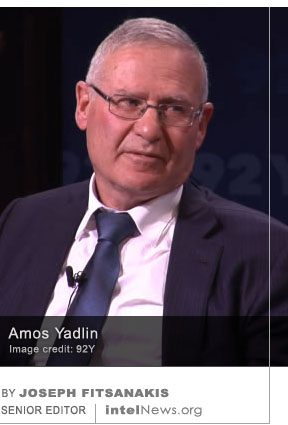
Amos YadlinThe government of Iran is smuggling parts for ballistic missiles to Lebanon, where they are secretly assembled in clandestine factories operated by the Shiite militant group Hezbollah, according to Israel’s former spy chief. For several months now, the international news agency Reuters has been claiming that Tehran has transported short-range ballistic missiles to secret bases controlled by pro-Iranian militias in Iraq. Iran’s move was aimed at “deterring attacks on [Iran’s] interests in the Middle East and to give it the means to it reginal foes”, said Reuters, citing “Iranian, Iraqi and Western sources”. Both Iran and Iraq denied the Reuters report.
In September, another report, citing “Western intelligence sources”, said that Iran had begun smuggling parts of short-range ballistic missiles to Hezbollah-controlled areas of Lebanon, using commercial flights. The report pointed to at least two flights that are suspected by Western intelligence agencies of having illegally transported precision weapon parts to Lebanon. Both flights were operated by Qeshm Fars Air, a company believed to be used by Iran’s Islamic Revolutionary Guard Corps (IRGC). Members of the IRGC, arguably the most loyal branch of the Iranian military, are selected on the basis of their ideological commitment to the defense of the 1979 Islamic Revolution. The two flights identified in the report departed from commercial and military airports in Tehran and landed in Lebanon after taking “uncharacteristic flight paths” through Syria, said Western intelligence sources.

On Sunday, Israel’s highest-circulation newspaper, Yedioth Ahronoth, carried an interview with the former director of the Jewish state’s Military Intelligence Directorate, Major General (ret.) Amos Yadlin. Yadlin, who also served as Israel’s military attaché in Washington, said that Iran used to hide ballistic missile parts in Syria, hoping to establish de facto missile bases there. However, Tehran’s plan suffered a major setback last May, said Yadlin, when Israel’s air force destroyed approximately 50 targets inside Syria, including —according to Yadlin— Iranian missile factories. Since then, he said, Tehran has been relocating its missile factories to Lebanon, believing that Israel will not attack its neighbor to the north. But Yadlin, who is a known supporter of left-of-center parties in Israel, and a proponent of the two-state solution to the Palestinian problem, argued that Israel should consider attacking Iran’s military factories in Lebanon. The Jewish state faces two choices, said Yadlin: “to strike [Lebanon], not necessarily by air”, or to allow Hezbollah to acquire precision missiles. “Israel will not accept this change”, he added.

Author: Joseph Fitsanakis | Date: 22 October 2018 | Permalink

Czech spy agency says it neutralized Hezbollah cyberespionage network

Czech Security Information ServiceOfficials in the Czech Republic have announced that the country’s spy agency headed an operation in several countries, aimed at neutralizing a cyberespionage network operated by the Lebanese militant group Hezbollah. Early last week, the Security Information Service (BIS), the primary domestic national intelligence agency of the Czech Republic, issued a short statement saying that it “played a big part in helping to identify and disconnect Hezbollah servers in the Czech Republic, other EU member states and the US”. But it did not elaborate. On Tuesday, however, ZDNet’s Zero Day security blog published more information from the Czechs about the BIS operation.
According to the BIS, its cyber security force discovered a number of servers located on Czech soil, which were “almost certainly” used by Hezbollah, the Shiite militant group that controls large swathes of territory in Lebanon. The servers were allegedly used in a wide-range cyberespionage operation that began in 2017 by a group of Hezbollah hackers based in Lebanon. It was there, said the BIS, where the command-and-control facilities of the operation were located. The servers located on Czech soil were used to download phone apps that contained malicious software. The hackers targeted individual phone users located mainly in the Middle East, according to the BIS, but other targets were in eastern and central Europe. It is believed that the majority of targets were Israeli citizens. Invariably, targeted individuals were approached online, mostly through fake Facebook profiles. Most of the targets were men, and the fake Facebook profiles featured pictures of attractive young women. After initial messages were exchanged via Facebook, the targets were convinced to download phone applications that would allow them to continue communicating with the ‘women’. These applications would install spyware on their phones, thus allowing Hezbollah hackers to capture the content of messages and calls made on the phones. The latter could also be used as eavesdropping devices.

According to BIS Director Michal Koudelka, the spy agency “played a significant role in identifying and uncovering the hackers’ system. We identified the victims and traced the attack to its source facilities. Hacker servers have been shut down”, he said. Koudelka added that some of the servers used by Hezbollah were located in other European Union countries and in the United States. These were shut down following a joint cyber operation by BIS and “partners”, said Koudelka, though he did not identify them.

Author: Joseph Fitsanakis | Date: 17 October 2018 | Permalink

Suicide bomb threat reportedly leads to evacuation of Iranian envoy to Turkey

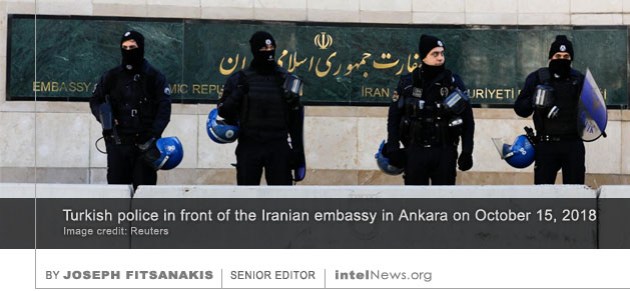
Iran embassy in AnkaraThere were conflicting reports yesterday in Ankara of an alleged evacuation of Iran’s ambassador to Turkey, following credible reports of a suicide bomb attack, possibly by the Islamic State. Several Turkish media outlets reported on Monday afternoon that authorities in Ankara had communicated an urgent intelligence warning to the Iranian embassy there of a possible suicide bomb attack. According to the reports, members of the Sunni militant group Islamic State of Iraq and Syria (ISIS) were behind the planned attack.
At 2 pm local time, reports stated that Iran’s ambassador to Turkey, Mohammad Ebrahim Taherian Fard, had been hurriedly evacuated from the Iranian embassy by Turkish security forces. By that time, all roads leading to the Iranian embassy, located next to the Ankara Hilton in one of the Turkish capital’s leafiest areas, had been cordoned off. Reporters from the Reuters news agency and Agence France Presse said that Turkish police and special forces had shut down Tahran Road, where the Iranian embassy is located, and were searching cars. Armed security forces had also surrounded the Iranian embassy, according to Reuters.

Strangely, however, reports of a possible bomb attack and of the ambassador’s evacuation were strongly refuted by the Iranian government, which denounced them as “sheer lies” and “complete fabrications”. In a statement published online on Monday afternoon, Iran’s Ministry of Foreign Affairs said that its diplomats in Ankara had noticed “an increased Turkish security presence” around the Iranian embassy. However, they continued working normally, as they were unaware of the reasons for the heightened security. They assumed that Turkish President Recep Tayyip Erdoğan was appearing nearby, said the statement. A statement by the Iranian embassy in Ankara said that consular employees were present at the embassy and that all scheduled services were being offered without interruption.

In the past month, the embassies of Iran in Paris and Athens have come under attack by Kurdish separatists and leftwing groups protesting against Tehran’s alleged oppression of ethnic minorities in the country. In the past, the Islamic Republic has been rarely targeted by ISIS, whose members dismiss Shiite Islam as a heresy. In June 2017, two attacks were carried out simultaneously in Tehran, targeting the Iranian parliament and the Mausoleum of Ruhollah Khomeini, founder of post-1979 Iran. In September of this year, ISIS claimed responsibility for an attack in Iran’s southwestern city of Ahvaz, which killed 25 soldiers and civilians during a military parade.

Author: Joseph Fitsanakis | Date: 16 October 2018 | Permalink

Pakistan removes judge who accused spy agency of trying to rig general election

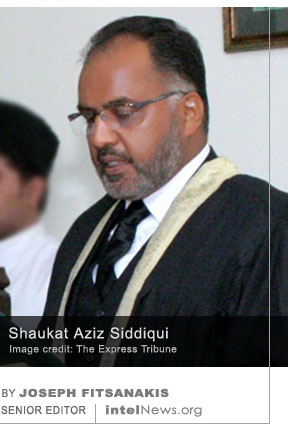
Shaukat Aziz SiddiquiThe government of Pakistan has dismissed a High Court judge who accused the country’s powerful intelligence agency of interfering with the judicial process in order to rig the outcome of last July’s general election. On July 25, the governing center-right Pakistan Muslim League – Nawaz (PML-N) was unseated by the conservative-centrist Pakistan Tehreek-e-Insaf, headed by former cricket star Imran Khan. The elections took place amidst a corruption scandal that saw Nawaz Sharif, former prime minister of Pakistan and leading member of PML-N, arrested on charges of fraud. Sharif was charged following the release of the so-called Panama papers, the massive data leak of documents belonging to Panamanian offshore firm Mossack Fonseca. The leak disclosed that Sharif and his family were owners of a large number of high-end properties in the United Kingdom and elsewhere around the world.
Shortly after the revelations, Sharif moved to Britain, where he and his children cared for his ailing wife. During his absence, he was sentenced in absentia to ten years in prison. Sharif chose to return to Pakistan on July 13, less than two weeks prior to the general election, and was arrested upon arriving in Islamabad. His supporters claim that the media spectacle surrounding his imprisonment severely hurt PML-N’s electoral performance. Last month, the High Court in Islamabad suspended Sharif’s prison sentence and ordered his release on bail, saying that the prosecution had failed to prove conclusively that the high-end properties in the UK belonged to him. Sharif’s release prompted renewed accusations of electoral rigging by PML-N supporters, who claim that Sharif could have been released from prison before the elections, and that the High Court deliberately withheld its decision until this month in order to hurt PML-N.

In July, Shaukat Aziz Siddiqui, a High Court judge, publicly added his voice to those claiming that Sharif’s arrest had been politically motivated. In a speech given before the Rawalpindi Bar Association, the High Court judge accused Pakistan’s powerful Inter-Services Intelligence Directorate (ISI) of exercising pressure on High Court judges in order to delay the decision to release Sharif on bail until after the general election. Justice Siddiqui’s charges made national headlines and prompted strong denials from the Pakistani military, which governs the ISI, and the Pakistan High Court. The latter launched an investigation of Justice Siddiqui, following a complaint issued by the country’s military leadership.

On Friday, the panel of judges that carried out the investigation on Justice Siddiqui, accused him of “conduct unbecoming of a judge of a high court” and recommended his removal from the High Court. On the same day, the Ministry of Justice of Pakistan announced that the country’s President, Arif Alvi, was “pleased to remove Mr. Justice Shaukat Aziz Siddiqui […] from his office with immediate effect”. The announcement did not elaborate on the precise reasons that led to Justice Siddiqui’s removal from the country’s High Court. Siddiqui’s firing marks the first time that a judge has been dismissed under an elected government in Pakistan. In the past, such incidents have occurred only under military dictatorships, which have ruled Pakistan for prolonged periods since the country’s independence in 1947.

Author: Joseph Fitsanakis | Date: 15 October 2018 | Permalink

US intelligence has evidence Saudis planned to capture missing journalist

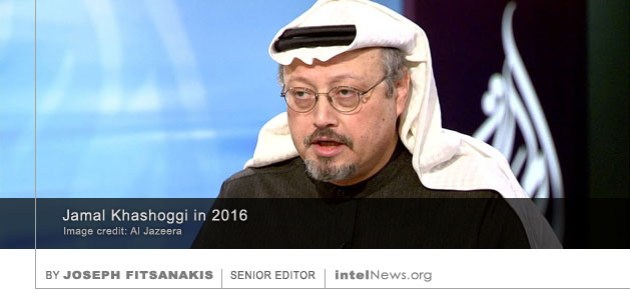
Jamal KhashoggiAmerican intelligence agencies have evidence that the Saudi royal family tried to lure The Washington Post journalist Jamal Khashoggi back to Saudi Arabia, in order to capture him, according to sources. Khashoggi, 59, is a Saudi government adviser who in 2015 became a critic of the kingdom’s style of governance. He moved to the United States, from where he began to criticize Saudi Arabia’s involvement in the civil war in Yemen, its support for the repression of political freedoms in Egypt, and other issues. He also joined the staff of The Washington Post and penned columns in which he criticized Saudi policies. He has been missing since Tuesday, when he visited the Saudi consulate in Istanbul. He went there for a scheduled appointment in order to be issued a document certifying his divorce from his former wife in Saudi Arabia.

Last Sunday, Turkish government officials said that Khashoggi was brutally murdered inside the Saudi consulate during his visit, probably on orders of the Saudi government. Turkish media reports said on Sunday that a 15-member Saudi team arrived in Istanbul shortly prior to Khashoggi’s visit to the consulate. The team, whose members carried diplomatic passports, tortured and then killed Khashoggi, said Turkish sources. They then dismembered his body and took it out of the consulate hidden inside a diplomatic vehicle. Saudi Arabia has denied the charges and said that Khashoggi left the consulate in Istanbul less than an hour after entering it on Tuesday afternoon.

On Wednesday, The Washington Post cited anonymous US officials in claiming that the Saudi royal family had devised an elaborate plan to lure Khashoggi back to Saudi Arabia in order to capture him. The paper said that US intelligence agencies are in possession of communications intercepts of exchanges between Saudi officials, in which the plan to lure Khashoggi back to Saudi Arabia is discussed. The Post also cited “several of Khashoggi’s friends” who said that in recent months he received phone calls from Saudi officials close to the kingdom’s controversial crown prince Mohammed bin Salman. The officials reportedly offered Khashoggi political protection from prosecution if he returned to Saudi Arabia. They also offered him high-level government jobs, said The Post. But Khashoggi was skeptical of the offers and rejected them, his friends said.

The paper also cited an anonymous “former US intelligence official” who said that the travel details of the 15-member Saudi diplomatic team that went to Istanbul on the day of Khashoggi’s disappearance “bore the hallmarks of [an extralegal] rendition” —a person’s unauthorized removal from one country and detention and interrogation in another. Turkey has said that the Saudi team arrived in Istanbul in two separate groups using private aircraft, and departed from the country at different times going to different destinations in the hours after Khashoggi’s disappearance.

Author: Joseph Fitsanakis | Date: 12 October 2018 | Permalink

Major suspect in Maduro assassination plot dies in captivity in Caracas

Nicolás MaduroA leading suspect in a failed attempt to kill Venezuelan President Nicolas Maduro using drones, has died in mysterious circumstances while being held by the country’s intelligence agency. The attack took place on August 4, 2018, in front of the Palacio de Justicia government complex in the Venezuelan capital Caracas. That afternoon, President Maduro was giving a nationally televised speech on the occasion of the 81st anniversary of the Bolivarian National Guard. An hour after the commencement of the outdoor ceremony, Maduro’s speech was interrupted by a loud noise that appeared to come directly from above, approximately 100 yards away from the podium. The noise turned out to have been a bomb affixed on a modified, commercially available drone. Moments later, another drone exploded after crashing into a building just two blocks northeast of where the Venezuelan president was standing. Seven members of the National Guard were injured in the attack.
President Maduro, who escaped unharmed, has blamed Colombia-based far-right extremists for the attack, and has named former Colombian President Juan Manuel Santos as their leader. But the Colombian government has rejected these allegations and has demanded to see proof. Throughout August, several people were arrested by Venezuelan authorities and charged with treason in connection with the assassination plot. Approximately 30 people have been named as participants in the plan. Among them was Fernando Albán, a 56-year-old critic of Maduro, who was serving as an opposition city councilor in Caracas. Althouth his arrest was announced on Friday, there were no reports about his fate over the weekend. On Monday, however, the government said that Albán had died after committing suicide. A subsequent report said that the 56-year-old had died after throwing himself out of a window located on the tenth floor of the headquarters of the Bolivarian Intelligence Service, where he was being held. Later on Monday, Nestor Luis Reverol, Venezuela’s Minister of Interior, said that Albán voluntarily jumped out of the window as he was being transported to court in order to be formally charged.

On Monday night, Venezuela’s Attorney General Tarek William Saab said during a television interview that Albán had been given permission to go to the bathroom and used it as an opportunity to kill himself. But critics of the government see the August 4 assassination attempt as a false-flag operation orchestrated by the Maduro administration to justify a new crackdown on the opposition. They claim that Albán was murdered and that it would have been impossible for him to throw himself out of a window given the security precautions that are in place at the Bolivarian Intelligence Service building. Meanwhile, Albán’s attorney, Joel Garcia, dismissed the Venezuelan government’s explanation of his client’s death as “totally false” and doubted that he would have been allowed to go to the bathroom unaccompanied.

Author: Joseph Fitsanakis | Date: 10 October 2018 | Permalink

Russia claims ‘misunderstanding’ led to arrests of four spies in Holland

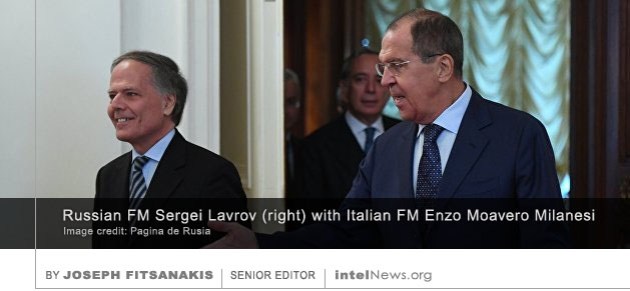
Sergei LavrovRussia’s minister of foreign affairs has downplayed the arrest and expulsion of four Russian military intelligence officers in Holland last April, saying that the incident was caused by a “misunderstanding”. Last Thursday, the US government named and indicted seven officers of the Main Directorate of the General Staff of Russia’s Armed Forces, known as GRU. The seven are alleged to have participated in cyber-attacks on international agencies, private companies and government computer networks in at least half a dozen countries around the world since 2015. Four of the men named last week were reportedly detained in April of this year while trying to hack into the computer network of the Organization for the Prohibition of Chemical Weapons (OPCW). Headquartered in The Hague, the OPCW oversees efforts by its 193 member states to detect and eliminate chemical weapons stockpiles around the world. In the past year, the OPCW has been probing the failed attempt to poison the Russian former double spy Sergei Skripal in England, which the British government has blamed on Moscow.

On Monday, Russia’s Minister of Foreign Affairs Sergei Lavrov dismissed Washington’s accusations against the GRU and said that the Dutch authorities had overreacted in detaining the four Russian officers in April. Following a meeting in Moscow with his Italian counterpart Enzo Moavero Milanesi, Lavrov said that the visit of the four GRU officers in Holland had been “customary”, adding that “there was nothing clandestine in it”. The GRU specialists were in Holland in order to secure computer servers used at the Russian embassy there. “They were not trying to hide from anyone once they arrived at the airport”, said Lavrov. They then “checked into a hotel and paid a visit to our embassy”, he added. Had they been engaged in espionage, the men would have taken strict precautions, said the Russian foreign affairs minister. They were eventually “detained by Dutch police without any reason or explanations, and were not allowed to contact our embassy”, said Lavrov. Eventually they were “asked to leave the country”, but it was “all because of a misunderstanding”, he concluded.

The Russian official did not address the information provided a series of photographs released by Holland’s Ministry of Defense, which show a car used by the four Russians at the time of their arrest in April. The photographs show that the car was equipped with WiFi antennas and transformers. A wireless server and batteries can also be seen in the photographs. Lavrov said that the allegations against the GRU were meant to draw attention to Russia and distract Western citizens from “widening divisions that exist between Western nations”.

Author: Joseph Fitsanakis | Date: 09 October 2018 | Research credit: S.F. | Permalink

Turkey claims Saudi dissident was killed, dismembered inside Saudi consulate

Jamal KhashoggiTurkish government sources have said that a former trusted aide of the Saudi royal family, who was shunned by Riyadh after criticizing Saudi policies, was murdered inside the Saudi Arabian consulate in Istanbul. Jamal Khashoggi, 59, is an American-educated former adviser to Saudi royals. He worked for years as an advisor to Prince Turki al-Faisal, one of Saudi Arabia’s most recognizable public figures who represented the Kingdom as ambassador to the United States and the United Kingdom. But in 2015, when Mohammad bin Salman, favorite son of Saudi Arabia’s King Salman, began to rise through the ranks of the royal family, Khashoggi became sharply critical of changes in the Kingdom’s style of governance. He moved to the United States, from where he began to criticize Saudi Arabia’s involvement in the civil war in Yemen, its support for the repression of political freedoms in Egypt, and other issues. Earlier this year, Khashoggi joined the staff of The Washington Post and penned columns in which he criticized Saudi policies.

In recent months, Khashoggi moved to Istanbul and planned to marry Hatice Cengiz, a local graduate student. Last Tuesday, in preparation for his wedding with Cengiz, Khashoggi went to the Saudi consulate in Istanbul on a prescheduled visit, reportedly to request a document certifying his divorce from his former wife in Saudi Arabia. The document was reportedly required under Turkish marital law. But The Washington Post columnist has not been seen since. On Sunday, Turkish government officials said that Khashoggi had been brutally murdered inside the Saudi consulate, probably on orders of the Saudi government. Turkish media reports said on Sunday that a 15-member Saudi team arrived in Istanbul shortly prior to Khashoggi’s visit to the consulate. The team, whose members carried diplomatic passports, tortured and then killed Khashoggi, said Turkish sources. They then dismembered his body and took it out of the consulate hidden inside a diplomatic vehicle.

On Sunday, Saudi Arabia denied the charges and said that Khashoggi left the consulate in Istanbul less than an hour after entering it on Tuesday afternoon. But Turkish officials, speaking anonymously to local media, said that the government had “concrete proof” and that the case would be solved soon through a series of public announcements. However, no accusations have been issued publicly and some doubt that Ankara has evidence to implicate the Saudi government in Khashoggi’s disappearance. Others wonder whether the Turkish government will wish to enter into an escalating diplomatic confrontation with the powerful Saudi royal family. The New York Times said late on Sunday that the Turkish government “was waiting until the investigation was complete” before making a full disclosure regarding Khashoggi’s disappearance. Meanwhile government representatives in the United States, a close ally of the Saudi government, said on Sunday that the Department of State “cannot confirm Mr. Khashoggi’s fate” and that it is “following the case”.

Author: Joseph Fitsanakis | Date: 08 October 2018 | Permalink

France freezes assets of Iranian spies in response to foiled terror attack in Paris

French Ministry for the EconomyFrance has seized the financial assets of two Iranian spies and frozen all assets belonging to the Iranian Ministry of Intelligence, in response to a foiled bomb attack in Paris, which the French government has blamed on Tehran. The alleged bomb attack was uncovered on June 30 of this year, when members of Belgium’s Special Forces Group arrested a married Belgian couple of Iranian descent in Brussels. The couple were found to be carrying explosives and a detonator. On the following day, German police arrested an Iranian diplomat stationed in Iran’s embassy in Vienna, Austria, while another Iranian man was arrested by authorities in France, reportedly in connection with the three other arrests.
All four individuals were charged with a foiled plot to bomb the annual conference of the National Council of Resistance of Iran (NCRI) that took place on June 30 in Paris. The NCRI is led by Mujahedin-e Khalq (MEK), a militant group with roots in radical Islam and Marxism. The MEK was designated as a terrorist group by the European Union and the United States until 2009 and 2012 respectively. But it has since been reinstated in both Brussels and Washington, reportedly because it provides the West with a vehicle to subvert the Iranian government. France, Germany and Belgium allege that the aborted bombing plot was an attempt by Iran to disrupt the close relations between the MEK and Western governments.

On Tuesday, Paris announced the seizure of assets of two of the men who were arrested in June and July. One is an accredited Iranian diplomat identified as Assadollah Asadi, who is believed to be an official-cover intelligence officer. The other man is Saeid Hashemi Moghadam, who was arrested by French authorities. He is believed to be an Iranian sleeper agent. All assets belonging to the Islamic Republic’s Ministry of Intelligence were also been frozen, effective immediately, it was announced. In a joint statement, the French ministers of foreign affairs, economics and the interior said that the move reflected the France’s “commitment to fight terrorism, in all its manifestations […], especially on its territory”. The statement added that “the extremely heinous act envisaged on our territory could not go without a response”.

The Iranian government has denied all connection to the alleged plot in Paris and has dismissed the incident a “false flag” operation staged by MEK in cooperation with Tehran’s “enemies at home and abroad”.

Author: Joseph Fitsanakis | Date: 04 October 2018 | Permalink

New clues may help locate lost intelligence files from 1938 French-British-Nazi pact

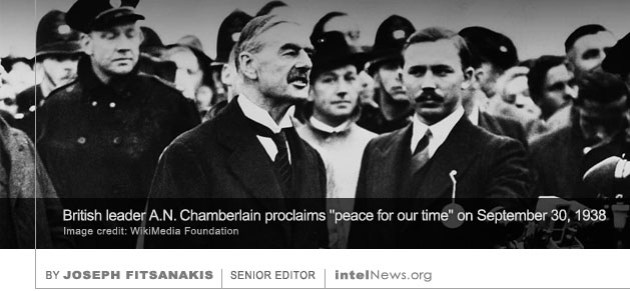
Neville Chamberlain Nearly 2,000 missing British intelligence files relating to the so-called Munich Agreement, a failed attempt by Britain, France and Italy to appease Adolf Hitler in 1938, may not have been destroyed, according to historians. On September 30, 1938, the leaders of France, Britain and Italy signed a peace treaty with the Nazi government of German Chancellor Adolf Hitler. The treaty, which became known as the Munich Agreement, gave Hitler de facto control of Czechoslovakia’s German-speaking areas, in return for him promising to resign from territorial claims against other countries, such as Poland and Hungary. Hours after the treaty was formalized, British Prime Minister Neville Chamberlain arrived by airplane at an airport near London, and boldly proclaimed that he had secured “peace for our time” (pictured above). Contrary to Chamberlain’s expectations, however, the German government was emboldened by what it saw as attempts to appease it, and promptly proceeded to invade Poland, thus firing the opening shots of World War II in Europe.
For many decades, British historians researching the Munich Agreement have indicated the absence of approximately 1,750 intelligence reports dating from May to December 1938. The missing files cover the most crucial period immediately prior and immediately after the Munich Agreement. They are believed to contain transcripts of German and other foreign diplomatic communications, which were intercepted by the Government Code and Cypher School (GC&CS), Britain’s signals intelligence agency at the time. In 1947, the documents were passed on to the GC&CS’s successor agency, the Government Communications Headquarters (GCHQ). But they subsequently disappeared, giving rise to numerous theories as to how and why. Some historians have theorized that the documents were deliberately destroyed by British officials shortly after the end of World War II. The move allegedly aimed to protect Britain’s international reputation and prevent a possible exploitation by the Soviet Union, which sharply criticized the West’s appeasement of Hitler in the run-up to the war. Another popular theory is that they were destroyed by senior civil servants connected to the Conservative Party —to which Chamberlain belonged— in order to prevent the opposition Labour Party from capitalizing on what many saw as a betrayal of British interests in September 1938 by the Conservative administration in London.

For a long time, the GCHQ’s official historians have strongly contested the view that the documents were deliberately destroyed. Now, according to The Independent newspaper, historians have found that the missing documents were still listed in GCHQ archive indexes in as late as 1968, a full 30 years after the Munich Agreement was signed. At that time it is believed that the files were temporarily transferred to another British government department in order to be used as references in an internal report about the Munich Agreement. It is very likely, some historians now say, that the documents were simply never returned to GCHQ. It is therefore possible that they may be stored in the archives of the Foreign and Commonwealth Office or the Ministry of Defence. This new clue, according to The Independent, substantially lessens the possibility that the documents may have been removed or destroyed for political reasons.

Author: Joseph Fitsanakis | Date: 01 October 2018 | Permalink

Swiss police saw Russian oligarch Abramovich as threat to security, files reveal

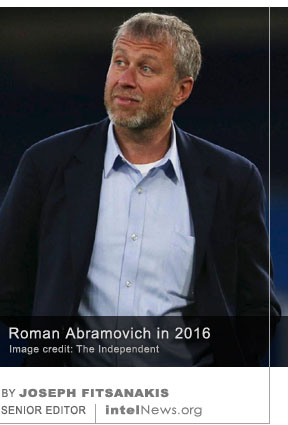
Roman AbramovichPolice in Switzerland cautioned that allowing the Russian billionaire Roman Abramovich to live there would threaten public security and damage the country’s reputation, according to files released this week. The Soviet-born Abramovich took advantage of Russia’s privatization laws in the early 1990s to gain considerable financial and political influence there. His friendship with Russia’s first post-Soviet President, Boris Yeltsin, was instrumental in his business career, and eventually placed him in close proximity to Russia’s current President, Vladimir Putin. Unlike many other oligarchs, Abramovich is believed to have remained close to Putin, despite living mostly in the United Kingdom in the past decade. The Russian oligarch has been staying in a mansion valued at close to $120 million in London’s exclusive suburb of Kensington. His lawyers have been renewing his British residence visa every six months.


However, the attempted assassination of Russian former spy Sergei Skripal earlier this year prompted the British government to intensify its scrutiny of Britain’s sizeable Russian expatriate community. London introduced tighter regulations that require Russian citizens applying to live in the UK to declare the source of their income in a far greater detail than previously. Soon after the new regulations were put in place, Abramovich’s lawyers withdrew his application to renew his British residency visa. Then, in May of this year, the Russian oligarch acquired Israeli citizenship. He has made it clear, however, that he does not intend to live in Israel. Instead, his legal team focused on an application for Swiss residency, which Abramovich first filed in the summer of 2016. In the application papers, Abramovich wrote that he intended to reside full time in Verbier, an Alpine village in the canton of Valais that is a popular holiday destination for celebrities and royalty.

A year later, following resistance and increasingly persistent questioning from the Swiss government, Abramovich’s legal team withdrew his residency application. Last February, when the Swiss press attempted to investigate the reasons behind the Swiss government’s reluctance, Abramovich’s lawyers secured an injunction forbidding the publication of information regarding his application to live in Switzerland. But the injunction was overturned late last week, and on Tuesday the Swiss media conglomerate Tamedia published some of the relevant documents. They include a letter from the Swiss Federal Police that strongly cautions against allowing the Russian-Israeli oligarch to resettle in Switzerland. The letter remarks that Abramovich has been repeatedly implicated in “suspicion of money laundering” and that the billionaire is “presumed [to have] contacts with criminal organizations”. Additionally, the letter states that Abramovich’s “assets are at least in part of illegal origin”. The letter concludes by strongly cautioning against allowing the oligarch to move to Switzerland, and argues that doing so would pose a “threat to public security” and be detrimental to the country’s international reputation.

The letter has raised eyebrows since its publication, because Switzerland is known for being highly welcoming of foreign billionaires while displaying minimal curiosity about the sources of their fortunes. Moreover, there are no known court rulings against Abramovich for money laundering or connections to organized crime. It is therefore presumed that the Swiss police report is based mostly on confidential informants and other informal sources. On Wednesday, Abramovich’s Swiss lawyer, Daniel Glasl, issued a statement saying that the Russian-Israeli magnate has never been charged with involvement in money laundering. He also reminded readers that his client has a blank criminal record.

Author: Joseph Fitsanakis | Date: 28 September 2018 | Permalink