Were Pakistani spies behind 2009 attack that killed seven CIA employees?

FOB ChapmanTwo recently declassified United States government documents suggest that Pakistani intelligence officers may have been behind a suicide attack that killed seven employees of the Central Intelligence Agency in Afghanistan. The attack took place at the Forward Operating Base Chapman, a US military outpost in Khost, Afghanistan. It was carried out by Humam al-Balawi, a Jordanian doctor who posed as a disillusioned member of al-Qaeda and had convinced his CIA handlers that he could lead them to the whereabouts of al-Qaeda’s deputy Emir, Ayman al-Zawahiri. During a scheduled visit to FOB Chapman on December 30, 2009, al-Balawi detonated a suicide vest, instantly killing himself and nine other people, including a Jordanian intelligence officer and seven CIA employees. The bloody incident, which marked the most lethal attack against the CIA in nearly three decades, was widely blamed on al-Qaeda and the Pakistani Taliban.

However, a set of newly released US State Department cables seem to suggest that Pakistani intelligence may have been behind the attack. The documents were released by George Washington University’s National Security Archive through a Freedom of Information Act request. One document, dated January 11, 2010, discusses the FOB Chapman attack in association with the Haqqani network, a Taliban-aligned Pashtun militant group that operates in Afghanistan but is headquartered in Pakistan. Western security observers have long considered the Haqqani network to be a paramilitary arm of Pakistan’s Inter-Services Intelligence (ISI) directorate. The January 11 State Department cable suggests that senior Haqqani network operatives met with their ISI handlers at least twice in the weeks prior to the FOB Chapman attack. Another cable, dated February 6, 2010, suggests that the ISI gave the Haqqani operatives $200,000 to step up attacks against Western forces in Afghanistan. A specific order was given at the meeting to carry out “the attack on Chapman [and] to enable a suicide mission by an unnamed Jordanian national”, presumably al-Balawi.

But an unnamed US intelligence official, who read the declassified documents, told the Associated Press news agency that the documents were “information report[s], not finally evaluated intelligence”. The material was thus “raw, unverified and uncorroborated”, said the official, and clashed with the broad consensus in the US Intelligence Community, which was that the attack was planned by al-Qaeda, not by the Haqqani network. The Associated Press contacted the Pakistani embassy in Washington, DC, about the National Security Archive revelations, but received no response.

Author: Joseph Fitsanakis | Date: 19 April 2016 | Permalink

Further arrests in Edward Lin spy case ‘possible’, says US official

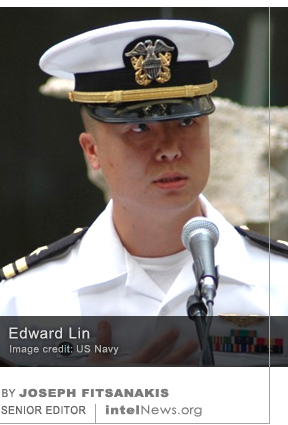
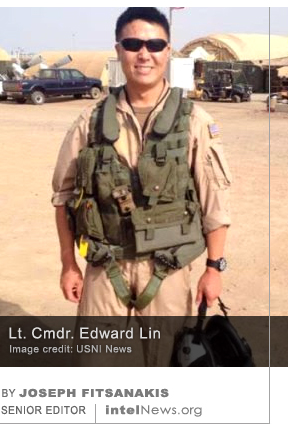
Edward LinAn American official has told Newsweek magazine that the possibility of further arrests in the espionage case of United States Navy flight officer Edward Lin should not be ruled out. Last Sunday, the US Navy reported the arrest Lt. Cmdr. Lin, who faces two counts of espionage and three counts of attempted espionage, among other charges. Aside from a three-page, heavily redacted charge sheet released by the Navy, almost nothing is known about this case. However, as intelNews opined earlier this week, there are several clues that point to the seriousness of the charges against Lin, and their potential ramifications for US national security, which are likely to be extensive.

On Thursday, longtime intelligence and security correspondent Jeff Stein wrote in Newsweek magazine that Lin appeared to have “scores of friends in sensitive places” in the US and Taiwan. That is not surprising, given that Lin served as the Congressional Liaison for the Assistant Secretary of the Navy, Financial Management and Comptroller, between 2012 and 2014. A cursory survey of Lin’s LinkedIn page, said Stein, shows endorsements by a senior commander at the US Naval Air Station at Guantanamo, Cuba, as well as the US Pacific Fleet’s senior intelligence analyst on Southeast Asia. Other endorsers include Congressional liaison officers for the US Navy, a Taiwanese military attaché, and a former official in Taiwan’s Ministry of Defense.

It is believed that Lin was arrested over eight months ago, but Stein says the investigation, which is being conducted jointly by the Naval Criminal Investigative Service and the Federal Bureau of Investigation is still underway. He quotes an unnamed “US official who asked for anonymity in exchange for discussing some details of the case” as saying that, given Lin’s extensive contacts in the US intelligence establishment, the possibility of further arrests in the case should not be ruled out. Lin is currently being held in the Naval Consolidated Brig in Chesapeake, Virginia.

Author: Joseph Fitsanakis | Date: 15 April 2016 | Permalink

Names of intelligence officials, agents, appear in Panama Papers

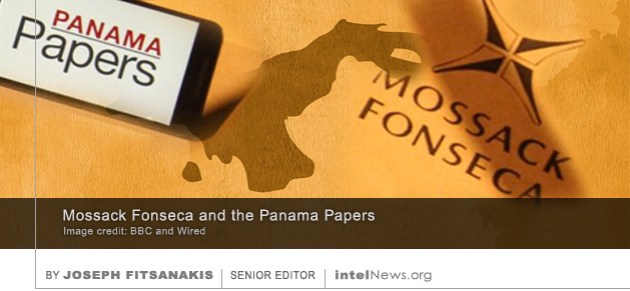
Panama PapersThe massive data leak of documents belonging to Panamanian law firm Mossack Fonseca has revealed the names of intelligence officials and agents form several countries, who employed front companies to conceal their financial activities. According to German newspaper Süddeutsche Zeitung, which was the initial recipient of the largest data leak in history last summer, the list of names includes intelligence officials from the Middle East, Latin America and Africa, as well as “close intermediaries of the [United States] Central Intelligence Agency”.

Referred to as ‘the Panama Papers’, the massive leak amounts to over 11.5 million internal files from Mossack Fonseca, one of the world’s most prolific registrars and administrators of shell companies in offshore locations. Throughout its history, the company has created more than 300,000 shell companies, most of them in offshore tax havens like the British Virgin Islands, Cyprus, or Guernsey. Its clients are offered the ability to incorporate a generic-sounding company and headquarter it in an offshore tax haven. In exchange for an annual fee, Mossack Fonseca provides the company with a sham director and shareholders, thus concealing the true owner and actual beneficiary of the business.

The Süddeutsche Zeitung said on Monday that senior intelligence officials from Rwanda and Colombia are listed as Mossack Fonseca customers, but did not report the names of the individuals. It did, however, single out the late Sheikh Kamal Adham, who was director of Saudi Arabia’s General Intelligence Directorate in the 1960s and 1970s. During his 14-year directorship of the GID, the agency became a leading intermediary between the CIA and Arab intelligence agencies, notably those of Egypt and Iraq. Sheikh Adham was also a personal friend of CIA Director George Bush, who was later elected US president.

According to the Süddeutsche Zeitung, Sheikh Adham is one of many individuals with close CIA links whose names appear in the Panama Papers. Another is Farhad Azima, an Iranian-born American businessman, who is rumored to have leased aircraft to the CIA in the 1980s. The American intelligence agency is said to have used the aircraft, which belonged to Azima’s Kansas City, Missouri-headquartered Global International Airways, to transport weapons to Iran. The secret transfers were part of what later became known as the Iran-Contra scandal, in which US officials secretly sold weapons to Iran in return for the release of American hostages held by Iran-linked groups in the Middle East. The funds acquired from these weapons sales were then secretly funneled to the Contras, a medley of anti-communist paramilitary groups fighting the Sandinista-led government of Nicaragua.

Author: Joseph Fitsanakis | Date: 13 April 2016 | Permalink

Analysis: How serious is the Edward Lin spy case?

Edward LinFor the first time since 1985, when the Federal Bureau of Investigation broke the John Walker spy ring, an active United States Navy officer has been charged with espionage. On Sunday, the US Navy reported the arrest Lt. Cmdr. Edward C. Lin, who faces two counts of espionage and three counts of attempted espionage, among other charges. Aside from a three-page, heavily redacted charge sheet released by the US Navy, almost nothing is known about this case. However, there are several clues that point to the seriousness of the charges against Lin, and their potential ramifications for US national security, which are likely to be extensive.

Lin was a signals intelligence (SIGINT) specialist with the Navy, focusing on the airborne collection of maritime intelligence, mostly in the Pacific Ocean. Given that he is a naturalized citizen from Taiwan and speaks fluent Mandarin, it is almost certain that he was tasked with collecting SIGINT from targets in China and Taiwan. If that is so, then the prospect that Lin may have given classified information to Chinese or Taiwanese intelligence officers will be especially unsettling for Washington. Moreover, Lin is believed to have worked with some of the most advanced airborne intelligence-gathering platforms in the Pentagon’s arsenal, including the MQ-4C Triton, the P-3C Orion, the P-8A Poseidon, and the EP-3 Aries II, which is arguably the most advanced maritime surveillance aircraft ever used by the US Navy.

It also appears that Lin had a relatively senior position in the US Navy’s chain of command. He was a departmental head in the Navy’s Patrol and Reconnaissance Group, overseeing the work of over 7,000 sailors. Prior to that post, he served as the Congressional Liaison for the Assistant Secretary of the Navy, Financial Management and Comptroller. Lin’s critical positions in the chain of command may explain why US authorities arrested him nearly eight months ago in absolute secrecy and been holding him in pre-trial confinement without releasing any information to the media until last weekend. This level of secrecy in a national security investigation is rare and possibly points to the extent of damage assessment that needed to be completed following Lin’s arrest. Read more of this post

Turkey arrests senior official for selling weapons plans to US-based firm

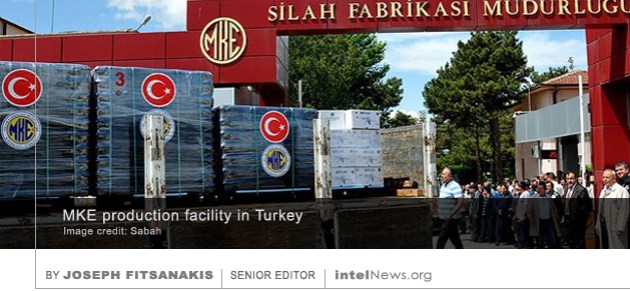
MKE TurkeyA senior official of Turkey’s state-run weapons manufacturer has been arrested on espionage charges, after he was caught selling weapons blueprints to the employee of an arms firm based in the United States. The official was named by Turkish authorities as Mustafa Tanriverdi, the general manager of one of Turkey’s largest weapons production facilities, located in the town of Kirikkale, 50 miles east of Turkish capital Ankara. Tanriverdi is reportedly employed by the Mechanical and Chemical Industry Corporation (MKE), a government-run manufacturing firm that provides much of the Turkish Armed Forces’ weaponry. The company also has a growing list of international buyers, which includes nearly 30 foreign governments.

Tanriverdi was arrested on Thursday by undercover members of Turkey’s security services, as he was leaving a restaurant in Ankara. Moments earlier, he had sold design blueprints and production plans for two MKE-manufactured weapons. According to Turkish authorities, the plans related to two Turkish-designed weapons, namely the MPT-76 infantry rifle and the MP-5 submachine gun. Tanriverdi is accused of having sold the information on the weapons for nearly $500,000 to an unnamed man working for a Turkish-owned weapons manufacturer that is based in the US.

Reports in the Turkish media said the man who purchased Tanriverdi’s documents is a US-based Turkish business executive. But his name remains unknown, as he is identified only as K.K. in news reports. Allegedly, K.K. had notified Turkish authorities about Tanriverdi and was himself part of a sting operation aimed at apprehending the Turkish official. The latter has now been charged with espionage, disloyalty to the Turkish state and exploiting state secrets for financial gain. He is said to have told the authorities that he did not sell classified information but was instead striking a “legitimate business agreement” with a man he thought was a weapons trader working for Turkey.

Author: Joseph Fitsanakis | Date: 12 April 2016 | Permalink

Analysis: The security implications of the Panama Papers

First Post HAside from their immediate shock value, the Panama Papers reveal the enormous extent of tax evasion on a worldwide scale. This unprecedented phenomenon is inextricably tied with broader trends in globalized finance-capitalism that directly threaten the very survival of the postwar welfare state. National intelligence agencies must begin to view offshore tax evasion as an existential threat to the security of organized government and need to augment their economic role as part of their overall mission to protect and secure law-abiding citizens.

THE BACKGROUND OF THE LEAK

The source of the Panama Papers leak —the largest in history— is apparently a single individual who contacted the widely respected German newspaper Süddeutsche Zeitung over a year ago. After receiving assurances that his or her anonymity would be safeguarded, the source proceeded to provide the paper with what eventually amounted to over 11.5 million files. They include company emails, banking transaction records, and files of clients that span the years 1977 to 2015. The source asked for no financial compensation or other form of reimbursement in return, saying only that he or she wanted to “make these crimes public”.

Faced with the largest data leak in recorded history, the Süddeutsche Zeitung reporters contacted the International Consortium of Investigative Journalists (ICIJ), which is the international arm of the Washington-based Center for Public Integrity. With ICIJ acting as an umbrella group, the German reporters were eventually joined by 370 journalists representing 100 news outlets from 76 Q Quotecountries. On Sunday, following a year-long analysis of the data, the reporting partners began publishing revelations from the Panama Papers, and say they will continue to do so for several days to come.
THE ROLE OF MOSSACK FONSECA

The documents are from the internal records of Mossack Fonseca, a law firm headquartered in Panama City, Panama, with offices in 42 countries. The company is one of the world’s most prolific registrars and administrators of shell companies in offshore locations. It has created more than 300,000 shell companies throughout its history, most of them in offshore tax havens like the British Virgin Islands, Cyprus, or Guernsey. Its clients are offered the ability to incorporate a generic-sounding company and headquarter it in an offshore tax haven. In exchange for an annual fee, Mossack Fonseca provides the company with a sham director and shareholders, thus concealing the true owner and actual beneficiary of the business.

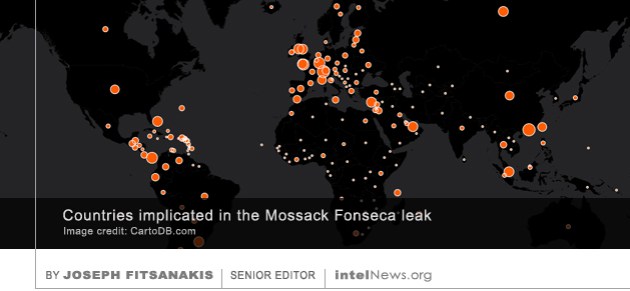
The power of the leaked documents is that they reveal the actual owners of 214,000 offshore shell companies managed by Mossack Fonseca. The long list of names includes dozens of current and former heads of state, as well as hundreds of politicians, public figures and celebrities. Many of these individuals have failed to declare their earnings from their shell companies in their annual tax Q Quotestatements, which means they have not been paying taxes in their country of citizenship or residency. Thus, there are now thousands of Mossack Fonseca clients in over 100 countries who are preparing to face the legal consequences of tax evasion.

SECURITY IMPLICATIONS

Equally importantly, however, the leaked documents reveal that Mossack Fonseca’s clients appear to include at least 33 individuals and companies that are involved in organized crime or have close contacts with terrorist organizations. This sheds light on the increasingly disappearing line that once separated illicit activities such as tax avoidance and tax evasion, from money laundering, organized crime and terrorism. This phenomenon is assisted by unscrupulous companies like Mossack Fonseca, which act as anonymizing platforms for wealthy celebrities, criminals and terrorists alike.

The leak also shows the extent to which national governments have been unable to stem the tide of unfettered finance-capitalism, which today threatens the stability and cohesion of developed and developing economies alike. Moreover, the sheer scale of offshore capital funds, which, according to one expert, amount to as much as $32 trillion, threaten the economic security of nation states and must be viewed as an existential threat to the ability of states to fund public expenditures though taxation. The political arrangement that led to the creation of the postwar welfare state is today being directly threatened by the inability or unwillingness of organized states to monitor the largely unregulated flow of capital to offshore tax havens.

Today, entire economies, including much of southern Europe, the Balkans, as well as Latin America, are crumbling under the fiscal weight created by mass-scale tax evasion and organized crime. Organized criminals are now actively working closely with the banking sector, thus creating even more opportunities for money laundering and other financial illegality on an unprecedented scale. The Süddeutsche Zeitung revelations demonstrate that the line that separates legitimate economic activity from the rogue underbelly of global capitalism is exceedingly thin. It is high time that Western intelligence agencies viewed this worrying development as an asymmetrical threat against the security of law-abiding societies and began dealing with offshore tax havens with the same intensity that they have displayed against terrorist safe havens since 9/11.

Author: Joseph Fitsanakis | Date: 04 April 2016 | Permalink
Russia claims arrest of alleged CIA-trained spy

Lubyanka SquareThe Russian government says it has arrested a senior Ukrainian intelligence officer, who was allegedly trained by the United States Central Intelligence Agency and tasked with infiltrating the Russian secret services. In a statement published on Thursday, Russia’s Federal Security Service, known as FSB, said the alleged infiltrator is a “senior level employee” of the SBU, the Security Service of Ukraine. The SBU is Ukraine’s primary counterterrorism and counterintelligence agency, with much of its output focused on the Russian Federation.
The FSB statement identified the Ukrainian man as Lieutenant Colonel Yuriy Ivanchenko, but did not release further information about his background and identity, nor did it specify the details of his activities in Russia. According to the Russians, Ivanchenko allegedly entered the country in recent weeks, ostensibly in order to visit family members who live in Russia. But his real goal, according to the FSB, was to make contact with Russian intelligence and infiltrate the country’s security structure. Moscow says that Ivanchenko had planned to pose as a willing spy, namely an employee of Ukrainian intelligence who was offering to provide information to Russia. He was not a genuine spy, however, but rather a ‘dangle’ —namely someone posing as a genuine spy, but who is in fact attempting to deceive a rival intelligence agency by knowingly giving it misleading or inaccurate information.

Moreover, the Russians claim that Ivanchenko was being jointly run by the SBU and the CIA, and that the American intelligence agency had trained him to pose as a ‘dangle’ in order to collect information about FSB activities in Ukraine. The goal of the CIA, said Moscow, was to “lure an FSB employee and capture him with incriminating information”. However, the FSB statement said that Ivanchenko’s SBU connection and CIA affiliation were known to Russia prior to his arrival in the country, as he had previously tried to offer his services to Moscow. He was therefore arrested and will be deported in the coming days with a persona non grata (unwelcome person) designation. The CIA and SBU have not commented on Russia’s allegations.

Author: Joseph Fitsanakis | Date: 01 April 2016 | Permalink

Revealed: Decorated Nazi commander became Mossad assassin

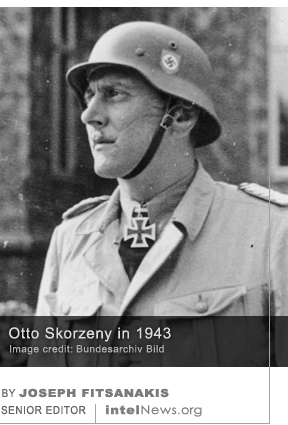
Otto SkorzenyA notorious lieutenant colonel in the Waffen SS, who served in Adolf Hitler’s personal bodyguard unit, worked as a hitman for the Israeli intelligence agency Mossad after World War II, it has been revealed. Austrian-born Otto Skorzeny became known as the most ruthless special-forces commander in the Third Reich. Having joined the Austrian branch of the National Socialist German Workers’ Party at 19, at age 23 Skorzeny began serving in the Waffen SS, Nazi Germany’s conscript army that consisted largely of foreign-born fighters. In 1943, Hitler himself decorated Skorzeny with the Knight’s Cross of the Iron Cross, in recognition of his leadership in Operation EICHE, the rescue by German commandos of Italian fascist dictator Benito Mussolini, who had been imprisoned at a ski resort in the Apennine Mountains following a coup against his government.
Skorzeny survived the war and ended up living in Spain under the protection of the country’s far-right dictator, Francisco Franco. The Mossad, Israel’s covert-action agency, which had made it a priority to arrest or kill senior Nazis who had survived the war, intended to kill Skorzeny. However, two veteran Israeli intelligence observers, Dan Raviv and Yossi Melman, revealed on Sunday that, instead of killing Skorzeny, the Mossad decided to recruit him. Based on “interviews with former Mossad officers and with Israelis who have access to the Mossad’s archived secrets”, Raviv and Melman allege that Isser Harel, who directed the Mossad from 1952 to 1963, decided that the former Waffen SS commander would be a useful asset against other Nazis operating in Europe and the Middle East. Specifically, Harel planned to use Skorzeny as a trap to lure a number of Nazi scientists who were secretly working for Egypt’s missile program.

According to Raviv and Melman, a Mossad team was sent to Spain to meet Skorzeny. After a tense incident that involved Skorzeny pointing a loaded weapon at two Mossad operatives, the former Nazi soldier agreed to cooperate with Israel in return for assurances that his name would be removed from the Mossad’s assassination list. Raviv and Melman claim that one of Skorzeny’s most high-profile operations as an agent of the Mossad culminated in the assassination of Heinz Krug in Munich in 1962. Krug was a German rocket scientist who was working for the Egyptian government under the tutelage of Dr Wolfgang Pilz, another rocketry expert who had put together a top-secret missile program for Cairo. Krug was targeted for assassination by Yitzhak Shamir, Israel’s future prime minister, who was then commander of the Mossad’s clandestine operations service.

Krug, who was worried for his life after receiving threatening messages from individuals he believed were connected with the Mossad, reached out to Skorzeny in hopes that the former Waffen SS commander could give him advice on enhancing his personal security. But Skorzeny, operating on orders of the Mossad, shot dead the German scientist in a remote wooded area outside Munich. A Mossad team then poured acid on Krug’s body before burying it in a grave that had been dug in preparation for his killing. According to Raviv and Melman, Skorzeny also sent German scientists in Egypt a number of mail bombs designed by the Mossad, which killed a number of people. Raviv and Melman also state that they received oral confirmation from Rafi Eitan, a legendary Mossad operations officer, that he “met and ran Skorzeny” on behalf of the Israeli intelligence agency.

Skorzeny died of cancer in Spain in 1975. He was 67. It is believed that the Mossad never tried to kill or kidnap him.

Author: Joseph Fitsanakis | Date: 29 March 2016 | Permalink

NSA director made secret visit to Israel last week

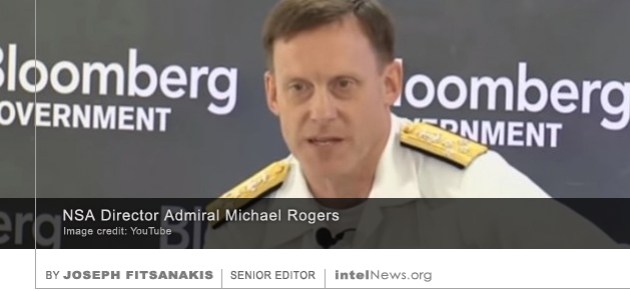
Michael RogersThe head of the United States’ largest intelligence agency secretly visited Israel last week, reportedly in order to explore forging closer ties between American and Israeli cyber intelligence experts. Israeli newspaper Ha’aretz said on Sunday that Admiral Michael Rogers, who directs the United States National Security Agency (NSA), was secretly in Israel last week. The NSA is America’s signals intelligence (SIGINT) agency, which is responsible for electronic collection, as well as protecting US government information and communication systems from foreign penetration and sabotage.
According to Ha’aretz, Rogers was hosted in Israel by the leadership of the Israel Defense Forces’ SIGINT unit, which is known as Intelligence Corps Unit 8200. The secretive group, which is seen as Israel’s equivalent to the NSA, is tasked with collecting SIGINT from Middle Eastern locations and protecting Israel’s electronic information infrastructure from adversaries. According to the Israeli newspaper, Rogers’ visit was aimed at exploring ways in which the NSA and Unit 8200 can enhance their cooperation, especially against regional Middle Eastern powers like Iran or non-state groups like Hezbollah.

IntelNews readers will recall that the IDF’s Unit 8200 is viewed by some Middle East observers as the creator of the Stuxnet virus. Stuxnet is a sophisticated malware that is believed to have been designed as an electronic weapon against Iran’s nuclear program. Among these observers is New York Times correspondent David Sanger; in his 2012 book, Confront and Conceal, Sanger claimed that Stuxnet was designed by NSA and Unit 8200 programmers as part of a joint offensive cyber operation codenamed OLYMPIC GAMES. According to Sanger, the two agencies collaborated very closely between 2008 and 2011 in order to bring about Stuxnet and other carefully engineered malware, including Flame.

Ha’aretz said that Rogers’ visit was meant to solidify US and Israeli cooperation on offensive cyber operations, based on the legacy of Stuxnet and Flame. During his visit to Israel, the US intelligence official also met with the heads of other Israeli intelligence agencies, said Ha’aretz.

Author: Joseph Fitsanakis | Date: 28 March 2016 | Permalink

Comment: Europe’s answer to Brussels bombs may be more damaging than ISIS

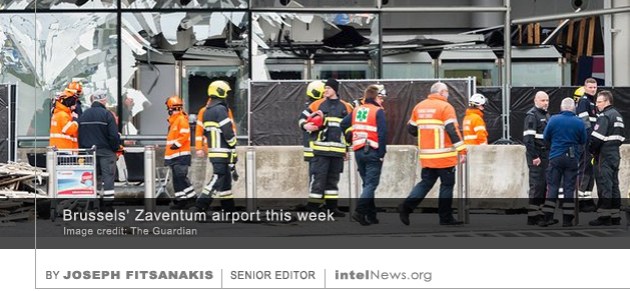
Brussels airportIn the past year, the Islamic State has claimed responsibility for at least nine terrorist attacks on foreign capitals. The growing list, which features Jakarta, Tunis, Paris, Beirut, Ankara, and Kuwait City, now includes the Belgian capital, Brussels. At least 34 people died in the attacks that rocked Brussels’ Zaventum airport and Maelbeek metro station on March 22, while another 300 were injured, 60 of them critically. This week’s bombings officially constitute the bloodiest terrorist attacks in Belgium’s history, prompting the country’s government to declare three days of national mourning.

Why did the Islamic State attack one of Europe’s smallest countries, with a population of just over 11 million? Some have suggested that Brussels was targeted by the terrorist group because it was an easy target. Observers noted that Belgium’s security and intelligence services are underfunded and demoralized —a “weak link in Europe”, in the words of one expert. There is no question that Belgium’s security apparatus is in need of serious overhaul; but the need is equally great in Amsterdam, in Athens, in Madrid, in Dublin, and elsewhere in Europe. In fact, the Islamic State could have struck any of these European capitals with the same ease that it attacked Brussels —and might still do so.

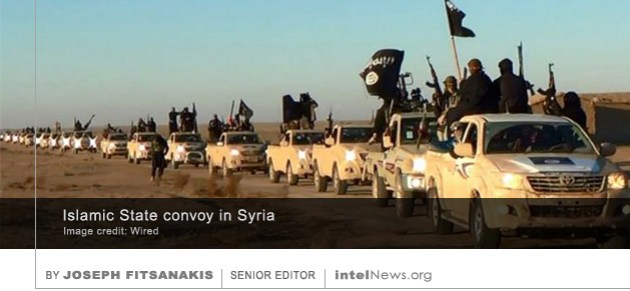
In reality, the Islamic State’s decision to attack Brussels was carefully calculated and consistent with the group’s overall strategy. The primary reason that the Islamists attacked Brussels is that Belgium is one of 30 countries that actively participate in the Combined Joint Task Force, the international group behind Operation Inherent Resolve. Led by the United States military, the operation has been targeting Islamic State forces in Iraq and Syria since October 2014. The Islamic State wished to send a message to Europeans that their military intervention in the Middle East will be costly at home. Secondly, Brussels was struck because it is the headquarters of the European Union, which last month declared the Islamic State’s campaign against religious and ethnic minorities in Syria and Iraq as an act of genocide. Third, and perhaps most importantly, Belgium was targeted because a significant percentage of its population —as much as 7 percent by some estimates— is Muslim.

What is more, the degree of integration of Belgian Muslims in mainstream life is markedly limited and partly explains why so many of them —400 by some estimates, the highest per-capita number in Europe—have emigrated to Syria and Iraq in order to join the Islamic State. It is worth remembering that the Islamic State emerged as the de facto guarantor or Sunni Muslims by essentially provoking Iraq’s Shiites to attack and marginalize the country’s Sunni Arab minority. Following a series of Shiite attacks against Sunni communities in Iraq, which were part of a broader post-2003 sectarian conflict between Sunnis and Shiites, the Islamic State emerged as the protector of Sunni Arabs and has since fought against Syrian Alawites, Hezbollah, Iranian forces, Iraqi Shiites, and others. Its popular support in Iraq and Syria stems from the fear held by Sunni Arabs that, if the Islamic State is defeated, their communities will be exterminated by vengeful and unforgiving Shiites.

Having gained from sectarianism in the Middle East, the Islamic State is now implementing the same tactic in Europe. It is thus targeting countries like France and Belgium, which have significant Muslim populations, in order to provoke aggressive reactions against domestic Muslim communities. In other words, it expects that attacks like those in Belgium will favor extremist ideologies throughout the European continent, and in turn further-marginalize European Muslims. The rise of Islamophobia, the strengthening of extremist political parties, and the disintegration of European values such as acceptance and tolerance, are likely to create a new generation of disaffected European Muslim youth, many of whom will be prime candidates for Islamic State membership.

European societies must not allow the Islamic State to change the political identity of an entire continent through violence. Along with meticulous police and intelligence work, the bombs in Brussels must be answered with concerted attempts to deepen the social integration of European Muslims, and more broadly to promote cohesion between ethnic and religious groups in Europe. Anything short of that will provide the Islamic State with the same strategic advantage it has enjoyed in the Middle East for nearly a decade.

* Joseph Fitsanakis is Assistant Professor in the Intelligence and National Security Studies program at Coastal Carolina University in the United States.

German court sentences intelligence officer who spied for CIA

Markus ReichelA court in Germany has sentenced a former officer of the country’s intelligence agency, who spied for the United States and Russia from 2008 to 2014. Regular readers of this website will recall the case of ‘Markus R.’, a clerk at the Bundesnachrichtendienst, or BND, Germany’s external intelligence agency. The 32-year-old was arrested in July 2014 on suspicion of having spied for the United States’ Central Intelligence Agency. Germany’s Office of the Federal Prosecutor said at the time that Markus R. voluntarily made contact with the CIA in 2008 and offered his services to the American spy agency. He began working for the United States as a double agent soon afterwards. Soon after Markus R.’s arrest was made public, the German government ordered the immediate removal from Germany of the CIA chief of station –who was essentially the top American intelligence official in the country. Berlin also instructed its intelligence agencies to limit their cooperation with their American counterparts “to the bare essentials” until further notice.
On Thursday, Markus R., identified in some German media as Markus Reichel, was sentenced for selling over 200 classified German government documents to the CIA between 2008 and 2012, for which he said he received €80,000 ($90,000). During his trial, Reichel also admitted giving German government documents to personnel at the consulate of the Russian Federation in Munich in the summer of 2014. Among the documents that the former BND clerks is said to have given the CIA was a list of thousands of German intelligence operatives —including agents— stationed abroad, which contained their operational cover names and real identities. But Reichel was caught when German counterintelligence officers intercepted correspondence between him and his handlers and then used the information to set up a successful sting operation.

During his trial, Reichel issued a formal apology for engaging in espionage against the German state. He told the court that he had been motivated by boredom and by “lust for adventure”, which he said he did not get working for the BND. He also said he was frustrated by the lack of confidence that his superiors and colleagues had in him. “At the BND, I had the impression that no one trusted me with anything”, said Reichel. “But the CIA was different. You had the opportunity to prove yourself”, he added. Reichel was found guilty of treason against the German state and sentenced to eight years in prison.

Author: Joseph Fitsanakis | Date: 17 March 2016 | Permalink

Defector reveals thousands of Islamic State internal documents

ISIS - JFTens of thousands of classified documents belonging to the Islamic State have been released by a disillusioned former member of the organization, who says that the group has been taken over by secularists. According to British-based agency Sky News, the documents were provided on a memory stick stolen from the Islamic State by a Syrian former member of the organization, who goes by the name “Abu Hamed”. Hamed allegedly stole the documents from the Islamic State’s “internal security police”, which Sky News also refers to as “the group’s Security Service”. He took it with him when he defected from the organization, which he says he joined as a convert from the non-Islamist Free Syrian Army. He told Sky News’ Stuart Ramsay that he left the group after concluding that it had been “taken over” by former Iraqi soldiers belonging to Ba’ath, the secularist party that was at the heart of the regime led by the late Iraqi President Saddam Hussein. As a result, “Islamic rules […] have totally collapsed” inside the Islamic State, said Hamed.
The documents that Hamed gave Sky News are said to number in the “tens of thousands” and reportedly identify nationals from over 50 countries who are members of the Islamic State. Many of the documents contain the 23-question form that all prospective members of the Islamic State have to complete before being admitted into the organization. The questionnaires contain the prospective members’ names and aliases, contact information and family background, among other identifying data. Ramsay said he met Hamed “in a secret location in Turkey”, where the former Free Syrian Army soldier is now living after defecting from the Islamic State. According to the Sky News reporter, Hamed said he abandoned the Islamist organization because its current leadership consists almost exclusively of Ba’athists, who are not known for their religious views or lifestyle.

Ramsay reports that many of the names of Islamic State members that are contained in the documents are already “well-known” to Western and Middle Eastern intelligence agencies. But the collection of members’ names contains several individuals from the Middle East, Northern Africa, Europe, as well as North America, who were allegedly not included in intelligence agencies’ lists. One file surrendered by Hamed is headlined “Martyrs”, and allegedly features the names of members of a brigade that consists “entirely of fighters who wanted to carry out suicide attacks and were trained to do so”. Hamed is also reported to have told Sky News that the Islamic State is gradually abandoning its self-described state capital of Raqqa in Syria and relocating to Iraq. Sky News said it had informed Western government agencies about the documents.

Author: Joseph Fitsanakis | Date: 14 March 2016 | Permalink

Senior South Korean officials’ cell phones hacked by North: report

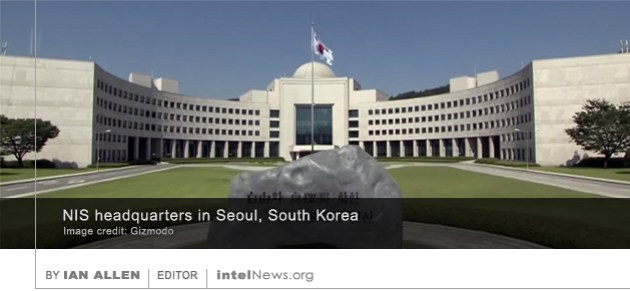
NIS South KoreaDozens of cell phones belonging to senior government officials in South Korea were compromised by North Korean hackers who systematically targeted them with texts containing malicious codes, according to reports. The National Intelligence Service (NIS), South Korea’s primary intelligence agency, said the cell phone penetrations were part of a concerted campaign by North Korea to target smart phones belonging to South Korean senior government officials. Once they managed to compromise a cell phone, the hackers were able to access the call history stored on the device, the content of text messages exchanged with other users and, in some cases, the content of telephone calls placed on the compromised device. Moreover, according to the NIS, the hackers were able to access the contact lists stored on compromised cell phones, which means that more attacks may be taking place against cell phones belonging to South Korean government officials.
The breach was considered critical enough for the NIS to host an emergency executive meeting with the security heads of 14 government ministries on Tuesday, in order to update them on the situation and to discuss ways of responding to the crisis. According to Korean media, the emergency meeting took place on Tuesday and lasted for over three hours. During the meeting the NIS told ministry representatives that the North Korean operation was launched in late February and was ongoing as of early this week. It specifically targeted government officials and appeared to concentrate on their cell phones, instead of their office phones –probably because the latter are known to be equipped with advanced anti-hacking features. The government employees’ cell phones were reportedly attacked using text messages and emails containing links to web sites that downloaded malicious codes on the users’ phones.

The NIS did not specify the precise purpose of the hacking operation, nor did it explain whether the attacks were informed by an overarching strategic goal. The officials targeted work for a variety of government ministries, but there is no clarification as to whether any operational or administrative links between them exist. The NIS did say, however, that approximately a fifth of all attacks against cell phones were successful in compromising the targeted devices.

Author: Joseph Fitsanakis | Date: 10 March 2016 | Permalink

Germans bill Israeli embassy after Mossad car gets stuck in mud

Mossad sealAuthorities in a northern German town have called on the Israeli embassy in Berlin to pay for the cost of extricating a car belonging to two Israeli spies, which was stuck in a mud pit in a restricted area. According to the Hamburg-based television station NDR, the incident occurred last December in Quarnbek, a coastal town in Germany’s Schleswig-Holstein state with a population of under 2,000. Two men were reportedly spotted late one afternoon driving a Ford Focus near a restricted area that is surrounded by a fence by the banks of the Kiel Canal. The men came across a locked gate to the restricted area, which, according to NDR, is clearly marked with “no trespassing” signs. However, they reportedly picked the lock and drove through the gate into the restricted area. Shortly afterwards, however, the Ford Focus got stuck in a mud pit inside the Kiel Canal restricted area.
As the two men unsuccessfully tried to get their car unstuck, night began to fall. An elderly resident spotted them and asked them if they were government employees. The men responded that they were there to survey the area in preparation for a sailing contest that was to take place in the Kiel Canal in the summer. But the resident became suspicious and called Quarnbek’s Mayor, Klaus Langer. In turn, the mayor called the police, which sent a team of officers to the restricted site. According to NDR, as soon as the two men spotted the police vehicle, they came out of their car and identified themselves as Israeli consular personnel with diplomatic immunity. They presented their credentials and informed the police officers that they were armed; indeed, two handguns were found in the Ford Focus.

German media reports said the police soon confirmed that the two men were officers of the Mossad, Israel’s primary external intelligence agency, and were in the region to accompany the transfer of the ThyssenKrupp submarine to Israeli hands. Known in Israel as the INS Rahav, the submarine was built in the Kiel shipyard on orders of the Israeli government. According to Mayor Langer, a team of local firefighters was dispatched to help extricate the Mossad officers’ car from the mud. Earlier attempts by a local farmer to extricate the car using a forklift had apparently failed. The Ford Focus was eventually extricated and the two Mossad agents were allowed to leave. Shortly afterwards, Mayor Langer, who was elected as a member of the Green Party, sent the Israeli embassy in Berlin a bill for $1392.28 to cover the cost of the extrication. According to recent reports, the Israelis said they intend to pay up.

Author: Joseph Fitsanakis | Date: 09 March 2015 | Permalink

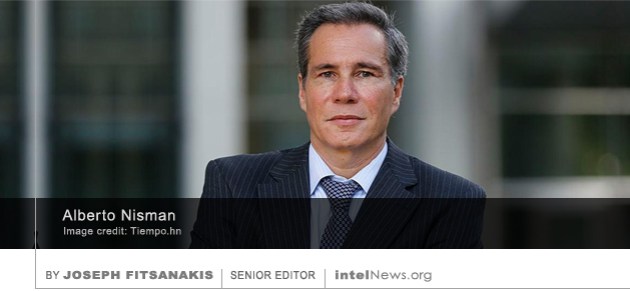
Argentine ex-spy says government killed prosecutor Alberto Nisman

Alberto NismanAn Argentine former senior intelligence official has claimed in court testimony that the administration of President Cristina Fernández de Kirchner murdered a state prosecutor who had accused senior officials of having colluded with Iran to bomb Israeli targets in Buenos Aires. In January 2015, the prosecutor, Alberto Nisman, prompted international headlines by launching a criminal complaint against President Kirchner and several other notable personalities of Argentine political life. Nisman accused them of having colluded with the government of Iran to obstruct an investigation into the bombings of the Israeli embassy and a Jewish cultural center in Buenos Aires in the mid-1990s. A dozen people died in the bombing of the embassy, while another 85 were killed two years later, when the Asociación Mutual Israelita Argentina community center in the Argentine capital was bombed. Nisman was found dead on January 19, 2015, hours before he was due to give Congressional testimony on the subject. His body was found in the bathroom of his apartment, which had been locked from the inside.

Argentine authorities say they believe Nisman killed himself with a single shot to the head from a .22 caliber handgun. His family, however, as well as many notable personalities in Argentina, believe he was murdered on the orders of government officials who wanted to silence him. Such claims were reinforced this week following a dramatic 17-hour court testimony by Antonio Horacio Stiuso, better known as Jaime Stiuso, who served as chief operating officer for Argentina’s Secretaría de Inteligencia del Estado (SIDE) under President Kirchner. Stiuso was fired after Nisman’s death, when the government suddenly dissolved SIDE and replaced it with a new agency, the Agencia Federal de Inteligencia. In justifying the dramatic move, President Kirchner accused SIDE of feeding Nisman fabricated information implicating her and her government minsters in a fictional collusion with the Islamic Republic, and then killing him in order to destabilize her rule. She then charged SIDE’s leadership, including Stiuso, with involvement in Nisman’s killing. Stiuso promptly fled Buenos Aires for Brazil, from where he flew to Miami, Florida, on February 19, using an Italian passport.

But the former spy recently returned to Argentina and on Monday he testified in a closed-door hearing as part of an official investigation into Nisman’s death. Although Stiuso gave his testimony in secret, Argentine media published several extracts on Tuesday, which appear to have been leaked by witnesses. According to the excerpts, Stiuso accused members of an “inner circle” inside President Kirchner’s government of having killed Nisman and then tampered with incriminating evidence from the scene of the crime. The former spy appears to have told the judge in the case, Fabiana Palmaghina, that the state prosecutor’s death “was intimately linked to the work he was doing”. He is reported to have added that “the author of all this madness was that woman, Cristina Fernández de Kirchner.

Stiuso has refrained from talking to the media, and his comments to the court have not been confirmed. However, the judge in the case, who previously favored the view that Nisman committed suicide, has now referred Nisman’s case to a higher federal court in Argentina with instructions that it be examined as a possible homicide.

Author: Joseph Fitsanakis | Date: 02 March 2016 | Permalink