Researchers uncover secretive Russian spy unit by studying its commemorative badges
July 21, 2025 2 Comments
 A GROUP OF RESEARCHERS in Finland have managed to outline the structure and geographic footprint of a highly secretive Russian signals intelligence (SIGINT) unit by studying commemorative badges issued by the Russian government. The research group, known as CheckFirst, specializes in open-source (OSINT) investigative reporting and works to combat online disinformation.
Earlier this month, CheckFirst published its latest report titled “OSINT & Phaleristics: Unveiling FSB’s 16th Center SIGINT Capabilities”. The 36-page report focuses on the study of Russian government-issued commemorative badges—also known as challenge coins—relating to Center 16 (16-й Центр). Also known as Military Unit 71330, Center 16 is a secretive SIGINT unit that houses most of the cyber espionage capabilities of Russia’s Federal Security Service (FSB).
Challenge coins are custom-made medallions given by military, intelligence, and government agencies to recognize service, commemorate achievements, or build morale. Originating in the United States military during World War I, and popularized during the Vietnam War, challenge coins are routinely exchanged in ceremonies or offered to personnel as tokens of camaraderie and loyalty within a specific unit or mission.
Often regarded as collectors’ items, challenge coins from various agencies are often resold on websites such as eBay, or displayed online on websites maintained by private collectors. CheckFirst researchers tracked down several versions of Center 16 challenge coins found on a variety of publicly available websites, as well as on the websites of Russian challenge coin manufacturers, such as GosZnak, SpetsZnak, or Breget.
Based on this OSINT methodology, CheckFirst researchers were able to identify 10 distinct directorates within Center 16, which specialize on various aspects of defensive and offensive cyber espionage. Previously only a single Center 16 directorate had been identified in the unclassified domain. Moreover, by examining geographic indicators found on several of challenge coins, such as maps or coordinates, CheckFirst researchers were able to partly map out the geographic structure of Center 16, locating nearly a dozen interception facilities throughout Russia.
► Author: Joseph Fitsanakis | Date: 21 July 2025 | Permalink
 THE
THE THE GOVERNMENT OF ISRAEL recently appointed a new acting chief at the Israel Security Agency (ISA, also known as Shabak or Shin Bet). Identified only by their first initial, “S.”, this individual is one of the deputies of the
 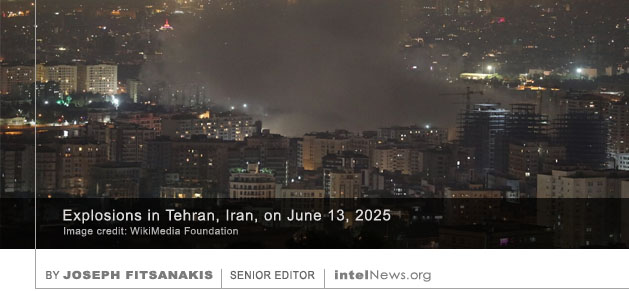 THE MOSSAD, ISRAEL’S PRIMARY external intelligence agency, had set up forward-operating bases deep inside Iranian territory several years prior to last week’s attacks, which targeted Iran’s military and nuclear infrastructure. In some cases, Mossad operatives, including commando forces, were operating inside the vicinity of the Iranian capital Tehran for months prior to June 13, according to Israeli media outlets.
 ON MAY 26, THE Austrian domestic intelligence service,
 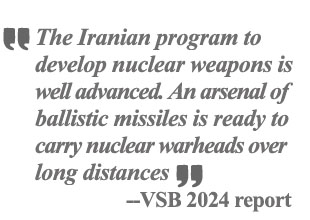 and specialized essays about certain relevant topics. Traditionally the media and public give most attention to those parts of the report that deal with extremism and terrorism of all kinds inside Austria.
 an unwanted wrench in President [Donald] Trump’s negotiation process to resolve the atomic crisis with Iran’s rulers because the data outlined in the report suggests the regime will not abandon its drive to secure a nuclear weapon.”
 TWO RUSSIAN SPIES USED forged documents acquired in Brazil in order to live in Portugal for years and use it as a base from where to conduct espionage, according to an investigation by Portuguese counterintelligence. The spies were husband-and-wife team Vladimir Aleksandrovich Danilov and Yekaterina Leonidovna Danilova, both in their 30s.
  EARLIER THIS WEEK THE High Court of Israel delivered its ruling regarding the
  THE ADMINISTRATION OF UNITED States President Donald Trump has ordered American intelligence agencies to focus on Greenland, while also mulling a plan to establish a formal association with the island territory. The Wall Street Journal
  VETERAN ISRAELI INTELLIGENCE OFFICER Ronen Bar, who has led the Israeli Security Agency (ISA, more widely known as the Shin Bet) since 2021, has submitted an affidavit to Israel’s Supreme Court, accusing Prime Minister Benjamin Netanyahu of serious misconduct. Netanyahu fired Bar in March, but the Supreme Court later
 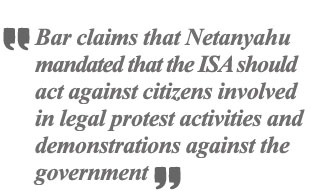 protesting activists, because, according to Netanyahu, they were “following security targets”.
 A 21-YEAR-OLD American citizen, whose mother is a senior Central Intelligence Agency (CIA) official, died while fighting with the Russian military in Ukraine in 2024, according to a news report. Late last week, the CIA confirmed the accuracy of the story while requesting that the media afford the bereaved family “privacy at this difficult time”.
 BRITAIN’S SECURITY AGENCIES HAVE reportedly warned civil servants and parliamentarians that public places located near government buildings may be bugged by foreign intelligence agencies. The warning covers the SW1 postcode district of southwest London, which encompasses the City of Westminster and includes the Houses of Parliament, the Office of the Prime Minister at 10 Downing Steet, and Whitehall. The latter is home to several ministries and departments, including the Foreign and Commonwealth Office, the Cabinet office, and the Ministry of Defense.
 OVER 250 FORMER MEMBERS of the Mossad, Israel’s external spy agency, have drafted an open
  THE REUTERS NEWS AGENCY has disclosed more information about an alleged plot by Russian intelligence to detonate bombs on cargo flights from Europe to North America. Initial details of the plot emerged in October 2024, when it was








Senior Mossad veteran discusses recruitment of Iranian assets in rare interview
July 22, 2025 by intelNews 2 Comments
It is a rare occasion to hear directly from a senior veteran of the Mossad. Oded Eilam (or Ailam), now 71, served in the Mossad for 24 years. In an interview with the German newspaper Bild, Eilam described the strategy that allowed the Israeli intelligence agency to successfully recruit and maintain an “extensive network” of spies inside Iran.
According to Eilam, the key to the Mossad’s success lies in Iran’s complex social structure. “Only 40% of [Iran’s] population of 90 million are Persians,” Eilam said, explaining that the ethnic divide makes it difficult for the Iranian government to control the population. “The [Iranian government’s] surveillance system has huge gaps; you can’t compare it to what the Stasi did in East Germany,” he added.
The former Mossad official explained that various ethnic groups inside Iran, such as Kurds, Turkmen, Baluchis, and Azeris, make up a potential pool for recruiting agents. According to Eilam, the motivation for cooperating with the Mossad is not necessarily support for Israel or financial reward, but often stems from dissatisfaction with the Iranian regime.
“Many people in Iran are unhappy. Large parts of society live in poverty,” explained Eilam. “While Iran has significant gas reserves, instead of investing this money in their country, the clerics have funneled billions into terrorist organizations like Hezbollah,” he added. Another factor that helps Mossad’s activities, according to Eilam, is Iran’s long territorial borders and the difficulty of monitoring them thoroughly. “This makes it possible to smuggle everything into the country,” he noted.
Eilam also emphasized the Mossad’s commitment to safeguarding its assets. “When someone works for us, we take care not only of them but also of their family,” he said, clarifying that the Mossad is dedicated to bringing its spies and their families to safety if needed. Although there are many opportunities to recruit agents in Iran, the Mossad is not in a rush. Eilam highlighted that the organization spends a significant amount of time on the process of selecting and screening candidates. “When we are looking for agents, we don’t just choose someone; we take a lot of time to ensure that the person is suitable.”
“When someone works for us,” the former officer noted, “the importance the Mossad attaches to verifying information. For a target, we do not use information from just one agent, but always multiple sources to be sure that the right person is hit,” said Eilam, also hinting at the extensive vetting processes the organization conducts before operational actions.
Eilam’s interview is a unique source of insight into the espionage operations of the Mossad. It is unclear why it was published—possibly to warn the Iranians to think twice before taking any offensive actions against Israel.
► Author: Dr. Avner Barnea* | Date: 22 July 2025 | Permalink
* Dr. Avner Barnea is a research fellow at the National Security Studies Center of the University of Haifa in Israel. He served as a senior officer in the Israel Security Agency (ISA). He is the author of We Never Expected That: A Comparative Study of Failures in National and Business Intelligence (Lexington Books, 2021).
Filed under Expert news and commentary on intelligence, espionage, spies and spying Tagged with Avner Barnea, espionage, Iran, Israel, Mossad, News, Oded Ailam, Oded Eilam