EU Council president grilled in closed-door probe of Polish-Russian spy deal
April 21, 2017 3 Comments
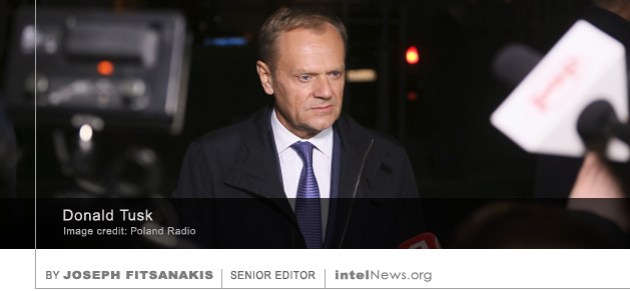 Senior European Union official Donald Tusk was grilled for several hours on Wednesday, in the context of a Polish government probe into an intelligence agreement between Warsaw and Moscow. But Tusk, who is the current president of the European Council, and served as Poland’s prime minister from 2007 to 2014, dismissed the probe as politicized and said it was deliberately designed to harm his political career. The investigation was launched by the government of Poland earlier this year. Its stated goal is to investigate an agreement that was struck in late 2013 between Poland’s Military Counterintelligence Service (MCS) and the Federal Security Service (FSB) of the Russian Federation. The agreement allegedly took place in secret, but was never implemented. The government of Poland canceled it in 2014, after accusing Moscow of illegally annexing the Ukrainian region of Crimea.
On Wednesday, Tusk spent nearly three hours at the office of the prosecutor in Warsaw, in a question-and-answer session that was held entirely behind closed doors. As he was leaving the building, the former Polish prime minister said he could not comment on the content of his testimony. But he used strong words to dismiss the entire investigation as “extremely political”, while accusing those behind it as holding a vendetta against him. Tusk and his supporters believe that the probe was primarily initiated by Jarosław Kaczyński, leader of the conservative Law and Justice party. They also claim that Kaczyński, who is Tusk’s political arch-foe in Poland, is spearheading a campaign of personal vindictiveness against him.
The rivalry between the two men began in 2010, when an airplane carrying a Polish government delegation to a World War II commemoration event in Russia crashed near the Russian city of Smolensk, killing everyone onboard. Among the dead was Polish President Lech Kaczyński, Jarosław Kaczyński’s brother. Since the air disaster, the leader of the Law and Justice party has maintained that the Russian government deliberately brought down the plane. He also accuses Tusk, who was Poland’s prime minister at the time, of colluding with Moscow to eliminate his brother. These allegations remain unsubstantiated, but they have contributed to the emergence of a venomous political climate in Poland that has dominated national politics for years.
On Wednesday, during Tusk’s three-hour testimony, several thousands of his supporters demonstrated outside the office of the prosecutor, urging Tusk to run for president in a few years. It is a common expectation in Poland that Tusk will soon turn his attention to domestic Polish politics and run for the highest office in the land in 2020.
► Author: Joseph Fitsanakis | Date: 21 April 2017 | Permalink
 The director of Nigeria’s powerful intelligence agency has been suspended on orders of the president, after a massive stash of cash totaling $43 million was found in an apartment in Lagos. The money was discovered by investigators working for the Nigerian Economic and Financial Crimes Commission (EFCC). Based in Abuja, the EFCC is a high-profile body that was created in 2003, in response to accusations by the international community that Nigeria is used as a major base for global money-laundering schemes.
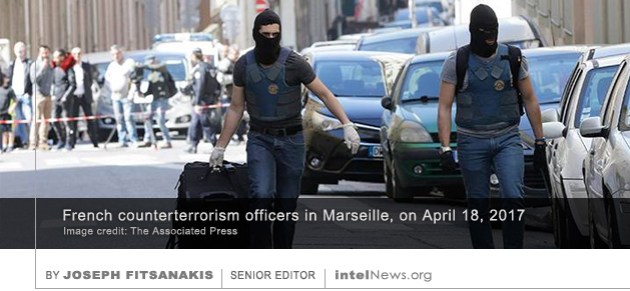 A tip from British intelligence helped French counterterrorist officials arrest two men who are thought to have been in the final stages of planning a large-scale terrorist attack, according to French media. Government sources in Paris say officers from the country’s domestic intelligence agency, DGSE,
 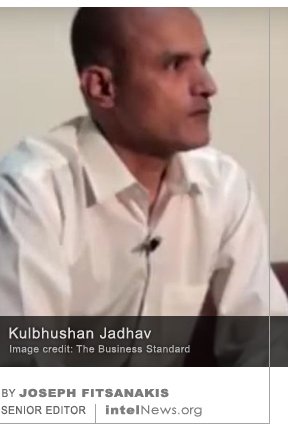 Analysts warn that South Asia may witness its worst crisis since the 2008 Mumbai attacks if Pakistan carries out its threat to execute an Indian former naval officer whom it accuses of espionage. Authorities in Islamabad say Kulbhushan Jadhav (pictured) worked for the Indian Navy until 2003, when he was recruited by India’s Research and Analysis Wing (RAW), a government intelligence agency that conducts operations abroad. The Pakistanis claim that Jadhav was arrested in southwest Pakistan in 2016, where he was engaged in funding and training secessionist militants from Pakistan’s Baluch minority. The Baluch are an Iranic people, most of whom live in a region known as Baluchistan, which is split between Iran and Pakistan. There are populous Baluch communities in the southern city of Karachi, one of Pakistan’s most populous ports. Some members of the Baluch community have secessionist aspirations and are accused of terrorism by Iranian and Pakistani authorities.
 Four hidden communications-surveillance compartments which are believed to date back to the Cold War, have been found in one of the most prestigious hotels of the former Yugoslavia. The discovery was made during an extensive renovation project that was recently completed in the Hotel Jama. The hotel is located in the southeastern Slovenian city of Postojnska, near the Italian border. For over a century, Postojnska has been famous for its network of limestone caves, which are among the largest in the world. Eager to cater to Italian, Austrian and other Western tourists, the government of Yugoslavia began construction on Hotel Jama in 1969. The hotel opened its doors in 1971, amidst much publicity and fanfare. It eventually became known as one of the most luxurious hotels in the communist world.
 Emirati intelligence has to be seen in two disparate tiers: actual home-grown intelligence efforts, which usually revolve within the small policing and military forces of the United Arab Emirates (UAE); and more elaborate, highly secretive, outsourced activities that use the UAE as a facilitating conduit or go-between with a clear advantage to Emirati interests.
 ultra-modern intelligence capabilities, and cooperates with international organizations, other countries, and policing agencies. In addition, the UAE leadership has taken initiatives recently to create a domestic level of intelligence scholarship and professionalization, namely in the form of the
 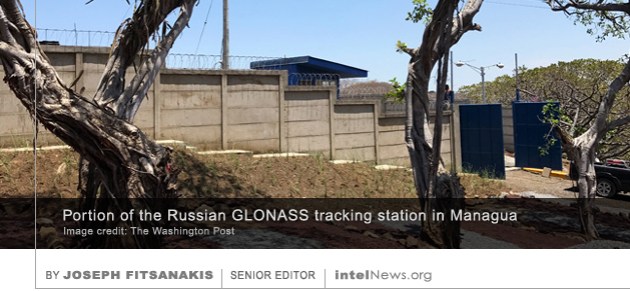 A Russian facility built on a hillside facing the United States embassy in the Nicaraguan capital Managua is seen by some experts as symptomatic of Russia’s renewed presence in the Americas. The official Russian explanation for the heavily protected facility, which is surrounded by high walls, is that it is meant to operate as a tracking station for GLONASS, Russia’s version of the global positioning system (GPS). The Russians do not use GPS, because it is owned by the US government and operated by the US Air Force. But some believe that only part of the compound is dedicated to GLONASS activities, and that a major portion is a Russian listening base that sweeps US communications from throughout the region.
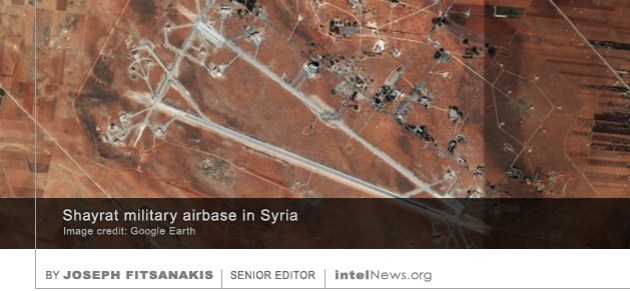 The nearly 60 Tomahawk missiles that the United States fired at Syria in the early hours of Friday local time were not the first. Nor were they the first that struck a Syrian government installation. In September of 2016, for example, a United States airstrike hit a
  given that Washington’s attack took place during the official visit to the United States by Xi Jinping, premier of China, another strong Syrian ally. Finally, it is worth considering possible Iranian responses to the US attack, especially if Iranian citizens end up on the casualty list.
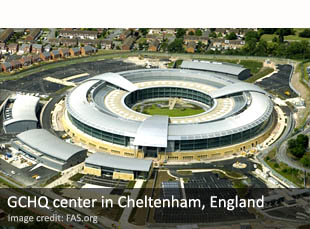 A new report authored by a consortium of government and private organizations in Britain has revealed the existence of a computer hacking operation, allegedly based in China, that is said to be “one of the largest ever” such campaigns globally. The operation is believed to have compromised sensitive information from an inestimable number of private companies in Southeast Asia, Europe and the United States. The
 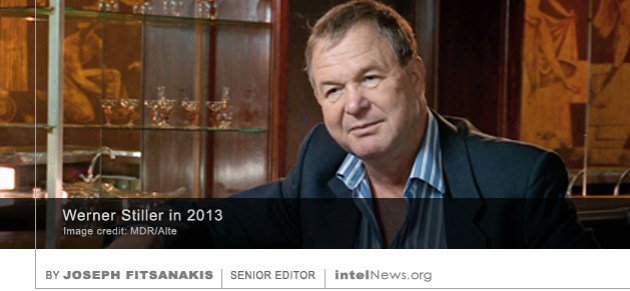 Werner Stiller, also known as Klaus-Peter Fischer, whose spectacular defection to the West in 1979 inflicted one of the Cold War’s most serious blows to the intelligence agency of East Germany, has died in Hungary. Stiller, 69, is believed to have died on December 20 of last year, but his death was not
  Relentless bureaucratic skirmishes between the White House and the United States Intelligence Community are occurring daily, with administration officials attempting to “seize the reins” of agencies, according to sources. The Associated Press
  An employee of the United States Department of State has been charged with lying to authorities about her contacts with Chinese intelligence operatives, who gave her money and gifts in return for information. Candace Claiborne, 60, joined the Department of State in 1999 as an office management specialist. She lives in Washington, DC, but has served overseas in American diplomatic facilities in Baghdad, Iraq, Khartoum, Sudan, and China, where she was stationed in Beijing and Shanghai. According to information provided by the Federal Bureau of Investigation, Claiborne had a top security clearance, which required her to report contacts with foreign nationals.
 Earlier this week, it was
 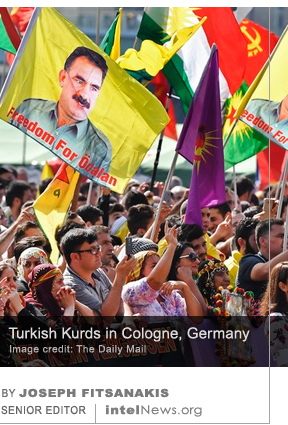 German intelligence and security agencies have publicly rejected a direct request made by Turkey’s intelligence chief to gather information on Turks who are living in Germany and are critical of the Turkish government. The request reportedly relates to attempts by the Turkish government to round up its critics, following a failed military coup in July of last year. The government of Turkish President Recep Tayyip Erdoğan accuses members of the so-called Gülen movement of orchestrating the coup, which included an armed attack on the country’s parliament and the murder of over 200 people across Turkey. The Gülen movement consists of supporters of Muslim cleric Fethullah Gülen, who runs a global network of schools, charities and businesses from his home in the United States. The government of Turkey has designated Gülen’s group a terrorist organization and claims that its members have stealthily infiltrated state institutions since the 1980s.








Iranian spies second most active in Germany, says Interior Ministry
April 25, 2017 by Joseph Fitsanakis Leave a comment
The Interior Ministry’s report reveals that German authorities initiated counterintelligence investigations against 22 cases of espionage by Iranian agents during the past decade. These account for over 17 percent of all counterintelligence cases conducted by the German state since 2007. Of the remaining cases, 27 concerned Russian spies, while China and Turkey are believed to be behind 15 spy cases each. Syrian intelligence operatives were found to be behind a total of eight spy operations conducted on German soil in the past decade. According to the report, the majority of intelligence operations conducted in Germany by Iranian agents were attempts to secure material and technologies that could be used in Iran’s nuclear program. Approximately half of Germany’s federal states reported attempts by Iranian agents to secure nuclear-related goods in recent years.
But Tehran has also allegedly been implicated in attempted assassinations of German citizens, according to the report. One example mentioned in the document is that of Mustafa Haidar Syed-Naqfi. Sayed-Naqfi, who is a Pakistani national, was arrested in the northern German city of Bremen in January of this year for spying on behalf of Iran. According to German authorities, the Pakistani man compiled lists of potential targets for assassination by Iran. As intelNews reported at the time, Syed-Naqfi’s list of targets included prominent Jews or German-Israelis living in northern Germany. Among them was Reinhold Robbe, a politician with the center-left Social Democratic Party (SPD), who served for a number of years as president of the German-Israeli Congress. According to reports, the spy had compiled detailed maps of Robbe’s daily movements, which outlined his travel routines and the routes he took from his home to the DIG headquarters in Berlin. German officials believe that the type of surveillance that Sayed-Naqfi. carried out against Robbe indisputably leads to the conclusion that the politician’s assassination was being planned.
German authorities believe that Syed-Naqfi worked for the Quds Force, a Special-Forces unit of Iran’s Revolutionary Guards Corps, which is responsible for covert operations outside Iran. Last month, the Pakistani man was given a four-year prison sentence by a Berlin court for engaging in espionage on German soil.
► Author: Joseph Fitsanakis | Date: 25 April 2017 | Permalink
Filed under Expert news and commentary on intelligence, espionage, spies and spying Tagged with counterintelligence, German Ministry of the Interior, Germany, Iran, Mustafa Haidar Syed-Naqfi, News