CIA places Iran operations division chief on administrative leave

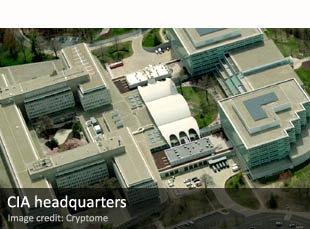
CIA headquartersBy JOSEPH FITSANAKIS | intelNews.org
The chief of Iran operations at the United States Central Intelligence Agency has been placed on paid administrative leave, allegedly for creating a hostile work environment that ended up impeding the Agency’s output. According to The Los Angeles Times, many members of the CIA’s Iran operations division had launched an “open rebellion” against their 46-year-old chief, which the paper identified by name. In an article published on Saturday, The Times stated that the veteran intelligence officer, who has now been removed from the CIA’s headquarters in Langley, Virginia, had previously served at CIA stations in Iraq, Russia and the Balkans. The paper added that, in 2010, the CIA had to pull out the officer from Pakistan, after he was publicly named as the Agency’s station chief in Islamabad. Some American officials have identified Pakistan’s intelligence services as the source of the leak that led to the officer’s public exposure, which was allegedly intended as retribution to a series of previous drone attacks by the CIA on Pakistani soil. The Times quoted “three former officials” who accused the chief of the Iran division of exercising a divisive and abusive management style, which led many of the division’s senior employees to request to be transferred elsewhere in the CIA. One unnamed source told the paper that, as a result of the division chief’s treatment and the open rebellion by his staff, the Iran office “was not functioning”. The veteran officer was “sent home” two weeks ago, after an internal investigation by the Office of the CIA Inspector General found that he had essentially lost the trust and respect of the division’s staff. Read more of this post
Obama comments on Senate-CIA dispute, fails to mention Feinstein

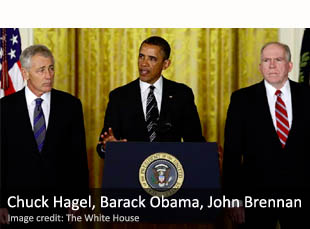
Chuck Hagel, Barack Obama, John BrennanBy JOSEPH FITSANAKIS | intelNews.org
Yesterday in a radio interview I opined that I would not be surprised if the White House stepped in to mediate the ongoing dispute between the Central Intelligence Agency (CIA) and the Senate Select Committee on Intelligence. Today, President Barack Obama broke his silence “with respect to the issues that are going back and forth between the Senate committee and the CIA”, as he said. But he refused to take sides —or did he? On Wednesday afternoon, the President responded to a question on the matter by a White House pool correspondent. The question related to the increasingly heated public spat between the CIA and the Senate Intelligence Committee. The latter is tasked, along with its sister body in the House of Representatives, with exercising legislative oversight of the Intelligence Community. Many members of the Committee, which is currently investigating the CIA’s use of enhanced interrogation against terrorism detainees, believe that, not only was the CIA’s use of harsh interrogation methods illegal, but that it also failed to generate useful intelligence. The CIA, however, denies this, and has been quite possessive of documents relating to the issue, which the Committee believes has a right to access. The Agency has now asked the Federal Bureau of Investigation (FBI) to look into whether Congressional staffers illegally removed classified documents from the CIA’s archives that were beyond the scope of the Committee’s investigation. The Committee has in turn asked the Bureau to investigate whether the CIA illegally searched the computers used by staffers to carry out their research into CIA files.

Read more of this post

Comment: The significance of the spat between Congress and the CIA

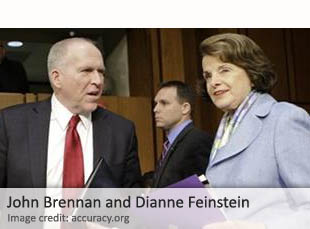
John Brennan and Dianne FeinsteinBy JOSEPH FITSANAKIS | intelNews.org
Dianne Feinstein, the chair of the United States Senate Select Committee on Intelligence, had gone out of her way in recent days to avoid commenting on the ongoing quarrel between her Committee and the Central Intelligence Agency (CIA). That ended yesterday, when she gave a press conference accusing the CIA of illegally spying on her Committee’s Congressional staffers. Her stunning announcement came shortly after her tense meeting with the Director of the CIA, a bad-tempered John Brennan. She told the media that at the meeting she requested from Brennan an apology and acknowledgement that the alleged CIA spying was “inappropriate”. By her own account, she failed to get either, so she decided to go public. In an interview I gave yesterday to Michigan’s WILS 1230 AM’s Capital City Recap, I argued that the quarrel between the two government bodies is not in itself important. What is important, I told radio host Mike Cohen, is that the dispute has entered the public arena. A routine ‘push and shove’ mêlée has turned into an all-out fistfight in full view of the media. One Republican Senator, Lindsay Graham, told the Associated Press on Tuesday that the time had come for “the legislative branch [to] declare war on the CIA”. In response to the Committee’s accusations, the CIA has apparently instructed the Department of Justice to investigate the alleged removal by Congressional staffers of classified documents that were “protected by executive privilege [and were] beyond the scope of the Committee’s investigation”.

Read more of this post

Rift between US Congress and CIA biggest in 40 years, say observers

CIA headquartersBy IAN ALLEN | intelNews.org
The system of checks and balances that defines the relationship between America’s legislative branch and the Intelligence Community has been strained more than any other time in nearly 40 years, according to insiders. The rift is especially wide between the Central Intelligence Agency (CIA) and the United States Senate’s Select Committee on Intelligence, which was formed in the mid-1970s after the Watergate scandal. Led by Senator Frank Church (D-Id) the congressional investigations into unlawful domestic intelligence activities by American spy agencies shaped the current oversight arrangements between the Senate and the CIA. But the two bodies are now engaged in what Foreign Policy magazine calls “a rare public feud” over the Committee’s ongoing investigation into the CIA’s harsh interrogation techniques. Foreign Policy cites interviews with “ten current and former congressional staff member and US government officials”, all of whom painted a “grim picture” of Senate-CIA relations. The Foreign Policy article quotes former Justice Department lawyer Dan Metcalfe, who opines that the current imbroglio “might well be the most acrimonious public moment between the CIA and a Senate committee [in] nearly 40 years”. Both sides accuse each other of violating longstanding agreements during the investigation into CIA’s use of torture in interrogations of terrorism detainees. Committee members have been claiming that the Agency’s interrogation methods have failed to produce useful information in pursuit of America’s national security. The CIA, on the other hand, accuses Committee staffers of illegally removing documents from an Agency facility, which the Committee was not supposed to see because they fell outside the scope of its inquiry. But some Senators on the Committee claim that the CIA did not want to hand over the documents precisely because they prove that no useful intelligence was extracted under torture. They also claim that the CIA effectively spied on Committee staffers by searching through their activity on computers used to access classified information. Read more of this post

News you may have missed #871

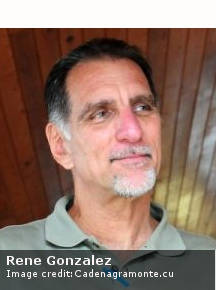
Rene GonzalezBy IAN ALLEN | intelNews.org
►►Britain denies visa for Cuban spy freed by US. Rene Gonzalez, one of the so-called “Cuban Five” intelligence agents convicted by the US of spying, has been denied a British visa to attend a London symposium. Gonzalez, who served 13 years in US prison before his release in 2011, had been invited to a two-day conference put on by “Voice for the Five”, an organization that campaigns in support of the convicted Cuban spies. The Cuban state-run newspaper Juventud Rebelde said Gonzales, 55, was denied a visa because British law prohibits entry of a person sentenced to more than four years in prison.
►►Canada fires intelligence analyst over contacts with Russians. Irina Koulatchenko, a 36-year-old who came to Canada as a Russian refugee via Cuba, has been fired by Canada’s financial-intelligence agency, known as FINTRAC. A Canadian Security Intelligence Service probe recommended she not be trusted to do that job, allegedly because “she had had several social encounters with Russian diplomats”. The latter included one she met “at a Cirque du Soleil show, another who was friends with her ex-fiancé and another she bumped into all the time at various social events”.
►►CIA suspected of spying on Congress members. The United States Department of Justice has opened an investigation into Senate aides removing documents from CIA headquarters that they reportedly “weren’t authorized to have”. It turns out, however, that the CIA found this out because they were secretly spying on members of the Senate Intelligence Committee and their staff who were working on a high-profile report on CIA torture of detainees. What is more, Democratic Senator Mark Udall has claimed US President Barack Obama knew of the CIA’s secret monitoring of the Committee.

US intelligence agencies urge ‘cautious approach’ on Ukraine

Chuck Hagel, Barack Obama, John BrennanBy IAN ALLEN | intelNews.org
American intelligence agencies see Russia’s control of the Crimean Peninsula as near-complete and urge Washington to take cautious steps on Ukraine, as Moscow appears prepared “to take military action” in defense of its strategic goals. The Los Angeles Times reported on Monday that some American intelligence analysts believe Moscow is genuinely convinced that its military action in Ukraine is justified under the Budapest Memorandum on Security Assurances. The agreement was signed in 1994 by the United States, United Kingdom, and the Russian Federation. The three nuclear powers guaranteed that they would refrain from actions that would subvert the territorial integrity and political autonomy of Ukraine. Western officials have accused Moscow of violating the agreement by dispatching Russian troops to southeastern Ukraine without the consent of the Ukrainian government. But some American intelligence analysts believe the Russian Foreign Ministry is convinced that Russian forces are acting within the scope of the 1994 agreement. The latter is interpreted by Russian officials as permitting Moscow to unilaterally dispatch up to 25,000 troops to the Crimea. This may even be the predominant view at the Central Intelligence Agency (CIA), judging by a briefing given last week by the Director of the CIA, John Brennan, to an unnamed “senior lawmaker”. The Times cited “US officials who declined to be named” as saying that Brennan suggested that Russian officials genuinely believe that the number of Russian troops in Ukraine “remains well below the threshold” specified in the Budapest Memorandum. Brennan added that, although he did not personally agree with Moscow’s interpretation of the Memorandum, it would be wise for Washington to tread cautiously on the subject, given the fact that Russian policy on Crimea remains unpredictable. Read more of this post

News you may have missed #870

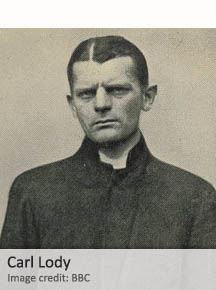
Carl LodyBy IAN ALLEN | intelNews.org
►►Documents show NZ spies taught ‘honey trap’ tricks. Members of New Zealand’s Government Communications Security Bureau were briefed by counterparts from the ultra-secret Joint Threat Research Intelligence Group, a unit of the British Signals intelligence agency GCHQ, on setting honey traps and Internet “dirty tricks” to “control, infiltrate, manipulate, and warp” online discourse, documents leaked by Edward Snowden reveal. According to the slides, JTRIG conducted “honey traps”, sent computer viruses, deleted the online presence of targets and engaged in cyber-attacks on the “hacktivist” collective Anonymous.
►►Ex-CIA analyst tells how data helped catch bin Laden. A central figure in the manhunt for Osama bin Laden, Nada Bakos spoke this week as the keynote speaker at a conference in California, on how data, big and small, led to the capture of al-Qaeda founder Osama bin Laden. “You don’t want to lead the information, you want the information to lead you”, she said, and credited the agency’s innovative gathering process that institutionalized various types of intelligence analysis —opposed to solely relying on general guidelines and best practices.
►►The story of WWI German spy Carl Lody. Towards the end of August 1914 a man checked into what is now the Balmoral Hotel in the centre of Edinburgh claiming to be an American tourist. In reality he was a German spy who had been sent to gather intelligence from the British. Carl Lody was a junior naval officer who had been forced to retire for health reasons but was looking for other ways to serve the fatherland. He was especially attractive to German naval intelligence because he had lived for years in the United States and spoke English fluently, although with an American accent.

US employed ex-Nazis to develop interrogation methods

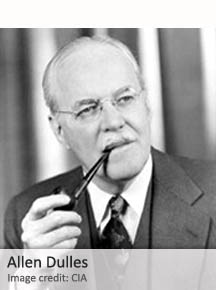
Allen DullesBy IAN ALLEN | intelNews.org
The United States relied on the assistance of dozens of German scientists to develop invasive interrogation techniques targeting the Soviet Union in the early years of the Cold War, according to a new book on the subject. The book, entitled Operation Paperclip: The Secret Intelligence Program that Brought Nazi Scientists to America, by American journalist Annie Jacobsen, is to be published this week. Operation PAPERCLIP was initially set up during World War II by the US Office of Strategic Services (OSS), a forerunner of the Central Intelligence Agency (CIA). Its aim was to recruit scientists that had previously been employed by the German Third Reich, with the primary goal of denying German scientific expertise to the USSR. Hundreds of former Nazi scientists were brought to the US under secret military research contracts during the second half of the 1940s. Eventually, the recruited scientists were used to augment an entire array of American government-sponsored endeavors, including the space program and several intelligence collection techniques. Jacobsen’s book details Operation BLUEBIRD, a program run by the CIA under PAPERCLIP, which employed former Nazi biological weapons experts, chemists and medical doctors. The latter were tasked with employing lysergic acid diethylamide, commonly known as LSD, in order to involuntary extort confessions from Soviet intelligence targets. In several cases, the hallucination-inducing chemical substance was dispensed on Soviet captives, who were also subjected to hypnosis and other methods of psychological manipulation. According to the book, the techniques were developed under the primary supervision of Dr. Walter Schreiber, Germany’s Surgeon General during the Third Reich. Schreiber helped the OSS set up an experimentation facility at Camp King, a CIA site located near Frankfurt in the American sector of Allied-occupied Germany. Read more of this post

Thatcher was warned about CIA activities in Britain, files show

Margaret ThatcherBy JOSEPH FITSANAKIS | intelNews.org
British Prime Minister Margaret Thatcher was warned in 1984 that American intelligence carried out operations in the United Kingdom without London’s consent. Although she dismissed the warnings, she authorized British counterintelligence to investigate the matter. A secret file from the British Foreign Office, which was declassified last month, shows that concerns about alleged American spy activity in the UK were communicated to the Tory Prime Minister by Paddy Ashdown —now Lord Ashdown— a Member of Parliament for Britain’s Liberal Party. In November of 1984, Ashdown notified Thatcher that he was concerned about a series of “clandestine activities” carried out by the United States Central Intelligence Agency (CIA) aimed at preventing communist countries from acquiring advanced computer technology developed by companies based in Britain. The written warning stated that CIA operatives had made “clandestine approaches” targetting individuals employed by leading British computer firms, inquiring about technology transfers to the Soviet Bloc. Ashdown added that the American intelligence agency had failed to provide the British government with advance notice of these activities, as was customary between the two allies. In his letter to Thatcher, the Liberal Party MP concluded that, based on his personal investigation into the matter, he was convinced the CIA operation was “still continuing”. The Prime Minister responded to Ashdown with an official letter explaining that there was “no evidence of improper activity by the CIA” or that British espionage laws had been violated by American intelligence personnel. She added that there was “close cooperation” between London and Washington on enforcing multilaterally agreed export controls, which included computer technology, and concluded that saw no need for an inquiry at that time. But London-based newspaper The Guardian, which accessed the declassified files on the case, said that Whitehall ordered the Foreign Office to investigate Ashdown’s allegations. The Foreign Office then tasked the Security Service (MI5) to find out whether the US had broken an agreement between the two countries to refrain from clandestine operations on each other’s territory unless the latter were authorized by both nations. Read more of this post

News you may have missed #864

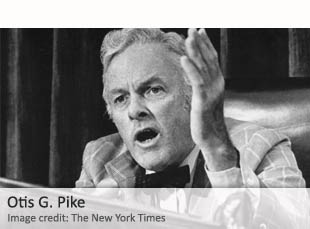
Otis G. PikeBy IAN ALLEN | intelNews.org
►►Germany says Obama’s NSA promise fails to address concerns. German Chancellor Angela Merkel’s government said yesterday that President Barack Obama’s pledge for new restrictions on mass surveillance by US spy agencies so far offered “no answer” to Germany’s concerns over spying. Merkel’s chief spokesman, Steffen Seibert, told reporters that Berlin would “look very closely at what practical consequences the announcements of the US president carry”, but added that key German concerns had not yet been addressed.
►►Longtime US Congressman who took on CIA dies. Otis G. Pike, a longtime Democratic Congressman from New York, who took on the CIA following the Watergate revelations, has died, aged 92. In 1975, he became chairman of the House Select Committee on Intelligence, which began examining suspicions that the CIA had had its hand in coups in Chile and other countries and was spying on American citizens. The inquiry paralleled one in the Senate, chaired by Frank Church. These committees marked the first time that Congress looked into allegations of abuse by the CIA and other US intelligence agencies.
►►East Timor slams Australia at The Hague over alleged spying.  The International Court of Justice in The Hague, Netherlands, is hearing a case brought against Australia by the government of East Timor. The small island nation accuses Australia of bugging the offices of key Timorese officials in an attempt to acquire inside information on a crucial energy deal. It alleges that a group of Australian Secret Intelligence Service (ASIS) officers disguised themselves as a refurbishing crew and planted numerous electronic surveillance devices in an East Timorese government office. The information collected from the listening devices allegedly allowed Australia to gain an upper hand during negotiations that led to the Certain Maritime Arrangements in the Timor Sea (CMATS) treaty.

German magazine reveals more information on elite NSA spy unit

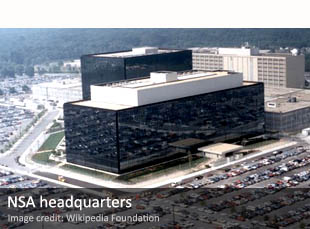
NSA headquartersBy JOSEPH FITSANAKIS | intelNews.org
Last June, we reported on the existence of an elite cyberatack unit within the United States National Security Agency (NSA), which operates under the Agency’s Office of Tailored Access Operations. Veteran NSA watcher Matthew M. Aid, who made the initial revelation, said at the time that the Office, known at NSA simply as TAO, maintains a substantial “hacker army” that works in close cooperation with the Central Intelligence Agency (CIA) and the Federal Bureau of Investigation (FBI). Now German newsmagazine Der Spiegel says it viewed internal documents that confirm the existence of TAO as the NSA’s elite operational unit. The publication describes TAO as “something like a squad of plumbers that can be called in when normal access to a target is blocked”. It adds that TAO operatives are routinely detailed to a host of American intelligence agencies to help conduct intelligence operations ranging from traditional espionage to counterterrorism and cyberwarfare. Furthermore, TAO’s personnel, which are allegedly far younger than the average NSA officer, are experts in exploiting the technical deficiencies of the information-technology industry. They have therefore been able to compromise communications hardware and software produced by some of the world’s biggest IT companies and service providers, including Huawei, Cisco and Microsoft. The Spiegel article claims that TAO was established in 1997, several years before the Internet became a prominent engine of economic and cultural activity around the world. Its personnel, which initially consisted of a few select technical experts, was housed at the NSA headquarters in Fort George Meade, Maryland, but “in a separate wing, set apart from the rest of the agency”. Notably, Der Spiegel cites a paper produced by a former TAO unit head, which states that the program has produced “some of the most significant intelligence our country has ever seen” and urges for its continued growth. Read more of this post

News you may have missed #862

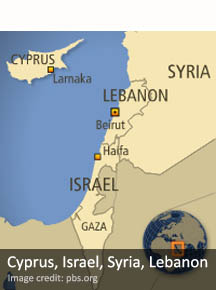
Cyprus, Israel, Syria, LebanonBy IAN ALLEN | intelNews.org
►►Covert CIA program helped Colombia kill rebel leaders. A covert CIA program has helped Colombia’s government kill at least two dozen leaders of the Revolutionary Armed Forces of Colombia, the rebel insurgency also known as FARC, The Washington Post reported Saturday. The National Security Agency has also provided “substantial eavesdropping help” to the Colombian government, according to The Post.
►►Israel asks US not to spy on it. Israeli officials broke their silence over the US surveillance scandal Sunday, angrily demanding an end to Washington’s spying on Israel. Last week more documents leaked by former NSA technical expert Edward Snowden uncovered a partnership between the NSA and British intelligence agency GCHQ from 2008 to 2011 to monitor office email addresses from the then-Israeli Prime Minister Ehud Olmert and Defense Minister Ehud Barak.
►►Germany reacts coolly to French request on Central Africa. Germany reacted coolly last week to a French request that European countries step up support for its military mission in Central African Republic, playing down the likelihood of any financial assistance on the eve of an EU summit. France has deployed 1,600 troops there to prevent worsening violence between Christian militias and largely Muslim Seleka rebels who ousted ex-President Francois Bozize.

American who disappeared in Iran in 2007 was working for the CIA

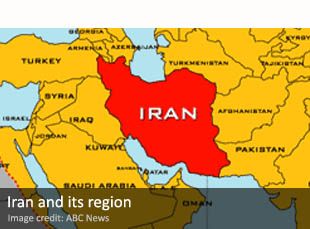
Iran and its regionBy IAN ALLEN | intelNews.org
An American private investigator, who was last seen in Iran in 2007, was under contract with the United States Central Intelligence Agency when he disappeared, according to information published last week. Bob Levinson was last seen alive in a hotel in Iran’s Kish Island, on March 8, 2007. He was reportedly there as a private investigator, to explore alleged links to a worldwide cigarette smuggling network. Both his family and the CIA have vehemently denied rumors that he was secretly working for the US government when he disappeared. Last week, however, the Associated Press and The Washington Post published lead articles in which they alleged that Levinson had been on a CIA mission at the time of his disappearance. The Associated Press, which described the news as “one of the biggest scandals in recent CIA history”, said it decided to run the story after agreeing to delay its publication three times in the past. The news agency said it first confirmed Levinson’s ties to the CIA in 2010, but was told by the US government that airing a story on the subject would compromise Levinson’s safety. Government officials reportedly told Associated Press editors that they were “pursuing promising leads” to get Levinson home, and that news of his CIA connection would fatally hamper their efforts. However the news agency decided to publish the story because, as its editors said, Levinson’s captors now “almost certainly know about his CIA association”. In a story aired on Friday, CNN said it spoke to an unnamed source “involved in the matter”, who confirmed that Levinson was in Iran on private business, but was also under contract with the CIA as an undercover agent. Read more of this post

CIA to cut back ‘unsuccessful’ non-official-cover program

CIA headquartersBy JOSEPH FITSANAKIS | intelNews.org
The United States Central Intelligence Agency is scaling down an ambitious human intelligence program that places case officers in non-diplomatic cover jobs, because it has been ineffective, according to media reports. When stationed abroad, the vast majority of CIA case officers pose as American diplomats. This type of cover allows them to mingle with —and attempt to recruit— foreign officials. It also offers them the added benefit of diplomatic immunity, which minimizes the possibility of their long-term imprisonment or even execution in the hands of adversaries. The pressures of the post-9/11 security environment, however, pushed the Agency to deploy case officers that are not associated with American embassies and consulates abroad. The reason is that members of non-state groups like al-Qaeda cannot be recruited on the diplomatic circuit. To penetrate these groups, CIA case officers must hit the streets of cities like Sana’a, Peshawar, Basra or Mogadishu. These case officers, who operate without diplomatic immunity, are known at the CIA as non-official-cover, or NOCs. They typically pose as business executives, students, academics, journalists, or non-profit agency workers, among other covers. The idea is that working outside of American embassies and consulates, they can be more successful in recruiting members of non-state terrorist entities. In the past decade, the CIA has spent over $3 billion on its NOC program, and has increased the number of active NOCs from several dozen to several hundred. Agency NOCs have been deployed all over the world, using elaborate fake ‘legends’ (identities and supporting information) connected with CIA front companies. Their job is considered one of the most risky at the CIA, because they cannot invoke diplomatic immunity if arrested in a foreign country. However, an article published last weekend in The Los Angeles Times alleges that the CIA’s NOC program, known officially as the Global Deployment Initiative, is now being scaled down. Read more of this post

CIA declassifies 1978 Camp David Accord files

Sadat, Carter and BeginBy JOSEPH FITSANAKIS | intelNews.org
The United States Central Intelligence Agency has declassified 1,400 pages of intelligence files relating to the Camp David Accords, the historic peace treaty between Egypt and Israel, which was signed in 1978. The treaty, the first between Israel and an Arab country, was signed on September 17, following thirteen days of high-level negotiations between Egypt and Isarel at the Camp David presidential retreat in the US state of Maryland. The two signatories were Egyptian President Anwar Sadat and Israeli Prime Minister Menachem Begin. The high-level summit was hosted by US President Jimmy Carter. All three heads of state were awarded the Nobel Peace Prize later that year, which they shared for helping bring about the first peace treaty between an Arab nation and Israel. The 250 previously classified documents on the Accords, which were released by the CIA earlier this week, date from January 1977 to March 1979. They include comprehensive political assessments and personality profiles of President Sadat, Prime Minister Begin, and other key personalities participating at the summit, which were given to President Carter to read before the meeting. One of the documents refers to a meeting between Carter and CIA analysts at the Agency’s headquarters in August 1978, during which the American President was coached about how to negotiate with the two Middle Eastern leaders. Or, as the document puts it, Carter was “steeped in the personalities of Begin and Sadat”. The papers also include declassified transcripts of meetings of the US National Security Council, in which the Accords were discussed. Read more of this post