China sentences US citizen to life for espionage following closed-door trial

Hong KongA CHINESE COURT HAS sentenced a United States passport holder to life in prison on espionage charges, following a brief closed-door trial. However, no information has been made available about the precise charges against him. Closed-door trials are frequent occurrences in Chinese courts, especially in cases relating to national security, which include charges of espionage against the state. However, life sentences are exceedingly rare for espionage cases.

The individual convicted in this case has been named in media reports as John Shing-Wan Leung, 78. He is reportedly a permanent resident of Hong Kong, a special administrative region of China, over which Beijing has near-absolute control. It is not known if Leung was a Chinese citizen at any time in his life. China does not recognize joint citizenship and requires its citizens to drop their Chinese citizenship when swearing allegiance to another country. The Reuters news agency reported on Monday that Leung was at some point a member of two American-based Chinese expatriate groups, which it described as “pro-China”. These are the United States-China Friendship Promotion Association and the United States-China Friendship Association.

Leung is believed to have been arrested in Hong Kong in 2021 by local Chinese counterintelligence officers. He has been held in prison ever since his arrest. A press release issued on Monday by the Intermediate People’s Court in Suzhou, a city located in southern Jiangsu province, 700 north of Hong Kong, said Leung had been found “guilty of espionage”. The press release added that Leung had been “sentenced to life imprisonment and deprived of [his] political rights for life”. However, the statement provided no information about Leung’s alleged crimes, or the country he was found to have spied for.

According to the BBC, the United States embassy in Beijing refused to discuss the details of this case, stating only that the United States government was aware of Leung’s conviction. An embassy spokesperson told the BBC that “the Department of State has no greater priority than the safety and security of US citizens overseas”.

► Author: Joseph Fitsanakis | Date: 15 May 2023 | Permalink

Senior members of South Korea’s largest trade union charged with espionage

KCTU South KoreaSOUTH KOREAN PROSECUTORS have charged four senior members of one of the country’s largest trade unions with espionage on behalf of North Korea. The move, which is seen as highly controversial by South Korea’s liberal opposition, has come a few months after the conservative administration of President Yoon Suk Yeol launched what some commentators have described as South Korea’s largest counter-espionage operation in over 30 years.

The operation came to light on January 18, when hundreds of police officers, led by officers of the National Intelligence Service (NIS), conducted search raids at a number of regional offices of the Korean Confederation of Trade Unions (KCTU). Founded in the mid-1990s, the KCTU represents over 1.1 million members. Most of its membership consists of supporters of the Democratic Party of Korea (DPK), a left-of-center liberal coalition that ruled South Korea until last year. Since its establishment in 2014, the DPK has been engaged in a bitter political rivalry with the People Power Party (PPP), a conservative coalition that currently governs South Korea.

On Wednesday, four KCTU officials, all of them men, between the ages of 48 and 54, were charged with several violations of South Korea’s National Security Act, including carrying out espionage on behalf of North Korea and meeting illegally with North Korean intelligence officers. South Korean government prosecutors accuse the four of meeting several times with their alleged North Korean handlers. The alleged meetings too place during overseas trips in Vietnam and Cambodia between 2017 and 2019.

While abroad, the four alleged spies were allegedly trained and given instructions to establish what prosecutors describe as “an underground organization [operating] under the guise of legal union activities”. The four men were allegedly tasked with steering the KCTU toward actions and rhetoric that were against the United States and Japan. They were also asked to helping organize worker rallies against the policies of the PPP. In other instances, the alleged spies photographed American military installations located in South Korea.

The opposition DPK has strongly condemned the charges, calling them politically motivated and describing them as a return to the days of rightwing military rule, which South Korea experienced until 1987. The NIS remains highly controversial among left-of-center South Koreans, many of whom view it as a corrupt state entity that is politically aligned with the conservative PPP. Between 2018 and 2022, the liberal DPK government spearheaded what it described as an “anti-corruption campaign” inside the NIS. As a result of that campaign, three former NIS directors were charged with —and eventually convicted of— secretly diverting funds from the agency’s clandestine budget. The funds were eventually used to aid the re-election campaign of the then-South Korean President, Park Geun-hye. Their apparent goal was to prevent the DPK from coming to power, fearing that the left-of-center party was too close to Pyongyang. President Park also went to prison for accepting financial bribes from the NIS.

► Author: Joseph Fitsanakis | Date: 12 May 2023 | Permalink
Russia calls for UN Security Council meeting in response to Polish espionage claims

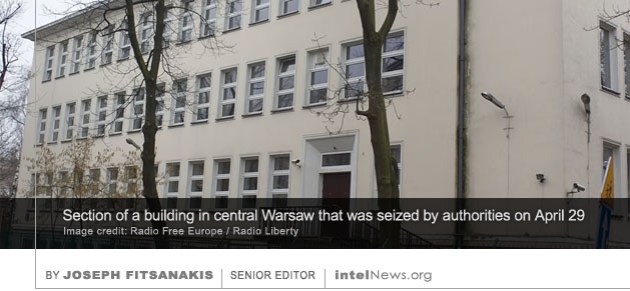
Warsaw PolandAUTHORITIES IN POLAND HAVE seized an abandoned school building in the Polish capital Warsaw, allegedly because it was being used as a base for espionage activities by the Russian government. Following the seizure  of the building complex, Russian officials issued stern but vague warnings, saying that action will be taken in response to what they termed as an “act of provocation” by the Polish government.

The controversial seizure was revealed on Saturday afternoon by Warsaw’s Deputy Mayor Tomasz Bratek, who announced that Warsaw city authorities had “taken possession” of the building. He was referring to a communist-era building complex in central Warsaw’s Ochota district, which, according to Moscow, belongs to the Russian government. The property was originally part of the Soviet embassy complex, but was later transformed into a high school and community center specializing in Russian language and culture. Many of its students were children of Russian diplomats who are stationed at the nearby Russian embassy. It has fallen into disuse in recent years.

Poland claims that the Russian government never officially bought or leased the property, and that it had been using it without permission for over three decades. Warsaw city officials maintain that the building belongs to the Warsaw city council and that they have repeatedly asked Russia to vacate the building, but to no avail. In recent years, the Polish government has been accusing Russia of using the high school as a cover for espionage activities, and claims that the use of the building by Moscow violates Polish sovereignty while also constituting a security threat.

Late on Saturday, the Russian government strongly denied the allegations and accused the Polish government of engaging in anti-Russian propaganda. It was later reported that Russia had called for an emergency meeting of the United Nations Security Council (which it currently chairs) to discuss the matter. The United States and other Western countries have not yet commented on the incident, but are likely to express support for Poland’s actions, given their own concerns about Russian intelligence activities in the region.

The seizure of the high school building is just the latest incident in a long list of espionage and counter-espionage incidents involving Russia and its neighbors in Europe. Since the Russian invasion of Crimea in 2014, such incidents have increased considerably. The seizure of the high school building in Warsaw highlights the continuing tensions between Russia and its neighbors in Europe, as well as the centrality of intelligence-gathering and counter-intelligence efforts in the region.

► Author: Joseph Fitsanakis | Date: 01 May 2023 | Permalink

China-based Australian businessman charged with espionage

ASIO AustraliaAN AUSTRALIAN BUSINESSMAN, WHO has worked in China for over two decades, is facing up to 15 years in prison for allegedly selling secrets to two foreign intelligence officers. The businessman, Alexander Csergo, 55, grew up in Sydney, but moved to China in 2002 and currently works for a digital solutions firm in Shanghai. According to reports, Csergo describes himself on social media as a “business strategist” and an “operational transformation specialist”.
Csergo was arrested by the Australian Federal Police (AFP) on Friday afternoon at his family home in the eastern Sydney suburb of Bondi. According to a press release, Csergo’s arrest resulted from an investigation by the Counter Foreign Interference Taskforce (CFITF), aa joint counterintelligence body led by the AFP and the Australian Security Intelligence Organisation. Established in 2021, the CFITF brings together counterintelligence units from across Australia’s federal government sectors in order to discover, disrupt and investigate foreign interference activity.

Australian government prosecutors claim that representatives of a foreign think-tank approached Csergo on social media while he was overseas —presumably in China. The think-tank representatives arranged for Csergo to come in contact with two individuals, calling themselves “Evelyn” and “Ken”. They offered to pay Csergo in return for reports that contained “information about Australian defence, economic and national security arrangements, as well as matters relating to other countries”.

Csergo allegedly agreed to provide the requested services and proceeded to compile a number of reports for the think-tank between February 2021 and April 14 of this year. The Australian government alleges that “Evelyn” and “Ken” are in fact emploees of a foreign intelligence service, which has not yet been publicly identified in Australian government press releases. The Australian government also claims that these individuals may have tried to recruit other Australians, or foreign citizens living in Australia.

► Author: Joseph Fitsanakis | Date: 17 April 2023 | Permalink

United States charges Russian spy who lived in Maryland using forged identity

US Department of JusticeA RUSSIAN INTELLIGENCE OPERATIVE, who lived in Maryland using forged Brazilian identity documents, has been charged with espionage and other crimes by the United States Department of Justice. Victor Muller Ferreira, a Brazilian national, was stopped from entering the Netherlands in June of last year, where he had intended to join the International Criminal Court (ICC) as an intern.
Shortly after Muller was stopped at Amsterdam’s Schiphol International Airport, the Netherlands General Intelligence and Security Service (AIVD) revealed that he was in fact Sergey Vladimirovich Cherkasov, a 36-year-old Russian citizen. According to the AIVD, Cherkasov had worked for over a decade as an intelligence officer for the Main Directorate of the Russian Armed Forces’ General Staff, which is commonly known in the intelligence field as GRU.

A few days after Cherkasov returned to Brazil, a federal court in Guarulhos, a suburb of Sao Paolo, found him guilty of having used the identity of a dead Brazilian citizen to forge identity papers, which he then used to enter and leave Brazil 15 times over 10 years. The 10-year period had started in 2010, when Cherkasov had entered Brazil using his real Russian identity. But when he left the country a few months later, he did so using the forged identity that had allegedly been provided to him by Russian intelligence. Having examined the charges against Cherkasov, the court jailed him for 15 years.

Now the United States Department of Justice has charged Cherkasov with a list of new crimes, including acting as an unregistered agent of a foreign power and repeatedly carrying out visa, bank and wire fraud. The charges resulted from an investigation that was conducted by the Federal Bureau of Investigation’s counterintelligence division, in coordination with the Bureau’s Washington Field Office.

The charges stem from the years 2018-2020, when Cherkasov used his forged Brazilian identity to enroll as Master’s student at the Johns Hopkins University’s School of Advanced International Studies. Cherkasov successfully completed his graduate degree in 2020. Two years later, he left for the Netherlands, where he hoped to enter employment in the ICC.

► Author: Joseph Fitsanakis | Date: 27 March 2023 | Permalink

Greek authorities uncover identity of Russian spy who posed as Greek citizen

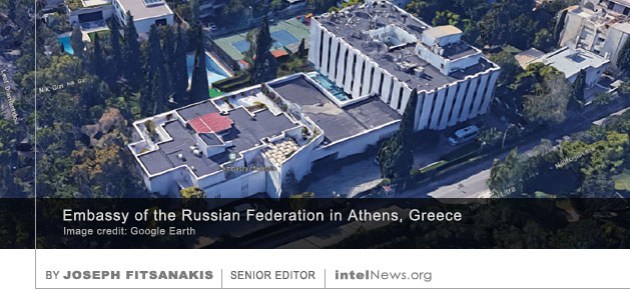
Embassy of Russia in GreeceGREEK INTELLIGENCE OFFICIALS ANNOUNCED late last week that they had uncovered the identity of a female Russian spy who lived in central Athens using a set of forged identity documents. According to the Greek National Intelligence Service (NIS/EYP), the case is under investigation by several Western intelligence agencies. Additionally, there seems to be a connection with Brazil where the Russian spy’s husband lived until recently, using forged identity papers.

In an article published on Friday, the Greek daily Kathimerini, identified the woman as “Irena A.S.”. It said she had arrived in Greece from an unspecified Latin American country in 2018. Soon afterwards, she assumed a new cover identity, using the birth certificate of a Greek child named Maria Tsalla. The child is believed to have died in the northeastern Athens suburb of Marousi in December 1991, a few days after being born. According to the report, NIS/EYP officers discovered that the dead child’s archived death certificate in the Marousi town hall had been removed by persons unknown, giving officials the impression that Maria Tsalla was still alive.

Soon after assuming her cover identity, Irena A.S. registered herself as a resident of Aliveri, a largely rural municipality in the central Greek island of Euboea. Less than a year later, using the name Maria Tsalla, she opened a knitwear store in the central Athens neighborhood of Pagrati, where she also rented an apartment. It is believed that she had hired an employee and had a Greek boyfriend, none of whom were aware that she was not Greek. According to the article in Kathimerini, the NIS/EYP has yet to uncover evidence that Irena A.S. was in contact with officials at the Russian embassy in Athens (pictured).

For reasons that remain unclear, Irena A.S. left Greece in a hurry in January of this year, leaving behind most of her personal belongings. She eventually contacted her store and apartment landlords, informing them that she would not be returning to Greece due to some health issues. In the weeks that followed, she ensured that all of her financial obligations toward her landlords and employee were met. It is believed that Irena A.S.’s husband, also a Russian national, who lived in Brazil using forged cover credentials, and going by the cover name “Daniel Campos”, also disappeared in January of this year. It is highly likely that they have both returned to Russia, possibly under fear of their cover being blown.

► Author: Joseph Fitsanakis | Date: 20 March 2023 | Permalink

Alleged Russian spy and sabotage cell busted in Poland [updated]

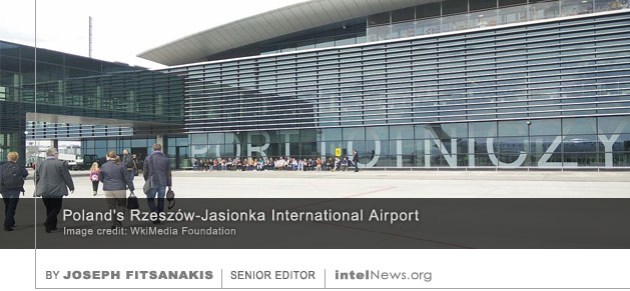
Rzeszów–Jasionka International Airport PolandSIX NINE MEMBERS OF AN alleged Russian saboteur cell have been arrested in Poland, according to media reports and official acknowledgements by Polish authorities. Early reports on Wednesday afternoon local time centered on the arrests of six nine individuals, who were detained on suspicion of conducting espionage and planning sabotage attacks against various elements of transportation infrastructure.

Radio station RMF24 FM reported that the six nine individuals were detained following a number of early-morning raids conducted by the Polish Internal Security Agency (ABW), which is the country’s primary counterintelligence and counterterrorism organization. At least some of the six nine individuals are reportedly Belarusian nationals who were active in Poland’s southeastern Podkarpackie Voivodeship, a largely rural province that borders Ukraine’s Lviv Oblast. Later on Wednesday, the RMF24 FM report was confirmed by Polish government officials, who spoke to the BBC.

Notably, the Podkarpackie Voivodeship is home to the Rzeszów–Jasionka International Airport, located near the village of Jasionka, which is approximately 60 miles, or 100 kilometers, from the Ukrainian border. Since the February 2022 Russian invasion of Ukraine, this provincial airport has been transformed into a major logistical gateway for the transportation of Western military and humanitarian aid to Ukraine. Dozens of Western aircraft land there every day, carrying supplies that are then loaded onto trucks or trains en route to Ukraine.

According to RMF24 FM, the six nine foreign nationals installed hidden miniature cameras at railway junctions and other strategic transportation hubs throughout the Podkarpackie Voivodeship. The cameras were allegedly used to collect information on the movement of trains and trucks that were being used to transport supplies from the Rzeszów–Jasionka International Airport to Ukraine. The radio station said that Polish authorities were scheduled to provide further information about the alleged spy cell at a press conference on Thursday.

[Updated to reflect arrest of nine individuals, as opposed to six, as initially reported]

► Author: Joseph Fitsanakis | Date: 16 March 2023 | Permalink

Australia to deport Kazakh-born Irish woman for allegedly spying for Russia

Irish National Space CentreTHE GOVERNMENT OF AUSTRALIA has ordered the deportation of a Kazakh-born Irish citizen, who is believed to be a spy for the Russian Federation, according to reports from Australia and Ireland. The woman in question has been identified as Marina Sologub, 39, an ethnic Russian who was born in Kazakhstan, but grew up in the Republic of Ireland.
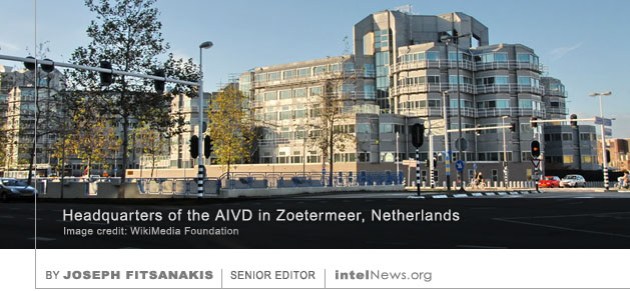
Sologub reportedly spent her teenage years in Glanmire, a suburb of the city of Cork, located on Ireland’s southern coastline. She eventually enrolled at University College Cork, where she graduated with a degree in Politics and Governance. While still at university, Sologub worked for Bernard Allen, a member of parliament for Ireland’s center-right Fine Gael political party. She then worked full-time at the office of Willie Penrose, a parliamentarian for the left-of-center Labour Party, which is far smaller than Fine Gael.

In 2011, when she was in her late 20s, Sologub was hired by Ireland’s National Space Centre in Middleton, Cork, where she remained for 7 years. According to media reports, Sologub has claimed that she was instrumental in “the development of intergovernmental agreement between Republic of Ireland and Russia Federation in use of space for civil purposes” during her time at the National Space Centre.

In 2020, Sologub’s impressive résumé landed her a job with the British-headquartered international consultancy firm Deloitte in Australia. She moved to Australia in September of that year and worked for Deloitte for about a year, at which point she was hired by a private firm specializing in the space industry. She subsequently entered employment with the city council of Marion, a small suburb of Adelaide, the capital of South Australia.

On February 22, the Australian Security Intelligence Organisation (ASIO), which is tasked with counterintelligence, announced that Sologub’s visa was under investigation on suspicion of her role in international espionage. It was reported that Sologub had had “extensive interactions with diplomatic staff from the Russian embassy” in Australia, which began soon after she entered the country in 2020. Now Australia has announced Sologub’s deportation from the country. According to media reports, Sologub’s deportation is part of a wider operation that aims “to identify Russian intelligence workers among high-ranking employees” in Australian government and industry.

► Author: Joseph Fitsanakis | Date: 27 February 2023 | Permalink

Russia covertly mapping key energy infrastructure for sabotage, Dutch report warns

AIVD HollandTHE RUSSIAN INTELLIGENCE SERVICES are “covertly mapping” the energy infrastructure of the North Sea, in preparation for acts of disruption and sabotage, according to a new report form the Dutch government. The 32-page report was published this week, ahead of the one-year anniversary of the 2022 Russian invasion of Ukraine. It was authored collaboratively by the two main intelligence agencies of the Netherlands, the General Intelligence and Security Service (AIVD) and the Military Intelligence and Security Service (MIVD).
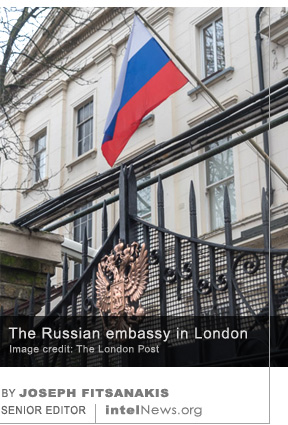
The report notes that Russian spy ships, drones, satellites and human agents are engaged in an unprecedented effort to chart the energy and other “vital marine infrastructure” of the North Sea. The purpose of this effort is to understand how the energy and other key infrastructure works in the North Sea. The term North Sea refers to the maritime region that lies between France, Belgium, the Netherlands, Germany, Denmark, Norway and the United Kingdom. It hosts key energy infrastructure, including oil, natural gas, wind and wave power installations, which supply energy to much of northern Europe.

According to the report, Russian intelligence and espionage activities in the North Sea “indicate preparatory acts of disruption and sabotage. These appear to be aimed at energy systems, but also other vital infrastructure, such as undersea power and communication cables, and even drinking water facilities. Consequently, physical threats toward any and all of these facilities should be viewed as conceivable, the report warns.

On Saturday, the Dutch government said it would expel an undisclosed number (believed to be at least ten) of Russian diplomats. It also accused Moscow of engaging in constant efforts to staff its diplomat facilities in the Netherlands with undercover intelligence officers. On the same day, the Dutch government said it would shut down its consulate in Russia’s second-largest city, St. Petersburg, and ordered Russia to shut down its trade mission in the port city of Amsterdam.

► Author: Joseph Fitsanakis | Date: 21 February 2023 | Permalink

Russia’s spy networks in Europe see greatest post-Cold War setback, experts claim

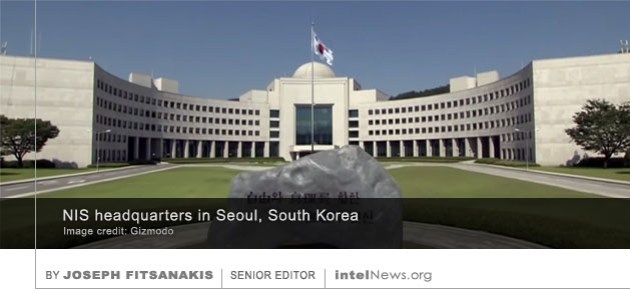
Russian embassy LondonRUSSIA’S ABILITY TO CONDUCT human intelligence operations in Europe has suffered greater damage in recent years than at any time since 1991, according to some experts. These setbacks have partly been caused by what The Washington Post refers to in a recent article as “a campaign to cripple Russian spy networks”, which is taking place across the continent. This Europe-wide campaign has grown in momentum since the Russian invasion of Ukraine and supplements boarder efforts to arm Ukraine in its war against the Kremlin.
The initial blow against the Kremlin’s spy network was delivered last year, when a wave of mass expulsions of Russian diplomats resulted in more than 400 suspected Russian intelligence officers being ordered to leave various European capitals. According to observes, the expelled Russian diplomats were in reality intelligence officers, who were active across Europe under diplomatic cover. Since that time, European counterintelligence agencies have launched a series of “precision strikes” against what remains of Russia’s human intelligence network across the continent.

The recent wave of expulsions of Russian intelligence personnel was not unprecedented. But it does suggest a degree of collaboration between Europe’s counterintelligence agencies that is difficult to match with historical examples. An interesting element in this collaboration is what The Washington Post describes as a “post-Ukraine shift in mind-set” in countries that had previously taken a softer approach toward the Kremlin. These include Germany, as well as Britain, which since 2018 has “refused on national security grounds over 100 Russian diplomatic visa applications”.

Russia’s response has been noticeably muted, and may mean that Moscow was caught off-guard by this Europe-wide counterintelligence campaign. The Post quotes Antti Pelttari, director of the Finnish Security and Intelligence Service (SUPO), who claims that the Russian capability to conduct human intelligence operations in Europe “has been degraded considerably”. This would imply that the Kremlin’s ability to carry out covert political action, such as political influence campaigns and related psychological operations, has been curtailed. Moreover, it is likely that the Russian intelligence services are unable to adequately assist the Kremlin’s decision-making capabilities with actionable information. Read more of this post

Tension mounts as South Korea launches largest anti-spying operation in 30 years

NIS South KoreaTENSION IS MOUNTING BETWEEN the government and opposition forces in South Korea, as the conservative administration of President Yoon Suk Yeol appears to be behind an effort to probe alleged links between senior liberal political figures and North Korean intelligence. The effort, which some commentators suggest could be the largest counter-espionage operation in the country’s history since 1992, is being led by the National Intelligence Service (NIS).
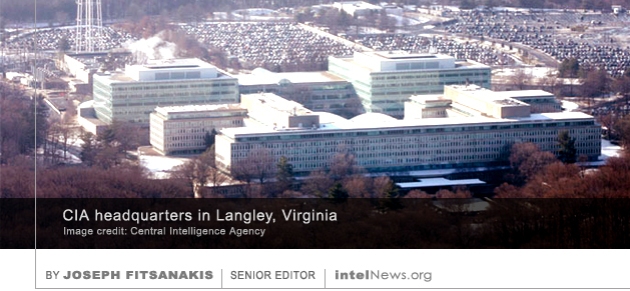
The operation came to light on January 18, when hundreds of police officers, led by NIS officers, conducted search raids at a number of regional offices of the Korean Confederation of Trade Unions (KCTU). Founded in the mid-1990s, the KCTU is South Korea’s second-largest labor coalition, representing over 1.1 million members. It is politically aligned with the Democratic Party of Korea (DPK), a left-of-center liberal coalition which was in government until last year. Since its establishment in 2014, the DPK has been engaged in a bitter political rivalry with the People Power Party (PPP), a conservative coalition that currently governs South Korea.

According to reports, the NIS is investigating charges that members of the KCTU formed “a clandestine organization” that engaged in protests against the United States and organized “various subversive campaigns under instructions from North Korea”. According to the NIS, the clandestine organization was led by a senior KCTU official, who was handled by clandestine operatives of North Korea’s ruling political party, the Workers’ Party of Korea (WPK). The NIS claims that the official met repeatedly with WPK operatives during trips to countries like Vietnam and Cambodia, between 2016 and last year.

On January 18, a large police force appeared to be trying to enter the KCTU headquarters in Seoul, in an attempt to arrest the trade union official, who has not been named. Video footage appeared on South Korean social media, which appeared to show a standoff between law enforcement and KCTU officials. The latter attempted to be trying to prevent the police and NIS representatives from entering the building. Eventually, the authorities were able to enter the building, while also attempting to prevent some individuals barricaded inside from leaving. Read more of this post

Espionage allegations prompt sharp exchanges between ex-CIA officials

CIAA BOOK BY A former Central Intelligence Agency (CIA) case officer, which alleges that a senior Agency official sabotaged American counterintelligence efforts on orders from Moscow, has prompted a series of fiery exchanges by retired CIA personnel. The primary figures in the dispute are the book’s author, Robert Baer, and Paul J. Redmond, who served as the CIA’s Associate Deputy Director of Operations for Counterintelligence.
Baer’s book, The Fourth Man: The Hunt for a KGB Spy at the Top of the CIA and the Rise of Putin’s Russia (Hachette Books, May 2022), focuses on the period following the arrests of three American intelligence insiders, who were found to have spied for the Kremlin: Federal Bureau of Investigation (FBI) agent Robert Hanssen, and CIA officers Aldrich Ames and Edward Lee Howard. By 2002, Hanssen and Ames were serving life sentences for espionage, while Howard had died in Russia where he had fled while under investigation by the FBI. Collectively, these three had been responsible for some of the CIA’s gravest operational setbacks against the Soviet KGB and its Russian successor agencies.

Some in the CIA, however, remained convinced that not all of the CIA’s failures in the 1980s and 1990s could be explained away in this fashion. They held on to the suspicion that Moscow had been able to recruit a senior CIA executive, who —among other things— had sabotaged numerous probes by some of the Agency’s most committed spy-hunters. Baer’s book discusses how, in the mid-1990s, the CIA’s Directorate of Operations actively pursued those suspicions, by setting up a Special Investigations Unit (SIU). This new unit was led by one of the CIA’s most talented counterintelligence officers, Paul Redmond.

CONTROVERSY

This is precisely the point at which Baer’s book turns wildly controversial: it alleges that the missing spy, whom Baer refers to as “the fourth man”, is none other than Redmond himself. The retired CIA case officer further alleges that even the SIU eventually concluded that Redmond —i.e. its leading member— was a spy for Moscow. The author claims that the SIU presented those findings at a briefing with Redmond among the audience. The presentation prompted Redmond to storm out of the meeting, Baer alleges.

Importantly, Baer describes his case as “inconclusive”, and claims that he relies on information from some of his former CIA colleagues. He also admits that the very idea of a “fourth man” may be nothing more than a chimera. Nevertheless, the SIU probe did occur. It also appears that the FBI opened an investigation into the matter in 2006. Baer claims to have received a visit by two FBI agents in 2021, in which he was asked about what he knew about Raymond. This, he says, left him with the impression that some sort of counterintelligence effort to find the “fourth man” was “ongoing then and is continuing” now. Moreover, according to Baer, this counterintelligence investigation is no longer confined in-house at CIA; the FBI has now taken the lead.

REDMOND’S SIDE RESPONDS

Remarkably, Baer appears to have spoken to Redmond at least twice while preparing his book. On each occasion, the retired CIA senior executive fiercely rejected Baer’s claims that he was a spy for Moscow. In recent months, Redmond voiced his dismay at Baer’s claims publicly. As SpyTalk reports, the first time Redmond spoke publicly about Baer’s book was in November of last year, during an event held by the Association of Former Intelligence Officers. Read more of this post

Austria expels four more Russian diplomats for espionage, sources say

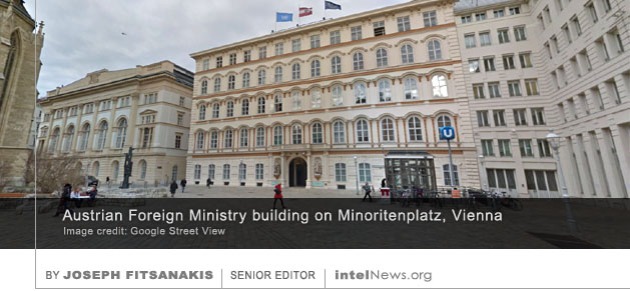
Austria Foreign Affairs MinistryTHE MINISTRY OF FOREIGN Affairs of Austria announced Thursday that it has ordered the expulsions of four Russian diplomats from its territory. It is highly unusual for Austria, which is traditionally reluctant to take sides in international political disputes, to expel Russian diplomats.
According to the ministry, two of the diplomats are stationed at the Embassy of Russia in the Austrian capital, Vienna. The other two diplomats are members of the Permanent Mission of Russia to the United Nations office in the same city. All four have been declared personae non gratae (unwelcome persons) in accordance with Article 9 of the Vienna Convention on Diplomatic Relations. They are being expelled for allegedly “committing actions incompatible with their diplomatic status”.

Although Austrian authorities have refused to provide details about the expulsions, the phrase “actions incompatible with [one’s] diplomatic status” is often used in diplomatic lingo to refer to activities relating to espionage or other clandestine operations. The Reuters news agency cited “officials speaking on condition of anonymity” in claiming the four Russian diplomats were indeed involved in espionage. However, the Russian embassy in Vienna declined media requests for comment.

The Russian diplomats have been ordered to leave Austria by the end of Wednesday, February 8. The last time Austria expelled Russian diplomats was 2020, prompting Russia to expel an Austrian diplomat in response. Since that time, and including this week’s expulsions, Austria has expelled a total of nine Russian spies from its territory. According to media reports, over 140 diplomats are currently based at the Embassy of Russia in Vienna.

► Author: Joseph Fitsanakis | Date: 03 February 2023 | Permalink

Germany arrests alleged collaborator of intelligence officer who spied for Russia

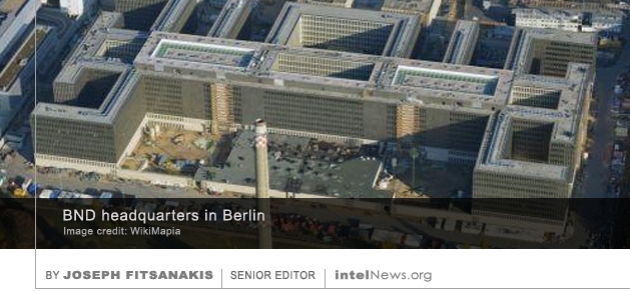
BND GermanyTHE GERMAN GOVERNMENT ANNOUNCED last week the arrest of a man believed to have acted as a courier between Russian intelligence and another German spy, who was arrested in December and is awaiting trial. The new arrest is bound to attract even more international attention to this unfolding case of espionage, whose urgency has reportedly alarmed Western intelligence services.

On December 22, German authorities arrested a senior German intelligence official, who has been charged with treason and remains in custody. The official, named only as “Carsten L.”, in compliance with Germany’s strict privacy laws, worked in the signals intelligence (SIGINT) wing of the Federal Intelligence Service (BND). As Germany’s foreign intelligence agency, the BND is tasked with collecting intelligence on foreign targets, a mission that makes it broadly equivalent to the United States Central Intelligence Agency (CIA).

As intelNews reported earlier this month, Carsten L.’s seniority within the BND allowed him to access several compartmentalized areas of information, including secrets shared with the BND by other Western intelligence agencies. For this reason, it was reported that some Western intelligence officials were “most incensed” with this case. One source reported that British intelligence leaders were “considering whether they will continue to provide the BND with their most sensitive information”.

Now a second arrest has come to arguably add to the gravity of this case. On January 22, the German Federal Criminal Police Office announced the arrest of “Arthur E.”, who was captured at the Munich International Airport. Apparently, Arthur E. is a German citizen who has German-Russian background. According to the press release issued by the German government, Arthur E. was arrested through a collaborative effort between the BND and the United States Federal Bureau of Investigation (FBI). Apparently, the FBI became suspicious when Arthur E. attempted to frantically leave the United States after Carsten L.’s arrest. Read more of this post

Iran executes former deputy defense minister, accusing him of being an MI6 spy

Ali ShamkhaniIRAN ANNOUNCED ON SATURDAY one of the most high-profile executions in its recent history, involving Alireza Akbari, who served as the Islamic Republic’s deputy minister of defense in the 2000s. Akbari, 61, a dual Iranian-British citizen, was reportedly executed by hanging on or before January 14.

As a government official, Akbari was associated with the Iranian Reformists, who were particularly prominent in the early 2000s during the presidency of Mohammad Khatami. Akbari served as deputy defense minister under Defense Minister Ali Shamkhani (1997-2005), a two-star general. General Shamkhani (pictured), an Iranian Arab, currently chairs Iran’s Supreme National Security Council. He is among the few Reformists who today remain in positions of power in Iran.

Akbari’s tenure was cut short in 2005, when Khatami was succeeded in the presidency by Mahmoud Ahmadinejad, a hardliner, who made sweeping changes in government administration. After he was briefly detained by pro-Ahmadinejad hardliners, Akbari moved to the United Kingdom in 2008, and established a small but reputable think-tank. By 2019, he had acquired British citizenship and was active in Iranian politics, but from afar. But in 2019, Akbari was invited to visit Iran by an unnamed “senior Iranian diplomat”, ostensibly to assist in negotiations with Western powers over Iran’s nuclear program. Having previously helped in international negotiations at the conclusion of the Iran-Iraq War in the late 1980s, Akbari agreed to travel to Tehran.

However, the invitation was part of what the Iranians later described as a “deception operation”, which marked the culmination of a “long and multi-layered process involving counterintelligence”. Akbari’s arrest in Tehran’s Imam Khomeini International Airport was the last time Akbari was seen in public. Iranian prosecutors later described Akbari as a “key spy” for Britain’s Secret Intelligence Service (MI6) and accused him of working for an MI6 front company. In that role, they claimed, Akbari gave MI6 information about nearly 200 Iranian officials, for which he was paid over $2 million in a variety of currencies. Read more of this post