Russia using nontraditional means to gather intelligence, Finland warns
November 18, 2024 3 Comments
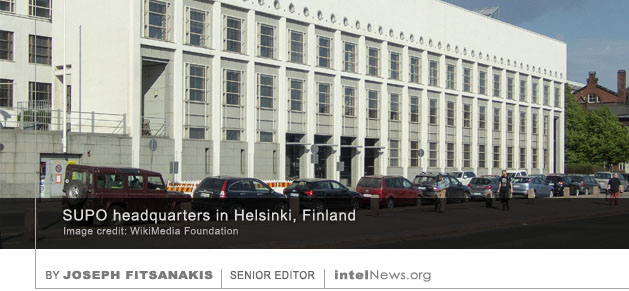 RUSSIA’S NEED TO GATHER intelligence from Scandinavian targets has increased considerably since Finland and Sweden joined the North Atlantic Treaty Organization (NATO), prompting Moscow to seek nontraditional means of collecting intelligence, according to Finland’s spy agency. A new report by the Finnish Broadcasting Company (Yle) relays a warning by the Finnish Security and Intelligence Service (SUPO) that Russian spies are increasingly operating in Scandinavia without relying on diplomatic protection.
Human intelligence (HUMINT) operations are typically carried out of diplomatic facilities by intelligence officers who enjoy various degrees of diplomatic immunity. Such protections are seen as crucial for the safety of intelligence personnel, who tend to engage in illegal activities while stationed abroad. However, the number of Russian intelligence officers who are based in diplomatic facilities in Finland and elsewhere in Scandinavia has “significantly decreased” in recent years, according to the Yle report.
The reason for the decline in numbers rests with the numerous expulsions of Russian diplomatic personnel —which include intelligence officers— that took place throughout Europe in the months following Russia’s February 2022 invasion of Ukraine. Since then, Finland is one of dozens of European countries that have repeatedly denied Russia’s requests for the issuance of diplomatic visas. As a result, Russian embassies and consulates in Finland remain understaffed and mostly devoid of intelligence personnel.
In response to this new reality, the Kremlin has been experimenting with using nontraditional HUMINT collectors. The latter are not based in diplomatic facilities and are not protected by diplomatic immunity. Such nontraditional intelligence collectors operate as “journalists or researchers”, according to SUPO. At the same time, Russian intelligence agencies increasingly target for recruitment Finns who life in Russia, or try to recruit them while they are traveling elsewhere in Europe.
Lastly, Russian intelligence agencies are systematically hiring criminals to carry out specific tasks on behalf of the Kremlin, in return for money. Such criminals include computer hackers, who are attracted by the Russian state. Indeed, the Russian government is systematically “providing favorable conditions” for computer hackers to operate out of Russian territory. They receive money and protection in return for letting the Russian state use them as a cover for cyber espionage, sabotage, and influence operations.
► Author: Joseph Fitsanakis | Date: 18 November 2024 | Permalink
 An investigative journalist in Finland, who recently co-authored an exposé of a Finnish intelligence program targeting Russia, destroyed her computer with a hammer, prompting police to enter her house on Sunday. The journalist, Laura Halminen, co-wrote the exposé with her colleague, Tuomo Pietiläinen. Titled “The Secret Behind the Cliff”, the article
  German intelligence, possibly with the collaboration of the United States, monitored communications lines connecting Finland with at least five countries in the early 2000s,
 By JOSEPH FITSANAKIS | intelNews.org |












 intelNews.org
Researchers uncover secretive Russian spy unit by studying its commemorative badges
July 21, 2025 by Joseph Fitsanakis 2 Comments
Earlier this month, CheckFirst published its latest report titled “OSINT & Phaleristics: Unveiling FSB’s 16th Center SIGINT Capabilities”. The 36-page report focuses on the study of Russian government-issued commemorative badges—also known as challenge coins—relating to Center 16 (16-й Центр). Also known as Military Unit 71330, Center 16 is a secretive SIGINT unit that houses most of the cyber espionage capabilities of Russia’s Federal Security Service (FSB).
Challenge coins are custom-made medallions given by military, intelligence, and government agencies to recognize service, commemorate achievements, or build morale. Originating in the United States military during World War I, and popularized during the Vietnam War, challenge coins are routinely exchanged in ceremonies or offered to personnel as tokens of camaraderie and loyalty within a specific unit or mission.
Often regarded as collectors’ items, challenge coins from various agencies are often resold on websites such as eBay, or displayed online on websites maintained by private collectors. CheckFirst researchers tracked down several versions of Center 16 challenge coins found on a variety of publicly available websites, as well as on the websites of Russian challenge coin manufacturers, such as GosZnak, SpetsZnak, or Breget.
Based on this OSINT methodology, CheckFirst researchers were able to identify 10 distinct directorates within Center 16, which specialize on various aspects of defensive and offensive cyber espionage. Previously only a single Center 16 directorate had been identified in the unclassified domain. Moreover, by examining geographic indicators found on several of challenge coins, such as maps or coordinates, CheckFirst researchers were able to partly map out the geographic structure of Center 16, locating nearly a dozen interception facilities throughout Russia.
► Author: Joseph Fitsanakis | Date: 21 July 2025 | Permalink
Filed under Expert news and commentary on intelligence, espionage, spies and spying Tagged with challenge coins, commemorative badges, cyberespionage, Finland, FSB, FSB Center 16, News, OSINT, Russia, SIGINT