Excessive secrecy hurts intel agencies, says head of NZ spy review
July 21, 2015 Leave a comment
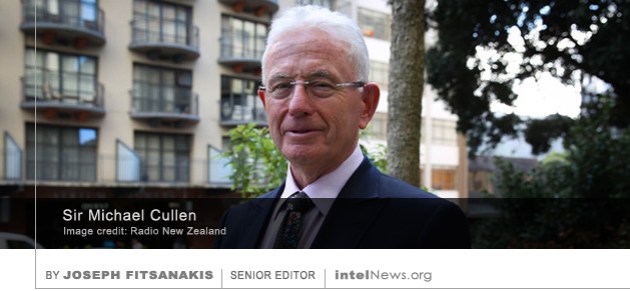 A former deputy prime minister of New Zealand, who is heading a major review of intelligence practices in the country, has said in an interview that spy agencies hurt their mission by practicing excessive secrecy. Sir Michael Cullen served as finance minister, education minister and attorney-General before serving as deputy prime minister of New Zealand, from 2002 to 2008. He was recently appointed by the government to co-chair a broad review of state intelligence agencies, with particular focus on updating the applicable legislative framework and evaluating the oversight exercised by lawmakers and the executive. The review is expected to affect the work of New Zealand’s two most visible intelligence agencies, the Security Intelligence Service and the Government Communications and Security Bureau.
Last Saturday, Sir Michael spoke to TVNZ, New Zealand’s national television broadcaster, about the progress of the review, and shared some of his preliminary thoughts on the subject of intelligence practice and reform. He said in the interview that much of the documentation about intelligence processes and operations was being kept secret without apparent reason. “I’ve seen documents [from] briefings, which it would be hard to justify in my view those briefings not being made public”, he said. He added that there was “a need for the agencies to be much more open about what they do”, noting that sources and methods could be adequately protected through a careful process of redacting. The former deputy prime minister said that, ironically, the intelligence agencies are “their worst enemy by being so secretive about almost everything that they do”. Their attitude, he told TVNZ, negatively affected the level trust between them and the citizens they protect; the latter, he added, “would get a better idea of the need for the [intelligence] agencies if some of these documents were made public”.
Sir Michael also commented on New Zealand’s membership in the so-called ‘Five-Eyes’ alliance, which is part of the UKUSA intelligence-sharing treaty between it and the nations of Australia, Canada, the United Kingdom and the United States. He told TVNZ that New Zealand had to share intelligence with allied nations, because it needed access to offshore information affecting its national security, which it cannot collect by itself. Some New Zealand politicians and pundits suggested that the country should exit the treaty after it was revealed last year that the US had been making use of New Zealand embassies around the world to collect electronic signals. In April of this year, The New Zealand Herald said that the country’s embassy in Bangladesh had been made available to British and American intelligence agencies to operate out of. Wellington’s relations with Dhaka have been strained as a result.
► Author: Joseph Fitsanakis | Date: 21 July 2015 | Permalink: https://intelnews.org/2015/07/21/01-1739/


 This morning I










 intelNews.org
Israeli nuclear whistleblower recalls his 1986 capture by the Mossad
September 3, 2015 by Joseph Fitsanakis 1 Comment
Soon after Vanunu settled in London, the Israeli intelligence agency Mossad began making plans to capture him. The spy agency sent one of its American-born female officers, Cheryl Bentov, to befriend Vanunu. The decision was taken after Mossad psychologists determined that Vanunu was lonely and longed for female companionship. Masquerading as an American tourist by the name of ‘Cindy’, Bentov convinced Vanunu to go with her on Vacation to Rome, Italy. Soon after the couple arrived in the Italian capital, Vanunu was abducted by a Mossad team who injected him with a paralyzing drug before taking him away in a van. Vanunu was then transferred onboard the INS Noga, an Israeli signals-intelligence ship masquerading as a merchant vessel, which transported him to Israel. He was convicted to 18 years in prison and was released in 2004, after having spent 11 years in solitary confinement.
On Wednesday, Israel’s Channel 2 television showed excerpts of Vanunu’s first-ever interview to an Israeli media outlet. The interview, which is to be aired in full on Friday, includes Vanunu’s personal account of his capture by the Mossad. He told the interviewer that ‘Cindy’ first spoke to him as she walked alongside him while the two of them were crossing a London street. But he said that it was he who “initiated the relationship” with the woman posing as an American tourist. That was a critical moment in the whole process, said Vanunu, because “if she initiates you’ll suspect her”. The nuclear whistleblower insisted, however, that he did not “fall in love with her”, as some accounts of the Mossad operation have suggested, though he was “definitely attracted” to her, he said.
Vanunu added that the thought of ‘Cindy’ being a Mossad officer had initially crossed his mind; but he disregarded it and did not realize he was being tricked “until the very last moment”. He told Channel 2 that even after several days after his capture, he still believed that ‘Cindy’ had also been abducted. It was only later that he “reached the conclusion that she was part of the plan”, he said. At another point in the interview, Vanunu said that ‘Cindy’ was not the only Mossad officer who had tried to befriend him while he was in London, but that he was able to detect every other attempt by Israeli intelligence operatives.
► Author: Joseph Fitsanakis | Date: 03 September 2015 | Permalink
Filed under Expert news and commentary on intelligence, espionage, spies and spying Tagged with abductions, Cheryl Ben Tov, covert action, history, INS Noga, interviews, Israel, Israeli nuclear program, Mordechai Vanunu, Mossad, News