Analysis: Escalation Without Endgame and the Limits of Defeating Iran
March 3, 2026 5 Comments
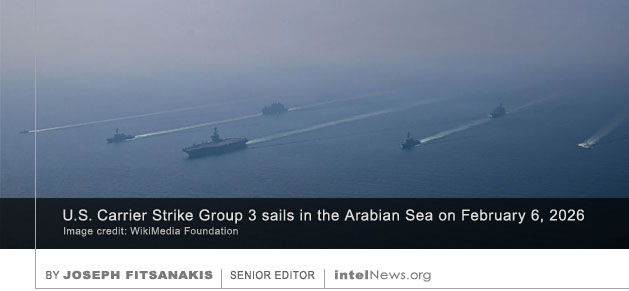 THE ONGOING CONFRONTATION BETWEEN Iran and its adversaries unfolds against the backdrop of a regime that is strategically depleted yet politically combustible. Yet strategic exhaustion does not equate to imminent collapse. Indeed, the potential degradation of Iran’s coercive institutions raises a more complex question: what follows tactical success? Thus, while Iran appears weakened and vulnerable, the longer-term trajectory of the conflict remains uncertain, fraught with the risk of protracted instability and regional spillover at a level that could make Libya and Syria seem mild by comparison.
Iran is Strategically Depleted and Vulnerable
Decades of crippling sanctions have ruined Iran’s economy and demoralized its population, causing an already polarized society to further-disintegrate. Outside of a small population of religious zealots, Iranians have little interest in martyrdom, and very few are willing to die for a regime that most see as politically and ideologically bankrupt. The stunning degree of the regime’s penetration by Israeli and American intelligence agencies is indicative of the disillusionment of ruling elites, let alone rank-and-file functionaries.
Militarily, this is hardly a war between equals. Even before bombs started falling in Tehran on February 28, Iran’s armed forces and its elite Islamic Revolutionary Guard Corps (IRGC) had been severely degraded by prior military engagements with the U.S. and Israel. Even with the assistance of its proxies and allies, Iran is demonstrably unable to match the military and intelligence resources of its opponents. As many have noted, Tehran’s retaliatory strikes appear to emphasize economic disruption and psychological pressure on civilian populations. But the marked inconsistency in the scale and delivery of Iran’s retaliatory attacks suggests that it is struggling to respond in a coherent fashion.
Russia, meanwhile, is nowhere to be seen. As in the cases of Venezuela and Cuba, Moscow has restricted its response to this crisis to diplomatic condemnations and offers to mediate, rather than offering military assistance to its Middle Eastern ally. This is hardly surprising, given Russia’s broader strategic priorities and its desire to further its ongoing expansionist goals in Europe by avoid overextension elsewhere.
Iran is weak, exhausted, alone. It is teetering on the edge. Yet, instead of cheering, this appears to trouble even seasoned Iran hawks like John Bolton, Trump’s onetime national security adviser. A veteran Republican, Bolton is probably the most consistent and vociferous Iran critic in the Western Hemisphere. The Iranian government has actively planned to assassinate him in recent years. But in a recent interview, Bolton cautioned about the lack of planning behind Washington’s latest adventurism in the Middle East and waned that the current situation may “deepen conflict, create a dangerous power vacuum, and purge the [entire Middle East] into turmoil”. What is Bolton seeing that Trump’s inner circle is not?
This War Will Not End Soon
American air campaigns have a demonstrated history of obliterating Washington’s tactical targets and severely disrupting its adversaries. Iran is unlikely to prove an exception to this rule. However, air campaigns—no matter how sophisticated—cannot by themselves reorder domestic politics and build long-lasting political outcomes. It follows that, despite delivering a series of indisputable tactical successes, including the assassination of Iran’s supreme leader and senior members of his inner circle, American and Israeli airpower cannot by itself ensure a pro-Western outcome in Iran.
Obliterating the Iranian regime’s military capabilities and degrading its ability to dispense violence against its own population is likely to create a power vacuum. But that is not the same as managing the ensuing political fallout. Even if the regime falls—which is not the likeliest scenario—its successor is unlikely to be friendly to the U.S. or Israel. For over a century, Iran has been permeated by a political culture shaped by fervent nationalism, revolutionary narratives and resistance against foreign intervention. This has been particularly so since 1979, with the theocratic regime building the nation’s identity around the idea of its resistance to the “Great Satan” and its regional allies, including Israel and Saudi Arabia. This identity permeates Iran’s security apparatus, its state institutions and its education system. Even anti-regime Iranians—including the student demonstrators who cheered Ayatollah Khamenei’s demise—espouse core elements of that narrative. Read more of this post
 THE UNITED STATES SECRET Service is among the world’s most prestigious law enforcement agencies. Its institutional experience in protecting US presidents and presidential candidates dates to 1901. Given its high-stakes protective mission —safeguarding the executive leadership of the world’s most powerful nation— the agency has historically placed emphasis on flawlessness: it simply can’t afford to fail.
 NO COUNTRY HAS BETTER intelligence on the Islamic State-Khorasan Province (known as ISIS-K) than the United States. American forces have faced ISIS-K almost from the moment the group was founded in 2015 in Pakistan, just a few miles from the Afghan border. It was there that a group of disaffected members of the Tehreek-e-Taliban-e-Pakistan (TTP, commonly referred to as the Pakistani Taliban) began turning their backs on al-Qaeda, which they saw as a failing brand, and joined the Islamic State of Iraq and Syria (ISIS).
 not being taken into consideration by the group’s primary targets, namely Afghanistan, Iran, and Russia. Indeed, despite the Washington’s best efforts, its warnings about pending ISIS-K attacks have been ignored by the group’s primary targets. A few days after an ISIS-K attack killed nearly 100 people in Kerman, Iran, The Wall Street Journal
  MIDDLE EAST OBSERVERS WERE hardly surprised by yesterday’s news of the apparent assassination of Hamas leader Saleh al-Arouri in Lebanon. Not only was al-Arouri a
  Yesterday’s assassination at the very heart of Hezbollah’s lair was nothing short of a demonstration of the Mossad’s competency in special operations.
 LAST WEEK THE UNITED States Department of Justice announced the arrest of Victor Manuel Rocha, 73, a former senior American diplomat, whose career included stints as ambassador and advisor to the National Security Council and the United States Southern Command. Cuban intelligence allegedly recruited Rocha when he was a student in the 1970s and inspired him to spend his entire professional life in search of opportunities to supply intelligence to Cuba —and possibly Russia and China. United States Attorney General Merrick Garland
  principal officer in the United States Interests Section in Cuba —effectively the second-in-command in Washington’s de facto embassy in Havana.
 ARGUABLY NO COUNTRY BENEFITED more from the American invasion of Iraq than the Islamic Republic of Iran. In a war that lasted over a decade, Washington spent over
  branch of the Iranian Armed Forces that protects and promotes the ideological inheritance of the 1979 Islamic Revolution.
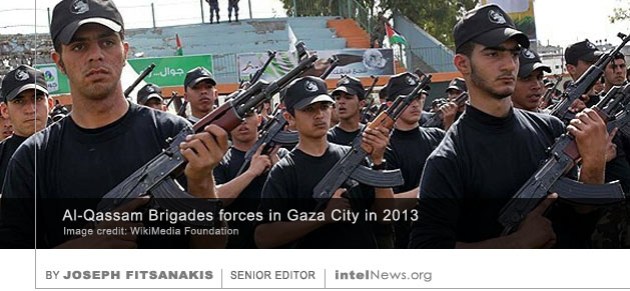
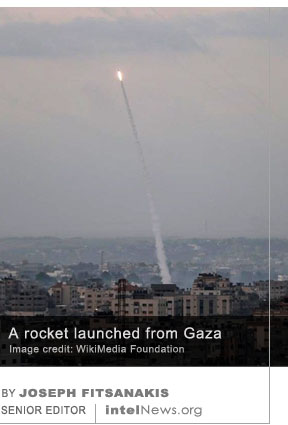 THE HAMAS-LED OPERATION al-Aqsa Flood, which began on October 7, marked the first large-scale conflict within the borders of Israel since the 1948 Arab-Israeli War. However, unlike the coalition of Arab armies it faced in 1948, Israel now confronts an alliance of sub-state groups. Led by Hamas’ military wing, the al-Qassam Brigades, this alliance includes the Syrian- and Iranian-backed Palestinian Islamic Jihad and a number of secular groups, such as the Fatah-aligned al-Aqsa Martyrs’ Brigades, the Popular Front for the Liberation of Palestine (PFLP) and the Democratic Front for the Liberation of Palestine (DFLP).
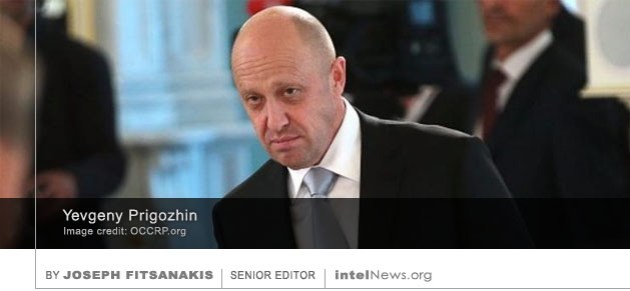 IN THE EARLY HOURS of June 23, PMC Wagner leader Yevgeny Prigozhin declared the launch of an armed campaign against the Ministry of Defense of the Russian Federation. Within hours, several thousand soldiers belonging to Wagner, one of the world’s largest private military companies, had abandoned their positions in eastern Ukraine and were en route to Moscow. Their mission, according to Prigozhin, was to arrest Minister of Defense Sergei Shoigu and Chief of the General Staff Valery Gerasimov, and try them for mismanagement and corruption.
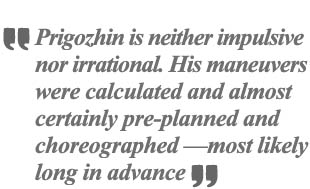 Wagner leader has repeatedly expressed his dismay at being viewed as an outsider by the Ministry of Defense, which it views as an elitist and incompetent bureaucracy. His experience in Ukraine, where Wagner’s forces faced stiff resistance from the local population and the Ukrainian military alike, added fuel to his rage against a host of Russian defense officials. Prigozhin has been voicing his denunciations of the way these officials have managed the war since March of 2022, just two weeks into the invasion of Ukraine.
 THE 49-PAGE GRAND JURY indictment, filed last week in Florida by the United States Department of Justice, contains 37 criminal charges against former president Donald Trump. The charges can be summarized into a two-fold accusation: Trump is alleged to have stolen more than 300 classified documents upon leaving the White House in January 2021. Moreover, he allegedly schemed with a group of advisors and aides in order to obstruct efforts by the government to retrieve the stolen documents. Both accusations are spelled out in stark detail in
 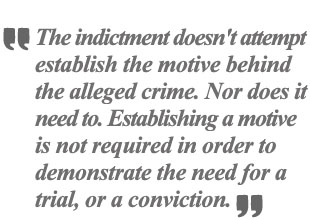 does it need to. Establishing a motive is not required in order to demonstrate the need for a trial, or indeed a conviction. Given the high stakes of this case, however, establishing a motive can provide much-needed clarity in the public sphere.
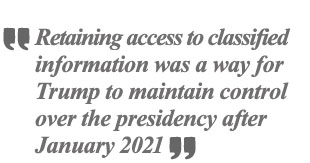 his determination to keep them in close proximity to his office and sleeping quarters.
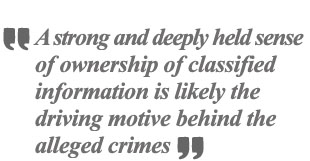 more pugilistic desires”, according to the paper. His attitude was not a show. It was sincere. Moreover, there is no reason to believe that it has subsided since his indictment.
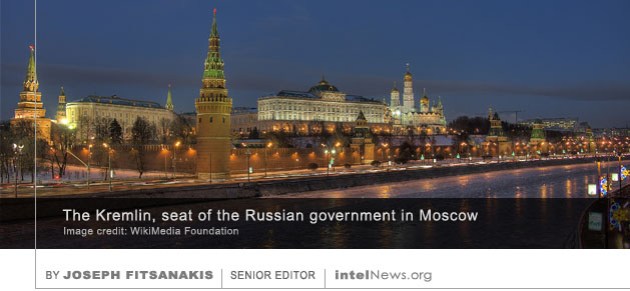 OFFICIALS IN UKRAINE HAVE
  Russia’s border with Belarus, two trains were
 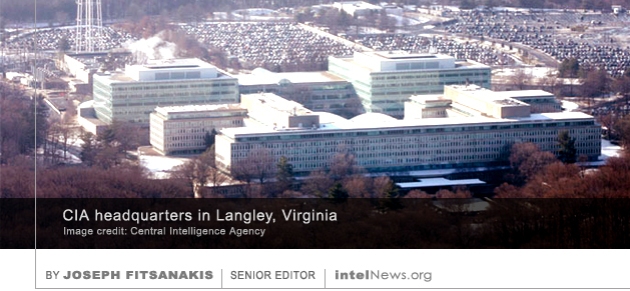 A BOOK BY A former Central Intelligence Agency (CIA) case officer, which alleges that a senior Agency official sabotaged American counterintelligence efforts on orders from Moscow, has prompted a series of fiery exchanges by retired CIA personnel. The primary figures in the dispute are the book’s author, Robert Baer, and Paul J. Redmond, who served as the CIA’s Associate Deputy Director of Operations for Counterintelligence.
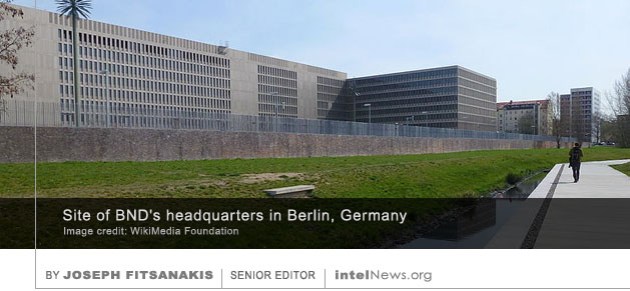 GERMANY’S EXTERNAL INTELLIGENCE AGENCY, the Federal Intelligence Service (BND), constitutes a liability for Europe’s security and is in desperate need of a drastic and immediate overhaul. That is the conclusion of a blunt
 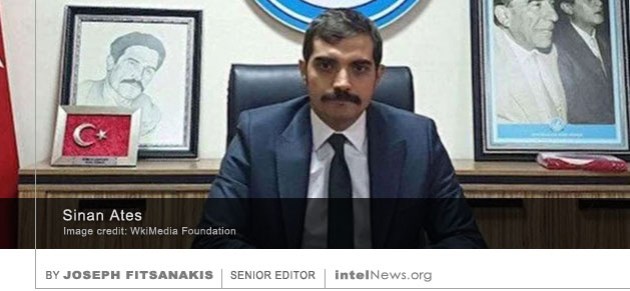 ON FRIDAY, DECEMBER 30, 2022, an assailant on a motorcycle
 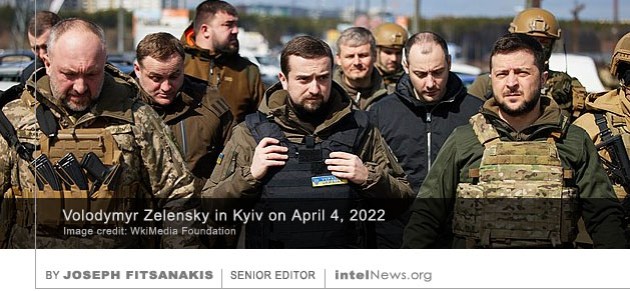 ON SUNDAY, JULY 17, the Ukrainian administration of President Volodymyr Zelenskiy announced the most extensive shake-up of the nation’s security leadership since the Russian military invasion. Two key members of Zelenskiy’s inner circle, Ukraine’s Prosecutor General Iryna Venediktova and domestic security chief Ivan Bakanov, were
 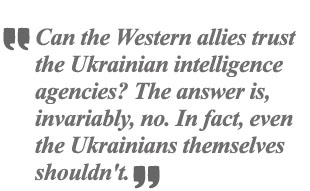 invariably, no. In fact, even the Ukrainians themselves are not in a position to trust their own intelligence services.






 intelNews.org
The Real War Is About To Begin: Iran Transitions to Full-Scale Insurgency
March 30, 2026 by Joseph Fitsanakis 6 Comments
And yet, as Carl von Clausewitz cautioned centuries ago, the outcome of war is not governed by formulaic calculus. No matter how astounding, operational sophistication and technological prowess do not guarantee success. Instead of an immediate collapse, the decapitation of the Iranian regime appears to have produced a series of unpredictable second-order effects. At the very least, it physically eliminated Iran’s few pragmatic leaders who have historically favored restraint. Their demise effectively handed over power to the hardliners of the Islamic Revolutionary Guard Corps. Moreover, the war appears to have paralyzed Iran’s domestic opposition, whose adherents may despise the regime but—unlike the U.S. and Israel—do not want to see their country break up into ethnic statelets.
Most importantly, the February 28 decapitation strike convinced Iran’s surviving leaders that this is an existential fight—not a limited confrontation like the Twelve-Day War. Today’s ruling Principalists in Iran differ sharply from the cosmopolitan, Western-educated elite of the 1960s and 1970s. They are largely provincial in origin, domestically rooted, and lack the international ties that once offered pathways of exit. They do not hold dual citizenships, do not maintain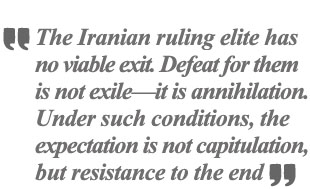 foreign residences, and few of them possess the linguistic or social capital to relocate abroad. Simply put, they have no viable exit. For them, defeat is not exile—it is annihilation. Under such conditions, the expectation is not capitulation, but resistance to the very end.
Activating the Iranian Asymmetric Doctrine
Starting in 2001, the campaigns in Afghanistan and Iraq offered Iranian war planners a prolonged and unusually comprehensive vantage point from which to study the American way of war in their immediate neighborhood. For over two decades, the Iranians analyzed these methods, learned from them, and internalized their logic into their own asymmetric warfare doctrine. And now, having survived the February 28 decapitation attack, the Iranian regime has put that doctrine into operation. Iran’s asymmetric doctrine channels the state’s military, civilian, economic, and informational assets into a multi-domain, protracted insurgency campaign designed to inflict maximum pain on its enemies. In doing so, it rests on what is perhaps the Islamic Republic’s greatest asset: its asymmetric patience—i.e., its capacity to endure more physical and emotional torment than its Western opponents and their allies.
The Iranians refined their asymmetric patience skills during what they refer to as the “War of Holy Defense” (1980-1988), one of the 20th century’s longest conflicts and the deadliest conventional war ever fought in the developing world. The then-newly formed Islamic Republic suffered over 500,000 casualties—many of those due to exposure to chemical warfare—but managed to bring Saddam Hussein’s Western-backed Iraq into a standstill and force it into a truce. To do so, they even resorted to so-called “human wave assaults”, large masses of mostly unarmed youth who swarmed enemy positions and overwhelmed them by the sheer power of their number. That was largely how the Basij, the Iranian regime’s paramilitary street gangs that continue to operate in modern-day Iran, were initially formed.
Iran’s “Economy of Resistance”
On March 28, the Telegram channel belonging to the Iranian Supreme Leader Mojtaba Khamenei issued an infographic titled “The Path to Defeating the Enemy in the Economic War”. The infographic reflects the Islamic Republic’s concept of “economy of resistance”, which was first developed in 2014 by Mojtaba Khamenei’s father, the late Supreme Leader Ali Khamenei. The central idea behind this concept is restructuring the Iranian economy, not simply to reduce its susceptibility to Western-imposed sanctions, but to allow it to stabilize and even develop. The goal of the economy of resistance is to prevent the destruction of the Islamic Republic and the Westernization of Iranian society. Through the economy of resistance doctrine, and with crucial help by China and Russia, Iran has largely managed to insulate its economy from the global economic system that is now reeling under Iran’s own asymmetric attacks. Read more of this post
Filed under Expert news and commentary on intelligence, espionage, spies and spying Tagged with 2026 Iran War, Analysis, Iran, Joseph Fitsanakis, Newstex