Guest Comment: India’s corporate espionage boom

AssoCham IndiaBy BRITTANY MINDER | intelNews.org |
A survey conducted earlier this month by the Associated Chambers of Commerce and Industry of India (AssoCham) found that corporate espionage in India is surging. The June 14 survey found that 35 percent of Indian firms regularly and aggressively conduct research on competitors and employees, which goes far beyond the normative business intelligence realm. Secretary General of AssoCham, D.S. Rawat, maintained that “demand from certain industries, such as information technology, infrastructure, insurance, [and] banking and manufacturing is overwhelming”. With an increasing demand for espionage gadgetry, up nearly 30 percent from last year, the survey also noted that “almost all the company representatives in these domains acknowledged the prevalence of industrial espionage to gain access to information and steal trade secrets of their competitors through private deals with sleuths and spy agencies”. The appetite for corporate espionage and gadgets doesn’t stop at rival-on-rival activity; espionage is a pursuit while industrial espionage is a practice. Overall corporate vulnerabilities, a lack of appreciation for corporate security best practices, and the tangible motivation of revenue is, according to AssoCham, driving, “companies who have strong unions and are vulnerable to pilferage hire spy agencies and plant an under-cover agent, a mole in minor job profiles in rival companies to ascertain if union leaders are getting paid for creating trouble”. According to The New York Times, conservative acknowledgements of the boon of the corporate spy industry willingly concede that some companies even hire “mystery vendors” to gauge their own employees’ response to sifting from outsiders. Read more of this post

News you may have missed #743 (espionage edition)

Vladimir LazarBy IAN ALLEN | intelNews.org |
►►Denmark professor jailed for spying. Timo Kivimäki a Finnish professor of international politics in Copenhagen, Denmark, has been sentenced to five months in prison for spying, following a trial held behind closed doors, from which even the verdict was not released. Several Russian diplomats left Denmark after the start of the spy case and, according to Danish media, Kivimäki’s lawyer, Anders Nemeth, had attempted to have them return to act as witnesses.
►►Retired Russian colonel convicted of spying for US. A Russian court has ruled that retired Colonel Vladimir Lazar spied for the US, and sentenced him to 12 years in prison. Lazar will be sent to a high-security prison and stripped of his military rank, the Federal Security Service said in a statement. Prosecutors said Lazar purchased several computer disks with more than 7,000 images of classified maps of Russia from a collector in 2008 and smuggled them to neighboring Belarus, where he gave them to an alleged American intelligence agent.
►►India arrests military intel staffer for spying. The soldier, identified only as Shivdasan, worked for the Indian Army’s Technical Support Division, which is a newly founded unit within Indian Military Intelligence. He was reportedly trapped by the Indian Directorate of Revenue Intelligence in an elaborate operation that involved a “double agent” and a relative of the soldier in Dubai.

French terrorist Merah planned attack on Indian embassy in Paris

Embassy of India in ParisBy JOSEPH FITSANAKIS | intelNews.org |
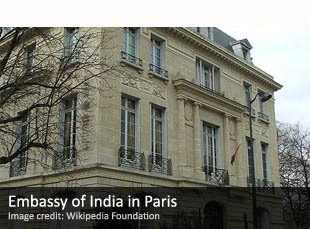
Mohamed Merah, the French Muslim who killed seven and injured five people in Toulouse last March, had planned to launch a massive attack on the Indian Embassy in Paris, according to new revelations. Merah was shot dead by French Special Forces on March 22, after killing three French Army personnel on March 15, and four civilians, including two children, on March 19. But according to French newspaper Le Monde, Merah had initially planned to attack the Indian embassy in Paris. Quoting sources from France’s Central Directorate of Interior Intelligence (DCRI) and the Special Forces (RAID), the French daily says that Merah’s handlers in Pakistan had initially tasked him with attacking Indian diplomatic targets in the French capital. “That was the initial target assigned to him by the Taliban, who trained him for holy war […] in Pakistan during the summer of 2011”, a French intelligence source is quoted as saying in Le Monde. By “Taliban”, the source was most likely referring to Lashkar e-Taiba, one of Asia’s largest militant Islamist groups, which is waging a protracted war against the Indian state in Indian-administered Kashmir and elsewhere. Most Lashkar e-Taiba training camps are located in Pakistan, where Merah, who was Algerian-born, traveled in the summer of 2011. However, the paper says that the DCRI, which is said to have employed Merah as an informant, had received prior warning of the plot, and had notified Indian officials, who in turn were able to beef-up security measures at the embassy. Read more of this post

News you may have missed #729 (intel blunder edition)

Alleged Venezuelan 'spy crossword'By IAN ALLEN | intelNews.org |

►►US drones ‘incidentally’ spy on Americans. A leaked US Air Force document stipulates that a drone that happens to capture surveillance images of Americans may store them for a period of 90 days. The paper appears to justify spying on citizens, as long as it is “incidental”. The document accepts that the Air Force may not record information non-consensually; however it does state: “collected imagery may incidentally include US persons or private property without consent”. The report, dated April 23 was discovered by Steven Aftergood of the Federation of American Scientists and has been put online.
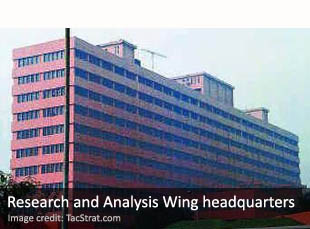
►►Indian intel blunder sparks anger in Pakistan. India’s Research and Analysis Wing (RAW) intelligence agency sparked outrage in Pakistan and self-deprecatory jokes in India itself last week, after it listed ordinary Pakistani shopkeepers as terrorists on a mission to attack some of India’s landmark institutions. RAW, which is considered India’s premier intelligence agency, issued an advisory to state governments in which it said that five trained militants from Pakistan’s banned Lashkar-e-Taiba group had sneaked into India with fake identities to attack a nuclear facility, oil refinery, seaport and defense academy. Within hours after photographs of the five men were released, a Pakistani television channel reported that two of the three men on the list were shopkeepers and one was a guard, all living in Lahore, and that none of them had ever left Pakistan.
►►Venezuelan spies face criticism over ‘crossword puzzle’ plot. Venezuelan government critics, and even some supporters, are ridiculing a Venezuelan state TV host’s allegation that a newspaper crossword puzzle may have had a hidden call for a plot to kill President Hugo Chavez’s elder brother. Intelligence agents questioned Neptali Segovia, the author of the puzzle, after state TV presenter Miguel Perez Pirela pointed out that Wednesday’s crossword contained the word “ASESINEN”, or kill, intersecting with the name of Chavez’s brother, “ADAN”. He noted they were below the word “RAFAGAS”, meaning either gusts of wind or bursts of gunfire.

News you may have missed #713 (analysis edition)

RAW headquarters, New Delhi, IndiaBy IAN ALLEN | intelNews.org |
►►Israel wary of changes in the Arab world. For decades, Israel had been hoping for change in the Arab world. Yet now that the region is in upheaval, its not just Israeli citizens who are concerned. The government has shown a preference for walling itself in rather than exploring new opportunities. The Jewish state has tried to integrate itself into the Middle East for decades. Now it is trying to cut the cord between itself and the surrounding region, blocking out the changes in its neighborhood.
►►Melting Arctic may redraw global geopolitical map. If, as many scientists predict, currently inaccessible sea lanes across the top of the world become navigable in the coming decades, they could redraw global trading routes —and perhaps geopolitics— forever. This summer will see more human activity in the Arctic than ever before, with oil giant Shell engaged in major exploration and an expected further rise in fishing, tourism and regional shipping. But that, experts warn, brings with it a rising risk of environmental disaster not to mention criminal activity from illegal fishing to smuggling and terrorism.
►►Why Indian intelligence doesn’t work too well in Pakistan. Sources in the RAW, India’s external agency, say India lacks both political will and the capability to carry out a hit inside Pakistan. “We do not have the mandate to do what Mossad does. Our charter does not include the job of getting [or assassinating] people from other countries. If such political will is there, the agency would be able to do it”, says a senior RAW official. Another former officer, who has spent a considerable time studying these outfits, attributes it to the fundamental difference between India and Pakistan in dealing with espionage. “It takes a great deal of money and time to cultivate sources in foreign soil. We don’t have either in plenty, unlike countries in the West. Pakistan’s ISI is better off in this as the state sponsors terrorism”, he says.

News you may have missed #694

Hakan FidanBy IAN ALLEN| intelNews.org |
►►India’s spy satellite to be launched in April. The Radar Imaging Satellite, or RISAT-1, is a wholly Indian-built spy-surveillance satellite that can see through clouds and fog and has very high-resolution imaging. The Indian Space Research Organisation (ISRO) has said that RISAT-1 is slated for launch in April. The satellite would be used for disaster prediction and agriculture forestry, and the high-resolution pictures and microwave imaging “could also be used for defense purposes”.
►►GCHQ staff could risk prosecution for war crimes. British law firm Leigh Day & Co. and the legal action charity Reprieve are launching the action against Britain’s foreign secretary William Hague, accusing him of passing on intelligence to assist US covert drone attacks in Pakistan. Human rights lawyers have said that civilian staff at GCHQ, Britain’s signals intelligence agency, could also be at risk of being prosecuted for war crimes.
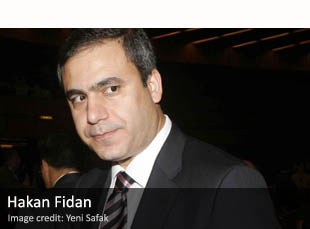
►►Turf war between Turkey’s top spy and police commander? A news report appeared yesterday, which claimed that there was a rift between Turkish intelligence agency MİT Undersecretary Hakan Fidan and National Police Chief Mehmet Kılıçlar, over intelligence sharing in the fight against the terrorist Kurdistan Workers’ Party (PKK). But the two agencies issued a rare joint statement calling media reports “unsubstantiated”.

News you may have missed #693: Israel edition

Meir DaganBy IAN ALLEN| intelNews.org |
►►India soon to announce Iranian role in New Delhi bomb attack. The Delhi Police has cracked the Israeli embassy car blast case and traced the conspiracy to Iranian secret agents. According to sources privy to the investigation, it has now been “conclusively established” that Syed Mohammad Kazmi, the freelance journalist recently arrested in the case, was in touch with an Iranian intelligence officer and had even visited Iran as part of the conspiracy. Sources in the Indian security establishment said that the breakthrough in the February 13 blast on an Israel diplomat’s car, will be announced by the New Delhi Police in a “day or two.” They added that another couple of detentions have been made in the case.
►►Ex-Mossad chief says Iran’s response to attack would be devastating. An Israeli attack on Iran would lead to a missile attack on Tel Aviv that would have a “devastating impact” on the ability of Israelis to continue their daily lives, Meir Dagan, former head of Israel’s spy agency Mossad, said on Monday. Dagan said that Iran doesn’t have only four nuclear sites, but it has “dozens” of them. He seemed quite skeptic over the effectiveness of an Israeli attack on Iran, saying that no military attack could halt the Iranian nuclear project. “The attack could only delay it”, he said.
►►Ex-Mossad chief says Iran regime is ‘very rational’. The Iranian regime is “very rational” and is moving deliberately in its secretive nuclear program, the former head of Israel’s Mossad intelligence agency says. “Maybe it’s not exactly rational based on what I call ‘Western thinking’, but no doubt that they are considering all the implications of their actions”, Meir Dagan said in an interview with CBS‘ 60 Minutes that aired Sunday.

News you may have missed #690

Katya ZatuliveterBy IAN ALLEN| intelNews.org |
►►Interview with Katia Zatuliveter. Just over three months ago Katia Zatuliveter was fighting to clear her name over claims she was a Russian spy who had passed British military secrets to Moscow. Now, in her first newspaper interview since winning her appeal against deportation from the UK, Katia Zatuliveter has told The Daily Telegraph why she does not support Vladimir Putin.
►►US Special Forces in Afghanistan to transfer to CIA. Top US Pentagon officials are considering putting elite special operations troops under CIA control in Afghanistan after 2014. If the plan were adopted, the US and Afghanistan could say there are no more U.S. troops on the ground in the war-torn country because once the SEALs, Rangers and other elite units are assigned to CIA control, even temporarily, they are not considered soldiers.
►►Indian army accused of spying on government officials. The Indian army is accused of using two surveillance vehicles to snoop near the offices and houses of senior Indian Defense Ministry officials. The vehicles with “off the air interceptors” were alleged to be parked in various localities in the New Delhi. Similar equipment is said to be used by the National Technical Research Organisation to listen to conversations without bugging the premises. The Defense Ministry has reportedly ordered a probe by the country’s Intelligence Bureau.

News you may have missed #677: Analysis edition

Che Guevara after his arrest in BoliviaBy IAN ALLEN | intelNews.org |
►►New book ties Johnson administration to Che Guevara’s death. Michael Ratner and Michael Steven Smith are the co-authors of a new book about the US role in the killing of Cuban revolutionary Ernesto “Che” Guevara. In their book, Who Killed Che?, Ratner and Smith draw on previously unpublished government documents to argue the CIA played a critical role in the killing. “The line of the [US] government was that the Bolivians did it, we couldn’t do anything about it. That’s not true”, Smith said. “This whole operation was organized out of the White House by Walt Whitman Rostow. And the CIA, by this time, had become a paramilitary organization”.
►►CIA digs in as US withdraws from Iraq and Afghanistan. The CIA is expected to maintain a large clandestine presence in Iraq and Afghanistan long after the departure of conventional US troops as part of a plan by the Obama administration to rely on a combination of spies and Special Operations forces to protect US interests in the two longtime war zones, US officials said. They added that the CIA’s stations in Kabul and Baghdad will probably remain the agency’s largest overseas outposts for years.
►►Indian Army ‘preparing for limited conflict with China’. Noting that India is increasingly getting concerned about China’s posture on its border, James Clapper, US Director of National Intelligence, said this week that the Indian Army is strengthening itself for a “limited conflict” with China. “The Indian Army believes a major Sino-Indian conflict is not imminent, but the Indian military is strengthening its forces in preparation to fight a limited conflict along the disputed border, and is working to balance Chinese power projection in the Indian Ocean,” he said.

News you may have missed #665

Matthew M. AidBy IAN ALLEN | intelNews.org |
►►Joseph Fitsanakis interviewed on ABC Radio National. IntelNews‘ own Dr Joseph Fitsanakis was interviewed on Friday by reporter Suzanne Hill, for ABC Radio National’s flagship evening news program ‘PM‘. In the interview, which was about the assassination of Iranian nuclear scientist Mostafa Ahmadi-Roshan, Fitsanakis points the finger at the Mossad, and explains why he doesn’t believe the United States had anything to do with the killing. You can listen to the interview here. The transcript is here.
►►India releases diplomat jailed for spying. Last April, Madhuri Gupta, second secretary at the Indian high commission in Islamabad, Pakistan, was arrested for working for Pakistan’s ISI spy agency. She apparently had a “relationship of personal affection” with an aide of her Pakistani handler. On Tuesday, she was granted bail by an Indian court, after 21 months in prison.
►►Matthew Aid interviewed about his new book. Matthew M. Aid, author of The Secret Sentry, has written a new book, Intel Wars: The Secret History of the Fight Against Terror. You can listen to an extensive interview he gave on January 11 on NPR’s Fresh Air, in which Aid outlined his view that “overlapping jurisdictions, bureaucratic policies and a glut of data have crippled the intelligence community in its war against would-be terrorists”.
►►British spies to be cleared on torture allegations. The British government, including Scotland Yard and the Crown Prosecution Service, has just finished a four-year inquiry into the country’s security and intelligence services, sparked by allegations by terrorist suspects released from Guantanamo Bay, that they were severely tortured. The results have not yet been announced. But British media report that, according to information from trusted sources, the inquiry has concluded that (…drumroll…) there is no evidence that officers from either MI5 or MI6 were aware of the mistreatment of prisoners.

News you may have missed #663

X-37B spaceplaneBy IAN ALLEN | intelNews.org |
►►Indian spy agency seeks more wiretap powers. As intelNews reported in December, India’s primary intelligence agency, the Research and Analysis Wing (RAW) was granted unfettered access to intercept electronic communications inside India. According to reports from India, the country’s Department of Telecommunications has now asked Interpol to help it gain access to encrypted electronic communications exchanged over Skype, BlackBerry telephones, etc. But doesn’t the Indian government already have access to BlackBerry communications?
►►US spaceplane spying on China. America’s classified X-37B spaceplane is probably spying on China, according to a report in Spaceflight magazine. The unpiloted vehicle was launched into orbit by the US Air Force in March last year and has yet to return to Earth. The Pentagon has steadfastly refused to discuss its mission but amateur space trackers have noted how its path around the globe is nearly identical to China’s spacelab, Tiangong-1.
►►Mossad seeks Chinese speakers. Do you speak Chinese? If so, Israel’s Mossad needs you. Recently, the spy agency put up a job posting on its website for a strategic researcher. The ad notes that preference will be given to Chinese, Arabic and Persian speakers. Experience in intelligence work is also a plus. Notably, China maintains close relations with Iran and with Arab states, possibly prompting the Mossad to seek Chinese speakers for its current and future intelligence work.

Did cell phone companies help India spy on the United States?

Page from the Lords of Dharamraja document leakBy JOSEPH FITSANAKIS | intelNews.org |
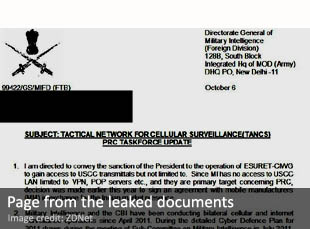
Leaked documents acquired by a computer hacker collective appear to show that international cell phone manufacturers helped Indian intelligence agencies spy on the United States, in return for access to the Indian cellular phone market. The documents, which are written in English, were posted online on Saturday by a group of Indian hackers calling themselves Lords of Dharamraja. In a statement, the group said they obtained the documents by breaking into the computer servers of Indian Military Intelligence, after managing to acquire the source code of Symantec Corporation, makers of Norton antivirus software. According to the documents, the companies arm-twisted to assist Indian intelligence agencies to spy on the US included Apple, Nokia, and Research in Motion, the company that builds BlackBerry devices. The documents also appear to show that Indian intelligence agencies were particularly eager to spy on the United States-China Economic and Security Review Commission. Established by the US Congress in 2000, the Commission is tasked with researching and reporting on the national security implications of bilateral trade between the US and China. Allegedly, the cellular telephone makers provided Indian intelligence agencies with backdoor access to personal phones used by Commission members. These back doors allegedly allowed the Indian Military Intelligence Directorate and India’s Central Bureau of Investigation to spy on Commission members beginning in April of 2011. Read more of this post

CIA installed nuclear surveillance device atop Himalayas mountains

Nanda DeviBy JOSEPH FITSANAKIS | intelNews.org |
The United States Central Intelligence Agency tried at least twice to install a nuclear-powered surveillance device atop the Indian Himalayas, in an effort to spy on China. The decision to plant the device was taken in 1964, soon after communist China detonated its first nuclear bomb. In 1965, a team of CIA operatives attempted to climb Nanda Devi in the Garhwal Himalayas, which, at 25,645 feet (7,816 meters), is the highest mountain peak located entirely within Indian territory. But the top-secret mission failed miserably after adverse weather forced the CIA team to give up its effort approximately 2,000 feet below the summit. Battling against a heavy snowstorm, the CIA officers abandoned the 125-pound device, which was eventually swept away (.pdf document) by an avalanche. Incredibly, the team members deserted the surveillance device even though they knew it contained plutonium 238, which can emit radioactivity for over 500 years. In 1966, the same CIA team returned to Nanda Devi, in an effort to recover the complex surveillance instrument, but failed to locate it. In response to the second failed mission, the Agency decided to close the book on Nanda Devi, and instead constructed an identical surveillance device, which was transported and installed on Nanda Kot, a mountain peak located about nine miles (15 km) southeast of Nanda Devi. At 6,861 meters, Nanda Kot is about 3,000 feet shorter and far less steep than Nanda Devi. In 1967, a successful CIA attempt was made to reach the peak of Nakda Kot, where the radioactive surveillance device was installed. It is believed that it served its purpose before being abandoned there in 1968. Ten years later, in 1978, both operations were revealed in an article published in US-based Outside magazine. The revelation caused a major political uproar in India, as many Indians consider the Himalayas ‘sacred’ ground. Now the National Archives of India has released a batch of previously classified internal documents from India’s Ministry of External Affairs. Read more of this post

News you may have missed #653: India edition

Research and Analysis WingBy IAN ALLEN | intelNews.org |
►►India’s external intel agency gets wiretapping powers. India’s government has given the country’s external intelligence agency, the Research and Analysis Wing (RAW), the right to intercept domestic phone calls, emails and voice and data communications. This is the first time that RAW has been authorized to intercept communications inside the country. Should Indian citizens be bracing for more political policing?
►►India uncovers alleged Pakistan honey trap operation. A lieutenant colonel in the Indian Army was reportedly caught in a ‘honey trap’ by Pakistani intelligence agencies, as a result of which he was forced to spy for them against Indian interests, according to Indian media. The officer was allegedly in Bangladesh this past summer to attend a course at a military academy, when he was trapped by Pakistan’s Inter-Services Intelligence (ISI), sources said. What is it with Indian government employees and honey trap operations?
►►Indian arrested for spying for Pakistan. Indian police in Rajasthan said it arrested Pawan Kumar Sharma, a clerk working at the regional Sub-Divisional Magistrate’s office in Suratgarh town, on charges of spying for Pakistan. Authorities said Sharma is suspected of spying for Pakistan’s Inter-Services Intelligence (ISI) directorate for the past year-and-a-half, using a prepaid cell phone provided by the ISI.

Analysis: India’s spies keep tabs on political opponents, not terrorism

IB seal

IB seal

By JOSEPH FITSANAKIS | intelNews.org |
She is America’s rising ally in South Asia and is widely regarded as the world’s largest democracy. But India’s political system is highly chaotic and often repressive. This is aptly reflected in the operations of the Intelligence Bureau, India’s foremost domestic intelligence agency. One would think that the IB has its hands full with India’s countless domestic security concerns, which include increasingly popular and active Maoist insurgents, as well as mounting religious and political tensions in the predominantly Muslim states of Jammu and Kashmir, located in the country’s north. But one of India’s most respected English-language newspapers, The Hindu, cites “highly placed intelligence sources” who allege that most of the IB’s intelligence collection activities are targeted against the Indian government’s political opponents, not terrorism. According to the unnamed sources, “less than a third of the IB’s estimated 25,000-strong manpower [sic] is dedicated to what might be described as national security tasks”. Conversely, over two-thirds of the organization’s staff is reportedly tasked with “providing the government raw information and assessments on its increasingly bleak political prospects”, claims the paper. Examples of political policing by the IB include monitoring public meetings led by Rahul Gandhi, parliamentarian and leader of the National Congress, which is India’s main political opposition group. Another target of the IB’s alleged political policing campaign is anti-corruption activist Anna Hazare, who has become internationally known for spearheading popular protests against government sleaze in New Delhi and elsewhere. According to The Hindu, intelligence on political figures is collected by the IB’s state-of-the-art communications interception systems, which were purchased from Western hardware manufacturers following the sophisticated 2009 Mumbai Attacks by the Pakistani militant group Lashkar-e-Taiba. Read more of this post