UK blames Russia, says it will not invoke NATO Article 5 in attack on ex-spy

Theresa MayThe British prime minister said on Monday that it was “highly likely” the nerve agent used to attack a Russian defector in England last week was developed by Russia. But sources in London told the BBC that the British government would not invoke Article 5 of the North Atlantic Treaty Organization (NATO), which states that an attack on one member of the alliance is an attack on all. Theresa May was referring to an assassination attempt carried out on March 4 by unknown assailants against former KGB Colonel Sergei Skripal. The 66-year-old former spy and his daughter were found in a catatonic state in the town of Salisbury. It was later determined that they were attacked with a nerve agent.

Speaking in the British House of Commons, Mrs. May said that “world-leading experts” in chemical weapons had concluded Mr. Skripal had been attacked with a “military-grade nerve agent”. It was, she added, part of a group of nerve agents developed by the USSR in the 1970s and 1980s, known collectively as novichok (newcomers). The existence of these nerve agents took place in secret, but was later revealed by Russian government agents who defected to the West. British officials also disclosed yesterday that the British Foreign Office summoned the Russian Ambassador to London, Alexander Yakovenko, to seek an explanation about the attack. Additionally, London has called on Moscow to provide a “full and complete disclosure” of its novichok nerve agent program to the Organization for the Prohibition of Chemical Weapons, an intergovernmental agency based in the Netherlands, which oversees the 1997 Chemical Weapons Convention.

Meanwhile NATO Secretary General Jens Stoltenberg told reporters on Monday that the alliance viewed the use of a military-grade nerve agent on British soil as “horrendous and completely unacceptable” and that it was in contact with British officials about the matter. But British government officials told the BBC that London had no intention of invoking Article 5 of the NATO treaty, which requires all member-states to rally to the defense of a member under attack. The only time that Article 5 has been invoked by a member was by the United States, in response to the September 11, 2001, attacks. In Washington, White House Press Secretary, Sarah Huckabee Sanders said on Monday that the United States was “monitoring the incident closely” and took it “very seriously”. Mrs. Sanders described the attack on Mr. Skripal as “reckless, indiscriminative and irresponsible”, and extended the American government’s “support […] to our closest ally”, the United Kingdom. But she refused to respond to questions about whether the Russian government was behind the attack, saying that British experts were “still working through […] some of the details” of the case.

On Monday, during an official visit to the southern region of Krasnodar, Russian President Vladimir Putin was asked by a BBC reporter to comment on the attack on Skripal. He responded to the British reporter saying that the government in London would first have to “sort this out for yourselves first, then come talk to us”. He then walked away. Commenting from Moscow on Mrs. May’s allegations, Russian Foreign Ministry spokeswoman Maria Zakharova said that her statement in the British Parliament had been “a circus show”.

Author: Joseph Fitsanakis | Date: 13 May 2018 | Permalink

Russian-trained Serb separatists are forming paramilitary group in Bosnia

Serbian Honor militiaA group of hardline Bosnian Serbs, some of whom have been trained in military tactics by Russian instructors, are secretly creating a paramilitary group to undermine the territorial integrity of Bosnia, according to reports. Information about the alleged paramilitary group was published on the Friday edition of Žurnal, a nonpartisan investigative newsmagazine. The allegations exposed by Žurnal were later repeated by Dragan Mektić, Bosnia and Herzegovina’s Minister for Security, who is himself a Bosnian Serb. Žurnal’s revelations came just days after hardline Serb separatists, dressed in dark-colored combat gear, staged a military-style rally in Banja Luka. The city of 200,000 is the administrative center of the Republika Srpska, the semi-autonomous Serb entity in Bosnia and Herzegovina. The entity was established under the terms of the 1995 Dayton peace agreement, which ended the Bosnian War that began in 1992.

The rally was held despite an earlier decision by the Constitutional Court of Bosnia and Herzegovina, which ruled that military-style marches by separatist organizations were unconstitutional. According to Žurnal, the rally was organized by Srbska čast (Serbian Honor), a militia made up of hardline Serb separatists. The group strongly supports Milorad Dodik, a Serb nationalist who has served as president of Republika Srpska since 2010. The investigative news site said that several members of Srbska čast’s were trained by Russian paramilitary instructors in the Russian-Serbian Humanitarian Center, a Russian-funded disaster relief center based in southern Serbia, which Western officials claim is really an intelligence base. Žurnal also said that one of Srbska čast’s leading figures, Bojan Stojković, a former commando, was trained in military schools in Russia and has been decorated by the Russian military.

Friday’s report by the investigative news outlet quoted extensively from a leaked report by Bosnia and Herzegovnia’s intelligence agency. The report allegedly states that Srbska čast leaders, including Stojković, met secretly with Dodik and discussed the formation of a new, heavily armed paramilitary unit, which will operate as an extrajudicial force in support of Dodik’s administration in Republika Srpska. One quote from the document said that the paramilitary force would engage in “possible intervention if the opposition [i.e. those opposed to Dodik] seeks to obstruct the functioning of the authorities” in the Republika Srpska. Bosnia and Herzegovina has been seeking to join the North Atlantic Treaty Organization since 2006. The country has gone through a series of stages in negotiations with NATO and ratified a membership action plan in 2010. Bosnia’s application is heavily supported by Turkey, NATO’s only predominantly Muslim member state, but is fiercely opposed by Russia and by the Balkan country’s Serb minority.

Author: Joseph Fitsanakis | Date: 15 January 2018 | Permalink

Poland arrests military intelligence chiefs for ties to Russian spies

PytelAuthorities in Poland have charged three high-level military intelligence officials with acting in the interests of Russia. The three include two former directors of Polish military intelligence and are facing sentences of up to 10 years in prison. The news broke on December 6, when Polish authorities announced the arrest of Piotr Pytel, who was director of Poland’s Military Counterintelligence Service (SKW) from 2014 to 2015. It soon emerged that two more arrests had taken place, that of Pytel’s predecessor, Janusz Nosek, and Krzysztof Dusza, Pytel’s chief of staff during his tenure as SKW director.

According to the newsmagazine Gazeta Polska, which provides extensive coverage of the arrests in its latest issue, the SKW officials are accused of having had unauthorized contacts with Russian intelligence personnel and of “operating on behalf of a foreign intelligence service”. The court indictment reportedly states that the Polish officials “cooperated, without seeking the necessary authorization, with members of the Russian Federal Security Service (FSB)”. The indictment also notes that “the mission of the FSB conflicts with that of the North Atlantic Treaty Organization”, of which Poland is a full member.

According to reports in the Polish media, the three men are accused of having held several undisclosed meetings with FSB officers in Poland. One such meeting allegedly took place in the village of Ułowo, in north-central Poland. The village is located just a few miles from Poland’s border with the Russian exclave of Kaliningrad, which lies between Poland and Lithuania on the Baltic Sea. During the meeting, which included dinner and “heavy consumption of alcohol”, the SKW officials allegedly met with the FSB’s senior representative in Poland, identified in court documents only as “W.J.”, as well as with several other Russian intelligence officers. Following that meeting, Pytel and Dusza allegedly helped falsify the application data of an unnamed representative of the FSB in Poland, who was stationed at Russia’s embassy in Warsaw. This allegedly allowed the Russian intelligence officer to evade diplomatic restrictions on travel and to gain access to information about Poland’s military that he otherwise would not have.

Speaking on Polish state-owned television, Poland’s Defense Minister Antoni Macierewicz said last week that he was aware of the seriousness of the accusation against the three SKW officials. He told the Telewizja Polska station that the three officials face “very serious allegations” that point to “fully conscious and illegal cooperation with Russian spies”. That, said Macierewicz, was the “worst kind of betrayal that can be committed by a Pole”. The three defendants claim that they were not working in the interests of the FSB and that it was their job to meet regularly with Russian intelligence representatives in Poland.

Author: Joseph Fitsanakis | Date: 18 December 2017 | Permalink

Polish counterintelligence chief questioned over alleged deal with Russia

General Piotr PytelThe former director of Poland’s military counterintelligence agency has been questioned by the country’s military police, over allegedly illegal cooperation with Russian intelligence. From 2006 to 2012, General Piotr Pytel was head of Poland’s Military Counterintelligence Service (MCS), which is responsible for domestic security and for ensuring the war-readiness of Poland’s armed forces. According to government prosecutors, General Pytel struck an illegal agreement with the Russian Federal Security Service, the FSB, in 2010. The alleged agreement concerned the return to Poland of troops who had been sent to serve in Afghanistan with the International Security Assistance Force (ISAF). Several hundred Polish troops participated in ISAF, a NATO-led security mission in Afghanistan, established by the United Nations Security Council in 2001.
General Pytel’s critics claim that he reached out to the FSB without authorization, and struck an agreement allowing for the passage of Polish troops through Russian soil on their way back to Poland from Central Asia. Some in the Polish government claim that the passage of Polish troops through Russia allowed the Russian spy services to collect intelligence on the Polish armed forces and thus weakened the Polish military vis-à-vis Russia. Polish authorities also accuse Genera Pytel’s predecessor at the helm of the MCS, General Janusz Nosek, of striking similar agreements with Moscow. These agreements were not authorized by NATO or the Polish high command and thus exceeded the prerogative of the MCS directors, according to prosecutors. The same prosecutors also questioned Donald Tusk, the current President of the European Council, who was Prime Minister of Poland in 2010. Mr. Tusk is also suspected of colluding with the Russian FSB, according to some reports.

But Mr. Tusk, and Generals Pytel and Nosek, deny that they engaged in illegal dealings with Russia and accuse the Polish prosecutor’s office of engaging in a political witch-hunt. All three of the accused belong to the Civil Platform, a liberal political party that is now in opposition but was the ruling party in the country from 2007 to 2015. Members of the Civil Platform have accused the Minister of Defense, Antoni Macierewicz, a member of the ruling conservative Law and Justice party (PiS), of politically persecuting his opponents. In statements made on social media on Wednesday, Mr. Tusk said he was proud to have worked with the two MCS former directors, whom he described “shining example[s] of responsibility, patriotism and honor”. He also called for Minister of Defense Macierewicz to resign.

Author: Joseph Fitsanakis | Date: 6 December 2017 | Permalink

German intelligence spied on EU and NATO allies, report finds

Bad Aibling - IAA major parliamentary inquiry into the operations of Germany’s main intelligence agency has concluded that it spied on nearly 3,500 foreign targets in recent years, most of which belonged to allied countries. The inquiry was initiated by the German government in response to a number of recent public controversies involving the Bundesnachrichtendienst, Germany’s Federal Intelligence Service, known as BND.
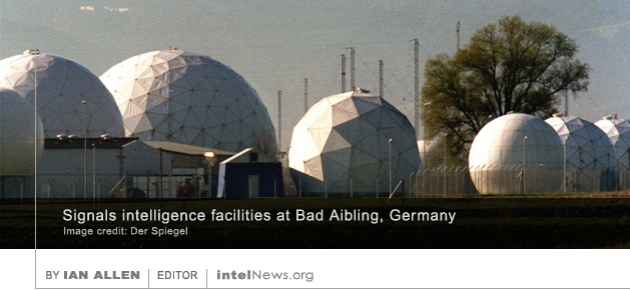
In 2015, the BND was found to have secretly collaborated with the US National Security Agency (NSA) in spying on several European governments and private companies. According to German investigative magazine Der Spiegel, the BND used its facilities at Germany’s Bad Aibling listening station to help the NSA spy on, among other targets, the palace of the French president in Paris, the headquarters of the European Commission in Brussels, and the France-based European conglomerate Airbus. In response to the revelations, Airbus filed a criminal complaint against the German government, while Belgium and Switzerland launched official investigations into the joint BND-NSA activities. The extent of the BND-NSA collaboration prompted widespread public criticism in Germany. In response to the criticism, German Chancellor Angela Merkel promptly fired the director of the BND in April of this year. Additionally, the German chancellor authorized a parliamentary inquiry into the operations of the BND, which was completed last spring.

The resulting 300-page report has not been made public. But summaries leaked to the German media reveal that the BND spied on 3,300 targets until the end of 2013. Nearly 70 percent of these targets belonged to countries that are members of the European Union or the North Atlantic Treaty Organization, and are thus some of Germany’s closest international allies. The targets allegedly included “hundreds of diplomatic missions” in Europe and elsewhere, as well as heads of state, government ministers, aides to foreign cabinet officials, and heads of foreign militaries. The report summary also states that the BND targeted non-governmental organizations and private corporations that are operate in the areas of aviation, weapons design, transportation, advertising and the media.

Last month, the German cabinet approved draft legislation that aims to reform the BND. The legislation explicitly bans the agency from spying on foreign governments or corporations for the benefit of German companies. It also prevents it from spying on targets within the European Union, unless the operation pertains to “information to recognize and confront threats to internal or external security”. The legislation also calls for the establishment of a new independent oversight body consisting of senior judges and representatives of the Office of the Federal Prosecutor, whose job will be to evaluate and approve the BND’s proposed espionage activities against foreign targets.

Author: Ian Allen | Date: 12 July 2016 | Permalink

Experts warn about Brexit’s effects on European, NATO cooperation

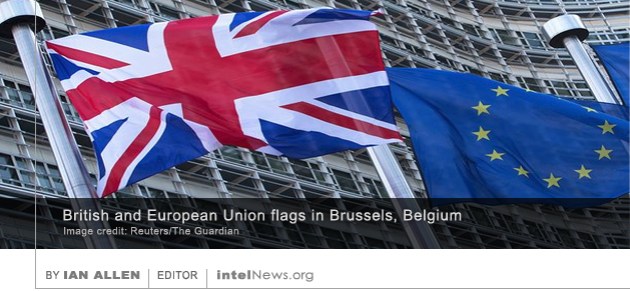
BrexitAfter Thursday’s Brexit vote, European and American security officials have tried to pacify concerns about major disruption of longstanding Western security cooperation arrangements. But experts stress that the international security landscape will be significantly impacted by Britain’s decision to leave the European Union (EU). As early as Thursday night, British defense, military and intelligence officials launched a marathon of phone calls in order to reassure their European and American counterparts that the United Kingdom was not going to retreat from its role in security pacts with Europe and the North Atlantic Treaty Organization (NATO).
On Friday, the office of NATO Director General Jens Stoltenberg issued a statement assuring the public that Britain’s decision to leave the EU would not impact on NATO’s security arrangements. On Sunday, however, a new statement by Stoltenberg appeared to revise his earlier comments. It argued that Britain was “the biggest provider of security in Europe” and that its eventual exit from the EU “matters”, adding that the West’s security situation post-Brexit was “more unpredictable […] than before”. Citing security officials from both sides of the Atlantic, including Stoltenberg, The Wall Street Journal opined on Sunday that Brexit “could have a profound effect on global security”, but stressed that its precise impact remains uncertain. Some officials warned that, in the long run, Britain’s exit from the EU would weaken its military, which is Europe’s most powerful. This could happen through a possible breakup of the country, with Scotland and Northern Ireland splitting from the United Kingdom in reaction to Brexit. Alternatively, Britain’s worsening economic situation could prove detrimental to its overall defense spending.

On Saturday, United States Navy Admiral (ret.) and former NATO commander James Stavridis, argued that NATO will benefit from Brexit, because it will allow the United Kingdom to devote “more resources and manpower to support” NATO’s mission. There will also be a “reduction in the […] battlefield competition between NATO and the EU”, said Adm. Stavridis, which “will likely produce a stronger NATO”. Others, however, disagreed. Citing several current and former officials, The Wall Street Journal warned that Britain’s exit from the EU would result in the loss of a quarter of the EU’s combat power. That could prompt Germany, France, and other EU nations to increase their military spending, in order to advance a more unified defense policy among EU nations. That could bring about a unified EU military headquarters, or even a joint European Army, which NATO has traditionally resisted, as it believes it would duplicate resources and undermine transatlantic cooperation. But with Britain leaving the EU, a staunch pro-NATO voice that strongly objected to the creation of a European Army ceases to exist. That could open the door to the creation of a European Army, say experts.

Last but not least, the UK was a strong player lobbying in favor of instituting EU-wide sanctions against Russia in the wake of the war in eastern Ukraine and Russia’s annexation of Crimea. With London now removed from the decision-making center in Brussels, the voices from EU member states like Spain, Italy and Greece, which argue for abandoning the sanctions against Moscow, are likely to grow louder, said The Wall Street Journal.

Author: Ian Allen | Date: 27 June 2016 | Permalink

Russia ‘mobilizing for war’ warns Canadian intelligence report

CSIS Canada A report by Canada’s primary intelligence agency warns in stark language that Russia is “retooling its military for a fight” and appears to be “mobilizing for war”. The classified report was accessed by the Canadian Broadcasting Corporation (CBC), the country’s state-owned broadcaster. According to the CBC, the document was produced by the Canadian Security Intelligence Service (CSIS), Canada’s primary national intelligence service. It is titled 2018 Security Outlook and is described by the CBC as a “distillation” of information from open sources and publicly available academic research, without input from internal CSIS assessments.
The 104-page report contends that, in the absence of any serious opposition inside Russia, the hardline nationalistic policies of Russian President Vladimir Putin are going unchallenged and becoming “more deeply entrenched”. When assessed collectively, Putin’s maneuvers in the area of national defense reveal that he is “retooling [the Russian] military for a fight”, claims the CSIS report. It goes on to add that Moscow “is not modernizing its military primarily to extend its capacity to pursue hybrid warfare”. The term ‘hybrid warfare’ is used by some experts to describe Russia’s utilization of irregular military tactics during its invasion and annexation of Crimea in 2014, and many believe that it points to the future evolution of Russian military thinking. But the CSIS document argues that President Putin is primarily modernizing Russian “conventional military capability on a large scale” and argues that “the state is mobilizing for war”.

The CSIS report is believed to be among several reasons why Ottawa is considering contributing hundreds of troops to a new 4,000-strong North Atlantic Treaty Organization (NATO) force that is expected to be stationed in the Baltic States in the coming months. The Canadian intelligence agency argues in favor of a more aggressive NATO policy vis-à-vis Russia in its report, stating that the economic sanctions imposed by the West on Moscow after the annexation of Crimea are not working. Instead of faltering due to outside economic pressures, the Kremlin “appears to be coherent, durable and united”, says CSIS. Consequently, “Western assessments that Russia is vulnerable to economic collapse and disruptive internal discontent are exaggerated”, according to the report. The document concludes that Russia is “adapting to diversity [by] deliberately tilting [its economy] to security, rather than economic freedom”.

Author: Ian Allen | Date: 16 June 2016 | Permalink

Portuguese, Russian spies arrested in Rome may have accomplices

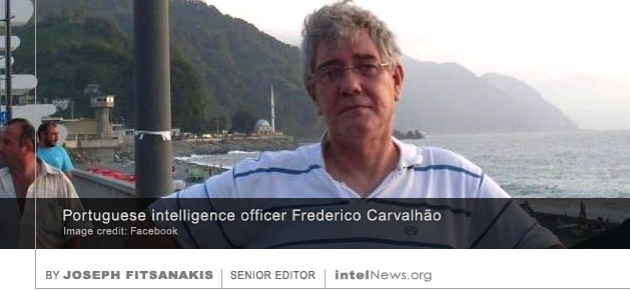
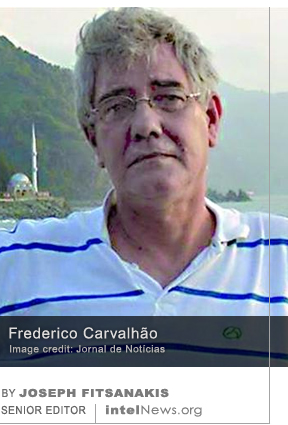
Frederico Carvalhão,A Portuguese intelligence officer arrested a week ago in Rome, allegedly while passing classified documents to his Russian handler, may have accomplices with access to North Atlantic Treaty Organization (NATO) secrets. IntelNews reported last week on the capture of Frederico Carvalhão, a section chief for Portugal’s Security Information Service (SIS), which is tasked with domestic security and counterintelligence. Carvalhão was arrested on May 23 at a café in the Trastevere district of Rome while passing a folder with six classified documents to a Russian man. The man is believed to be an employee of Russia’s Foreign Intelligence Service, known as SVR, though notably he does not have diplomatic status or immunity, and was therefore arrested. As we noted last week, this is atypical for an intelligence officer, as most of them operate as registered diplomats.
According to Portuguese media reports, the classified information that Carvalhão appears to have been sharing with the SVR since at least 2014 relate to NATO and the European Union (EU), of which Portugal is a member. However, the London-based newspaper Daily Telegraph reports that there are suspicions in Lisbon that Carvalhão was not working alone for the Russians. In other words, Portuguese investigators are looking into the possibility that the arrested spy was what is known as a ‘principal agent’. The latter signifies a mole that acts as a middle person between his foreign handlers and a cell of other agents working for him or her. The possibility that Carvalhão may not have been working alone was commented on by Portugal’s Minister of Foreign Affairs, Augusto Santos Silva, who said last week that the judicial investigation into the spy case was “ongoing”.

It appears that Carvalhão somehow managed to access NATO- and EU-related documents from the SIS’ Ameixoeira Fort headquarters in the Portuguese capital, to which he had no need-to-know access. Moreover, SIS computers do not accept flash drives, while all printed documents contain a secret watermark that identifies them as having been printed on an SIS printer. But Carvalhão appears to have somehow managed to acquire non-watermarked documents without having extracted them from an SIS computer with the use of a flash drive. Does that mean that someone else from inside SIS provided him with the documents? The EU and NATO are eagerly waiting for an answer.

Author: Joseph Fitsanakis | Date: 30 May 2016 | Permalink

Russian, Portuguese intelligence officers arrested in Rome on espionage charges

Frederico CarvalhãoTwo intelligence officers, one Russian and one Portuguese, have been arrested by Italian authorities on charges of espionage. The arrests took place in Rome on Monday by Italian police, who were reportedly accompanied by Portuguese counterintelligence officers. It is suggested in Portuguese media that the two men were arrested in the act of exchanging classified documents and money. The Portuguese intelligence officer has been identified in news reports as Frederico Carvalhão, a section chief for Portugal’s Security Information Service, which is tasked with domestic security and counterintelligence. The Russian intelligence officer has not been identified, but is believed to be an employee of Russia’s Foreign Intelligence Service, known as SVR. Interestingly, the Russian officer does not have diplomatic status and was therefore arrested, since he holds no diplomatic immunity.
A press release by the Portuguese government prosecutor said that Carvalhão had been arrested “along with a foreign subject linked to an intelligence organization” after a lengthy investigation into “concerns that [classified] information was being exchanged for money”. It is believed that Portuguese authorities began investigating Carvalhão in 2015, and now believe that he frequently traveled abroad to meet his Russian handler. He is thought to have been recruited by the Russians in 2014. According to Portuguese media reports, the documents that Carvalhão appears to have been giving the SVR contain information about the European Union and the North Atlantic Treaty Organization, of which Portugal is a member.

Carvalhão is said to have flown from Lisbon to Rome on Friday of last week in order to meet his SVR handler. The two men were meeting in a café on Saturday when they were arrested. The Portuguese government prosecutor said that Saturday’s arrests resulted from “rigorous collaboration between Portuguese and Italian authorities”. He also thanked Eurojust, a European Union agency based in the Netherlands, which focuses on cross-national judicial cooperation between European Union member-states. Security officers also raided Carvalhão’s home in Portugal, where they allegedly seized “documents and cash”. Both he and his alleged Russian hander remain in detention in Rome, while Italy is preparing to extradite them to Portugal.

Author: Joseph Fitsanakis | Date: 26 May 2016 | Permalink | News tip: C.W.

NATO missile system hacked remotely by ‘foreign source’

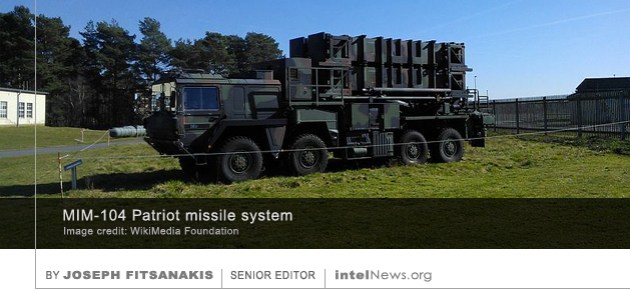
MIM-104 Patriot missile systemA Patriot missile system stationed in Turkey by the North Atlantic Treaty Organization (NATO) was allegedly hacked by a remote source, according to reports. German magazine Behörden Spiegel said this week that the hacked missile system is owned and operated by the German Army. It was deployed along the Turkish-Syrian border in early 2013, after Ankara requested NATO assistance in protecting its territory from a possible spillover of the civil war in neighboring Syria.

The Patriot surface-to-air missile system was initially built for the United States Army by American defense contractor Raytheon in the 1980s, but has since been sold to many of Washington’s NATO allies, including Germany. The Patriot system consists of stand-alone batteries, each composed of six launchers and two radars. The radars, which are aimed at spotting and targeting incoming missiles, communicate with the launchers via a computer system. The latter was hijacked for a brief period of time by an unidentified hacker, said Behörden Spiegel, adding that the perpetrators of the electronic attack managed to get the missile system to “perform inexplicable commands”. The magazine gave no further details.

Access to the Patriot missile system could theoretically be gained through the computer link that connects the missiles with the battery’s control system, or through the computer chip that guides the missiles once they are launched. Hacking any one of these nodes could potentially allow a perpetrator to disable the system’s interception capabilities by disorienting its radars. Alternatively, a hacker could hypothetically prompt the system to fire its missiles at an unauthorized target. According to Behörden Spiegel, the attack on the missile system could not have come about by accident; it was a concentrated effort aimed at either taking control of the missiles or compromising the battery’s operating system. Moreover, the sophisticated nature of such an attack on a well-protected military system presupposes the availability of infrastructural and monetary resources that only nation-states possess, said the magazine.

Shortly after the Behörden Spiegel article was published, the German Federal Ministry of Defense denied that Patriot missile systems under its command could be hacked. A Ministry spokesman told German newspaper Die Welt that the Ministry was not aware of any such incident having taken place in Turkey or elsewhere.

Author: Joseph Fitsanakis | Date: 10 July 2015 | Permalink: https://intelnews.org/2015/07/10/01-1732/

Ex-NATO supreme commander warns of ‘Grexit security nightmare’

James StavridisAn American former supreme allied commander of the North Atlantic Treaty Organization has warned that a possible Greek exit from the Eurozone “could become a geopolitical nightmare” for the European Union and NATO. James Stavridis, a retired four-start US Navy admiral, who served as NATO’s 16th Supreme Allied Commander Europe from 2009 to 2013, said solving the Greek crisis should not be left to the central bankers. In an article published Wednesday in Foreign Policy, Stavridis said the financial administrators that are handling the Greek crisis were not sufficiently cognizant of the massive geostrategic implications of a possible “Grexit”.
The retired admiral said that if the Greek economy continues its downward spiral, the country may not be able to fulfil its defense obligations to NATO, in which Greece has held full membership since 1952. As a result, the country may leave not only the EU, but also NATO. Neither organization has ever lost a member-state, said Stavridis, adding that such a development would constitute terra incognita and would “shake both organizations in fundamental ways” by weakening their broader ideological cohesion.

However, said Stavridis, chances are that Greece will remain a member of EU and NATO despite possibly exiting the Eurozone. But it would be “an angry disaffected and battered nation”, he said, and could thus wreak havoc in both organizations. The latter are consensus-driven, meaning that their actions depend on the unanimous agreement of all member-states. If Greece adopted an “uncooperative” attitude, it would easily bring both organizations to a halt when it comes to pressing issues, such the refugee crisis in the Mediterranean, sanctions against Russia over the war in Ukraine, the Iranian nuclear program, or even negotiations about transatlantic trade. Currently, Greece’s important geographic position means that its naval bases constitute the maritime flank of NATO during a critical time of tension in the eastern Mediterranean, said Stavridis.

And what if Greece, shunned by the West, started to look elsewhere for support? Russia, which shares strong historical and religious links with Greece, could be a “prospective partner” for Athens, argued Stavridis. If Moscow offered even marginal economic assistance to Athens, Greece could be tempted to further distance itself from its Western partners, both diplomatically and militarily.

Admiral Stavridis’ warning came a day after NATO Secretary-General Jens Stoltenberg said Greece had played “an important role in southern Europe as a NATO member” and urged Athens not to make cuts in its defense spending due to the ongoing economic crisis.

Analysis: Russia’s policy in Ukraine part of wider anti-NATO plan

Marina KaljurandBy IAN ALLEN | intelNews.org
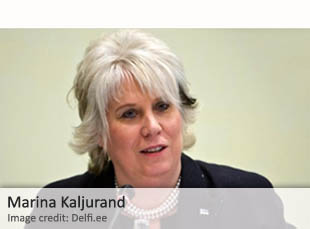
Russia’s tactical maneuvering in Ukraine is part of a wider strategy of pushing back Western influence from former Soviet territories, according to East European and Western officials. That is the conclusion in a lead article in the latest issue of Time magazine, which quotes several eponymous sources, including John McLaughlin, former director of the Central Intelligence Agency, and Marina Kaljurand, Estonia’s ambassador to Washington. She tells the newsmagazine that Russia’s meddling in Ukraine forms part of a carefully organized and well-funded strategy that involves “overt and covert” operations throughout Eastern Europe, the Caucasus and Central Asia. Kaljurand says the operations include “a range of Cold War espionage tools”, such as planted agents, citizen groups funded by the Kremlin, as well as recruitment of intelligence assets. The aim, she argues, is to “restore in one form or another the power of the Russian Federation in the lands where Russian people live”. Western officials quoted in the Time article seem to agree that the strategy has a long-term, wider goal, which is “to undermine and roll back Western power” in former Soviet lands. Currently, Russian push-back operations are not only underway in Ukraine, but also in Latvia, where nearly half of the population consists of ethnic Russians, as well as in Estonia, where one in four citizens is Russian in origin. As in all former Soviet republics, many ethnic Russians in Estonia are members of the Coordination Council of Russian Compatriots, a group that is coordinated, guided, and often funded, by the Russian embassy in the country. In a recent report, the Estonian Internal Security Service said the Russian embassy in Tallinn is “guiding the Russian-speaking population […] by using influence operations inherited from the KGB”. IntelNews regulars will recall the case of Herman Simm, the high-level official at the Estonian Ministry of Defense, who once headed the country’s National Security Authority. He was arrested in 2008 and later convicted for —among other things— giving classified North Atlantic Treaty Organization (NATO) material to Russia. Two years later, Estonia had been subjected to a sustained cyberattack after its government removed a statue commemorating the Soviet military contribution to World War II from downtown Tallinn. Read more of this post

Germany, UK, share intelligence with Free Syrian Army [updated]

Regional map of SyriaBy JOSEPH FITSANAKIS | intelNews.org |
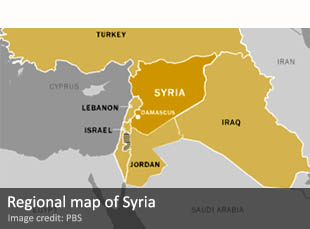
Two newspapers alleged over the weekend that German and British spy services routinely share critical intelligence on Syrian government troops with rebel forces in the country. In a leading article, German newspaper Bild am Sonntag claimed yesterday that Germany’s intelligence activities in Syria were far broader than officially acknowledged. The paper quoted an unnamed official from Germany’s Federal Intelligence Service (BND), who said that the country “can be proud of the significant contribution we are making to the fall of the Assad regime”. Also quoted in the article was an unidentified American intelligence official, who claimed that “no Western intelligence service has such good sources inside Syria as Germany’s BND”. According to Bild, the BND collects most of its intelligence on Syria through a number of ships, equipped with signals intelligence platforms, stationed in international waters off the Syrian coast. These ships can collect data on Syrian troop movements as far inland as 600 kilometers, or 400 miles. The collected data is then forwarded to BND officers stationed at the North Atlantic Treaty Organization base in Adana, Turkey, who are also tasked with intercepting radio messages and telephone exchanges between members of the Syrian government and/or military. The information is then passed on to members of the Free Syrian Army (FSA), the primary armed force engaged in a fierce civil war against the Syrian regime of Bashar al-Assad. Also on Sunday, the London-based Times newspaper quoted an unnamed FSA official as saying that the rebel forces are routinely given intelligence by British spy agencies. The official told the paper that “the British are giving the information to the Turks and the Americans and we are getting it from the Turks”. Read more of this post

News you may have missed #775

Ramstein Air Base, GermanyBy IAN ALLEN | intelNews.org |
►►Israel arrests man for allegedly spying for Syria. Israeli prosecutors have charged Iyad Jamil Assad al-Johari, a Druze resident of the occupied Golan Heights, with spying for Syria. The Shin Bet internal security service said in a statement that Johari, who is from the border village of Majdal Shams, was charged with “having contact with a foreign agent” and “passing information to the enemy”. The Shin Bet said Johari was arrested last month “on suspicion of maintaining contact with Syrian intelligence and passed information on Israeli army deployment on the Golan Heights”. The man’s family has denied the accusations.
►►German NATO employee charged with spying. Markus Koehler, a spokesman for German federal prosecutors, said in a statement that the suspect –identified only as Manfred K. in accordance with German privacy rules– was arrested Monday on charges of obtaining state secrets with the intent to provide them to an unidentified third party. The civilian NATO employee, who works at the US air base at Ramstein, is alleged to have obtained the data and then transferred it to his private computer.
►►Aussie spy agency looking for locksmith. In a new notice on its careers webpage, ASIS, Australia’s foreign intelligence agency, is looking for a “corporate locksmith”. “This is a unique role for a highly motivated and dedicated locksmith to provide complex locksmith services and advice across our organisation”, the notice states. “The position involves interstate and overseas travel, often at short notice”. The job notice says the successful applicant would have to manage the purchasing of all locks, safes and other secure containers for the service.

Comment: US helped Canada nab accused spy Jeff Delisle

Jeffrey Paul DelisleBy JOSEPH FITSANAKIS | intelNews.org |
Back in January of this year, when the Jeffrey Delisle spy affair made headlines around the world, I spoke with several journalists from The Globe & Mail, The Canadian Press, and other Canadian news outlets. Most of them were –rightly– curious about the role of the United States in the affair, in which Sub-Lieutenant Delisle, who had been employed at Canada’s ultra-secure TRINITY communications center in Halifax, was accused of spying for a foreign power. I told them that, given that Trinity handled –aside from Canadian– NATO communications, Canada was in fact obligated to notify all of its NATO partners about the suspected penetration. That aside, I said that it could be “safely assumed” that US counterintelligence agencies were “fully involved in the Delisle case, and probably ha[d] been for several months”. By the latter phrase, I implied that US counterintelligence agencies had been closely involved in helping their Canadian counterparts build their case against Delisle. Now a new report in The Globe & Mail suggests that US counterintelligence officials “supplied vital information” to their Canadian colleagues during “the early days of the investigation” into the Delisle affair. The article says that the full extent of what the Americans told Canadian authorities remains unclear; but it quotes “a source familiar with the matter”, who claims that the US “helped Canada build its investigation”, not necessarily by providing a single tipoff clue, but through “an accumulation of information”. The paper adds that Washington’s involvement in the investigation from an early stage “adds a key new detail to [the] story”. Not necessarily, I would argue. Read more of this post