Pro-Russian oligarch arrested —first sign of US sanctions on Russia?

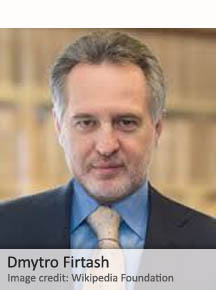
Dmytro FirtashBy IAN ALLEN | intelNews.org
A well-connected Ukrainian oligarch, who is considered one of Russia’s most trusted energy sales intermediaries, has been arrested in Austria at the request of the United States. Some speculate that this may be a first direct sign of America’s response to Russia’s military invasion of Ukraine. In an article published last week, The Washington Post suggested that the arrest of Dmytro Firtash, a citizen of Ukraine, may be “the beginning of a US effort to inflict financial pain on Russia over its role in the Ukrainian crisis”. Firtash’s lucrative business activities are inextricably tied to Gazprom, the world’s largest extractor of natural gas and one of the most powerful corporations in existence. The company, whose activities typically account for around 10 percent of Russia’s annual gross domestic product, is one of Moscow’s primary exporters of energy and among its most important sources of foreign revenue. Throughout the last decade, Firtash’s company, RosUkrEnergo, acted as the primary mediator between Gazprom and Naftohaz, Ukraine’s national oil and gas company. The latter would import Russian natural gas from Gazprom through RosUkrEnergo, which would purchase it from the Russian company and sell it to the Ukrainians at a noticeably steeper price. Eventually, in 2009, the government of pro-Western Ukrainian Prime Minister Yulia Tymoshenko managed to remove RosUkrEnergo as a broker from the energy deals between Kiev and Moscow. But Tymoshenko, who became herself embroiled in a financial corruption scandal, was soon imprisoned. And in 2013, Gazprom approached the pro-Russian government of Ukrainian politician Viktor Yanukovych and offered to sell natural gas to Ukraine at a 33 percent discount, providing that RosUkrEnergo was permitted to return as Moscow’s natural gas distributor to Ukraine. Last Wednesday, a statement from the Ukrainian government in Kiev confirmed that the man identified only as “Dmytro F., 48” in a laconic Austrian police report was indeed Dmytro Firtash. Read more of this post
US intelligence agencies urge ‘cautious approach’ on Ukraine

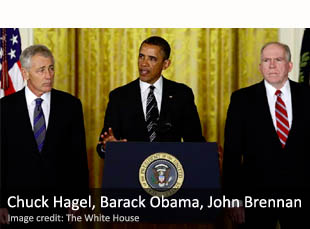
Chuck Hagel, Barack Obama, John BrennanBy IAN ALLEN | intelNews.org
American intelligence agencies see Russia’s control of the Crimean Peninsula as near-complete and urge Washington to take cautious steps on Ukraine, as Moscow appears prepared “to take military action” in defense of its strategic goals. The Los Angeles Times reported on Monday that some American intelligence analysts believe Moscow is genuinely convinced that its military action in Ukraine is justified under the Budapest Memorandum on Security Assurances. The agreement was signed in 1994 by the United States, United Kingdom, and the Russian Federation. The three nuclear powers guaranteed that they would refrain from actions that would subvert the territorial integrity and political autonomy of Ukraine. Western officials have accused Moscow of violating the agreement by dispatching Russian troops to southeastern Ukraine without the consent of the Ukrainian government. But some American intelligence analysts believe the Russian Foreign Ministry is convinced that Russian forces are acting within the scope of the 1994 agreement. The latter is interpreted by Russian officials as permitting Moscow to unilaterally dispatch up to 25,000 troops to the Crimea. This may even be the predominant view at the Central Intelligence Agency (CIA), judging by a briefing given last week by the Director of the CIA, John Brennan, to an unnamed “senior lawmaker”. The Times cited “US officials who declined to be named” as saying that Brennan suggested that Russian officials genuinely believe that the number of Russian troops in Ukraine “remains well below the threshold” specified in the Budapest Memorandum. Brennan added that, although he did not personally agree with Moscow’s interpretation of the Memorandum, it would be wise for Washington to tread cautiously on the subject, given the fact that Russian policy on Crimea remains unpredictable. Read more of this post

Comment: Is Ukraine’s Military Splitting in Two?

H First PostBy JOSEPH FITSANAKIS | intelNews.org
Much has been made about the presence of Russian troops —including what appear to be special forces units— in southern Ukraine. But peace and stability in the region are not threatened only by the actions of foreign troops; they are also threatened by the attitude of the armed forces of Ukraine, whose stance is likely to determine the outcome of the current crisis. The government of Ukraine has called all military reservists in the country to mobilize in order to “ensure the security and territorial integrity of Ukraine”. But what guarantee is there that the Ukrainian armed forces will remain united while the country is splitting in two —or three, counting the Tatars? At least 20 percent of Ukraine’s citizens consider themselves ethnically Russian, and there is little reason to believe that the ranks of the Ukrainian military, which reflect the ethnic makeup of the country’s divided population, will prove immune to rapidly intensifying sectarian tensions. Already Russian news outlets report that “the majority” of Ukrainian armed forces personnel stationed in Crimea have “switched to the side of local authorities” of the Autonomous Republic of Crimea. The secessionist government’s Deputy Prime Minister, Rustam Temirgaliev, said on Sunday that the Ukrainian armed forces in the breakaway region “have all but surrendered” and that many “are expected to take military oath soon”, declaring their allegiance to the Crimean Republic. Presumably these are ethnic Russians who are abandoning the Ukrainian military and joining that of the secessionist movement in Crimea out of nationalist allegiance.

Read more of this post

Comment: Nuland’s leaked phone call is ‘populist intelligence’

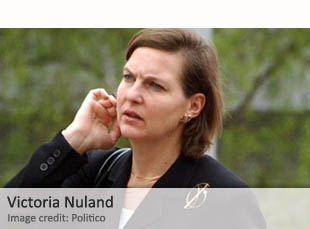
Victoria NulandBy JOSEPH FITSANAKIS | intelNews.org
My phone started ringing off the hook on Thursday evening, when a video appeared on YouTube containing a frank conversation between Victoria Nuland and Geoffrey Pyatt. Nuland, Assistant Secretary at the United States Department of State, and Pyatt, US Ambassador to Ukraine, were discussing US diplomatic moves on the political standoff in Ukraine. In the conversation, which was clearly meant to be private, Nuland expresses frustration with efforts by the European Union, which she deems weak and inadequate. In a shocking display of candor, Nuland tells Pyatt that the US should “help glue this thing and […] have the UN help glue it and, you know, f**k the EU”.

On Thursday night I spoke at the main news program of BBC television, where I agreed with most observers —some of the US government officials— that Russia was the obvious culprit behind the leaked conversation. The geopolitical interests of Washington and Brussels coincide almost completely when it comes to Ukraine, as both wish to detach the former Soviet republic from the Russian sphere of influence. So driving a wedge between the two allied sides is clearly to the benefit of Moscow. I added that the two American officials should have known better than to speak so frankly on the phone, given the constant monitoring of diplomatic communications by both adversary and friendly intelligence services, which is common knowledge in diplomatic circles. Read more of this post

Coroner’s report sees Russian state behind ex-KGB spy’s death

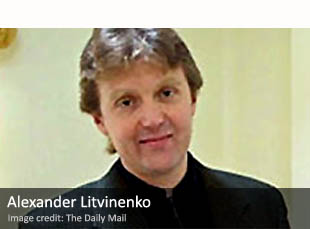
Alexander LitvinenkoBy JOSEPH FITSANAKIS | intelNews.org
A previously classified report by the British government official who certified the 2006 death of former KGB officer Alexander Litvinenko states that the Russian state was directly implicated in the murder. Litvinenko was an employee of the Soviet KGB and one of its successor organizations, the FSB, until 2000, when he defected with his family to the UK. He soon became known as a vocal critic of the administration of Russian President Vladimir Putin. In 2006, Litvinenko came down with radioactive poisoning soon after meeting former KGB/FSB colleague Andrey Lugovoy at a London restaurant. Many suspect that the Russian government is behind Litvinenko’s murder. In February of last year, Litvinenko’s family accused the British government of trying to block a probe into the murder case, after British Foreign Secretary William Hague limited the scope of a public inquest in to the matter on national security grounds. Supporters of Litvinenko have argued that White Hall has played down the Litvinenko murder case in order to preserve its trade ties with Russia’s government-owned energy companies. Members of the murdered spy’s family are now pushing for a full public inquiry into the incident, and are currently making the case before a specially appointed panel of judges at the High Court. In the course of this appeal, a previously classified document has emerged, which contains the report of Sir Robert Owen, the coroner who first examined the available evidence immediately after Litvinenko’s death. According to the document, which has been seen by the BBC, the coroner concluded that, based on “documents held by the UK government”, the “culpability of the Russian state in the death of Alexander Litvinenko” could be established “prima facie”. Read more of this post

US lawmakers say Snowden was coached by foreign spy agency

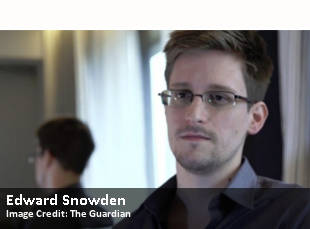
Edward SnowdenBy IAN ALLEN | intelNews.org
Two American lawmakers with senior positions in Congressional intelligence committees have expressed strong views that American defector Edward Snowden was probably coached by Russian intelligence prior to his defection. Speaking separately on Sunday, the two lawmakers —both Republican— said they suspected that Snowden had “acted in concert” with Russian intelligence in order expose Washington’s worldwide surveillance programs and steal military secrets. Snowden, a former technical expert for the Central Intelligence Agency (CIA) and the National Security Agency (NSA), is currently in Russia, where he has been granted political asylum. On Sunday, Mike Rogers, who chairs the Permanent Select Committee on Intelligence at the United States House or Representatives, said he was convinced Moscow had “at least in some part something to do” with Snowden’s defection. During separate interviews at NBC’s Meet The Press and CBS’ Face the Nation, Rogers said he thought it highly unlikely that Snowden’s defection was “a gee-whiz luck event”. He added that the former intelligence technician’s arrival in Russia had been likely pre-arranged by the FSB —the Russian Federal Security Service (though he likely meant the SVR, Russia’s Foreign Intelligence Service, which is responsible for intelligence activities outside the borders of the Russian Federation). The Republican lawmaker said that Snowden’s defection plan, ranging “from how he prepared to leave [to] his route of departure and how quickly [he] ended up in Moscow”, points to involvement by Russian intelligence. Also on Sunday, Republican Congressman Michael McCaul told ABC’s This Week that he did not think “Snowden woke up one day and had the wherewithal to do this all by himself”. The lawmaker, who chairs the US House of Representatives Committee on Homeland Security, cautioned that he could not prove definitively that Russia had a role in Snowden’s defection. Read more of this post

China ‘hacked European government computers’ prior to G20 summit

G20 Summit participantsBy IAN ALLEN | intelNews.org
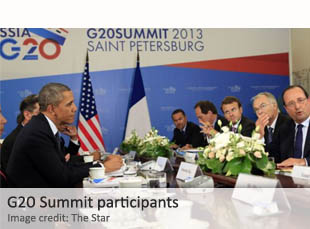
A group of hackers from China managed to compromise computer networks belonging to the foreign ministries of several European governments prior to last September’s G20 Summit, according to a private computer security firm. The Summit, which took place in St. Petersburg, Russia, on September 5 and 6 of this year, brought together the heads of state of 20 major economies, including the United States and many European Union countries. The meeting agenda was dominated by discussions concerning the response of the international community to the chemical attacks in Ghouta, Syria. According to the Reuters news agency, the hackers managed to infiltrate carefully targeted computer networks by sending emails containing infected attachments to employees of foreign ministries. The attached files bore titles such as “US_military_options_in_Syria”, which appeared designed to bear reference to the upcoming G20 Summit. The hacking revelations were made by FireEye, Inc., a California-based security firm, which says it has proof the hackers came from China. The firm says its confidence on the matters stems from “a variety of technical evidence”, such as the language used on the control server used by the hackers, as well as the types of machines that were used to test the virus before it was deployed. FireEye said its experts were able to keep tabs on the “inner workings” of the primary computer server that the hackers used to monitor the compromised computer networks. However, shortly before the Summit begun, the hackers migrated to another server, at which point the FireEye team lost contact with them. Read more of this post

US charges 49 Russian diplomats with fraud, says some were spies

Russian consulate in NYBy JOSEPH FITSANAKIS | intelNews.org
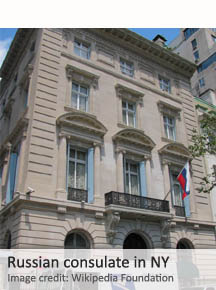
The United States has filed charges against dozens of current and former Russian diplomats, accusing them of defrauding American taxpayers of over a million dollars. Meanwhile, sources have told CNN that some of the accused also engaged in espionage against the US. Last week, the US Department of Justice charged 49 Russian citizens with participating in a nine-year fraud scheme, through which they pocketed approximately $1.5 million from Medicaid. Created in 1965, Medicaid is a US government insurance program for persons of all ages whose income and resources are insufficient to pay for health care. Twenty-five of those accused of fraud are current and former Russian diplomats, while 24 are spouses of diplomats. Eleven of them are currently in the US, ten of whom work at the Russian consular mission in New York. The remaining diplomat is stationed at the embassy of Russia in Washington, DC. The members of the fraud ring are accused of falsifying applications for Medicaid benefits by systematically under-reporting or completely concealing their incomes. While receiving thousands of dollars in benefits from the American government, the diplomats and their spouses lived a frivolous lifestyle, purchasing luxury goods in some of America’s most expensive department stores, like Tiffany’s and Bloomingdale’s. On Monday, however, CNN’s Security Clearance blog reported that some of the 49 Russian diplomats involved in the fraud scheme are also believed to have engaged in espionage against the United States. The spies were in fact investigated “for quite some time” by Federal Bureau of Investigation counterintelligence agents in Washington and New York, said CNN. At the end, however, federal prosecutors decided they had insufficient evidence to file espionage charges, and passed the case on to the Department of Justice, which brought fraud charges against the Russians. Read more of this post

Further evidence shows Litvinenko worked for MI6 when killed

Alexander LitvinenkoBy JOSEPH FITSANAKIS | intelNews.org
In 2012, a court in the United Kingdom was told that former KGB officer Alexander Litvinenko, who died of poisoning in 2006, had been working for British and Spanish intelligence when he was killed. Now British newspaper The Independent says it has proof that the late Russian spy provided “expert analysis” on Russian politics for British intelligence, shortly before his death. Litvinenko was an employee of the Soviet KGB and one of its successor organizations, the FSB, until 2000, when he defected with his family to the UK. He soon became known as a vocal critic of the administration of Russian President Vladimir Putin. In 2006, Litvinenko came down with radioactive poisoning soon after meeting a former KGB/FSB colleague, Andrey Lugovoy, at a London restaurant. Many suspect that the Russian government is behind Litvinenko’s murder. But the dead spy’s family has argued for years that his killers did not only kill an intelligence defector, but also an officer of British intelligence. On Thursday, The Independent said it had seen a diplomatic memo that was given to Litvnenko for analysis by British external intelligence agency MI6. The document, known in the British Foreign Office lingo as a “diptel” (diplomatic telegram), was dispatched to several British embassies around the world in 2000. It includes a descriptive analysis of a confidential meeting in London between British intelligence officials and Sergei Ivanov. Currently a political powerhouse in Putin’s administration, Ivanon was at the time an unknown quantity in Western circles. He had entered politics after having spent nearly two decades working for Soviet and Russian external intelligence. The diptel seen by The Independent outlines the exchange of views between Ivanov and the British officials during the meeting, and evaluates his stance on a broad range of issues, ranging from the rise of Islamic militancy, to China, the Middle East, and the role of the North Atlantic Treaty Organization. Read more of this post

European, American, Russian fighters join both sides of Syrian war

Regional map of SyriaBy JOSEPH FITSANAKIS | intelNews.org
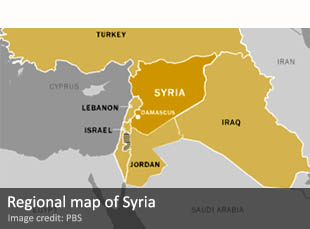
Nearly three years into the Syrian Civil War, it is becoming increasingly clear that the opposition forces are far more fragmented than the government side. Many of the rebel factions are now largely concerned with fighting each other for control of territory and other key assets, including oil installations and cross-border trade routes. Amidst the chaos, thousands of foreign fighters are flooding into the country, motivated by ideology or money. It is estimated that between 6,000 and 11,000 foreign fighters have entered Syria since the war, causing United States intelligence officials to speak of “a growing presence of foreigners” in the ranks of armed factions. At least 300 British citizens are estimated to have traveled to Syria with the intent of joining the Civil War, according to The Times of London. Most of them are young Islamist radicals who are intent on helping topple the administration of Syrian President Bashar al-Assad, according to the paper. Another British newspaper, The Daily Telegraph, reported recently that four British citizens —all London residents— died recently in Syria’s largest city, Aleppo, while fighting alongside government troops in support of President Assad. They were fighting against the al-Nusra Front, an opposition group with strong links to al-Qaeda. Meanwhile, The New York Times said on Wednesday that “dozens of Americans” have entered or tried to enter Syria to join various rebel factions in their fight against the government. The paper cited unnamed “American intelligence officials” in alleging that the Americans are a “small subset” of a larger group of “roughly 600” Western-born Islamists who have entered Syria from Western Europe, North America and Australia since 2011. The ongoing conflict has also attracted hundreds of Russian fighters, according to reports. Foreign Policy magazine notes the “rising flow” of radical Islamists from the Russian Federation to Syria in recent months. Read more of this post

FBI investigates Russian cultural center for alleged intelligence links

Russian Cultural CentreBy JOSEPH FITSANAKIS | intelNews.org
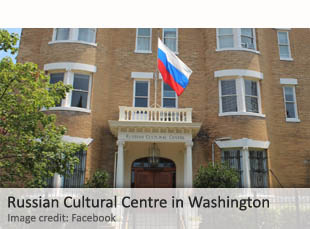
Authorities in the United States are probing a cultural exchange program run by the Russian government, on suspicion that it clandestinely recruited Americans as intelligence assets. Last week, Mother Jones magazine reported that agents from the Federal Bureau of Investigation had been interviewing American citizens who participated in the Rossotrudnichestvo exchange program. The program, which is operated by the Russian Centre for Science and Culture in Washington, DC, has sent approximately 130 Americans to Russia since 2001. Headquartered in northwest Washington, the Centre facilitates cultural programs and Russian-language lessons for a nominal cost. Many of the Americans who joined the Rossotrudnichestvo exchange program over the years were invited to travel to Russia in groups of 20 to 25. Most were graduate students, private-sector executives, political campaign staff, or workers in nonprofit organizations. They had their travel expenses, including transportation, lodging and meals, paid by the Russian government. During their trips to Russia, which customarily lasted for around 10 days, they stayed in expensive resorts and regularly met with officials from the Russian government. The American newsmagazine said that the FBI seems to be especially interested in Yury Zaytsev, a Russian government official who runs the Rossotrudnichestvo exchange program and is also Director of the Russian Centre for Science and Culture. The Washington Post reported that Zaytsev appears to be listed as a diplomat with the US Department of State. Read more of this post

News you may have missed #856

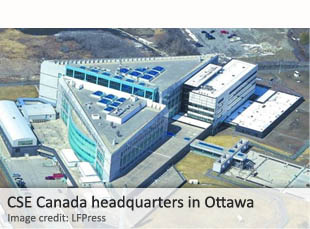
Communications Security Establishment CanadaBy IAN ALLEN | intelNews.org
►►Expert says Australia spies for the United States. Intelligence expert Professor Des Ball claims Australia is playing a role in America’s intelligence networks by monitoring vast swathes of the Asia Pacific region and feeding information to the US. Dr. Ball says the Australian Signals Directorate –formerly known as the Defence Signals Directorate– is sharing information with the National Security Agency (NSA). He adds that Australia has four key facilities that are part of the XKeyscore program, the NSA’s controversial computer system that searches and analyses vast amounts of internet data.
►►Canada silent on allegations of spying. A spokeswoman for Communications Security Establishment Canada has refused to comment on allegations that the agency mounts foreign operations through Canada’s embassies abroad. German magazine Der Spiegel says Canada is using diplomatic facilities to support surveillance operations in league with key allies the United States, Britain and Australia. The German newsmagazine indicates the Canadian spy agency hosts “Stateroom” sites —a term for covert signals-intelligence gathering bases hidden in consulates and embassies.
►►Russia denies spying on G20 leaders during summit. Russia has denied reports it attempted to spy on foreign powers meeting at the G20 summit in St Petersburg earlier this year, denouncing the allegations as a “clear attempt to divert attention” from revelations concerning the United States’ National Security Agency. Two Italian newspapers claimed on Tuesday that USB flash drives and cables to charge mobile phones that were given to delegates —including heads of state— at the September meeting were equipped with technology to retrieve data from computers and telephones.

News you may have missed #855

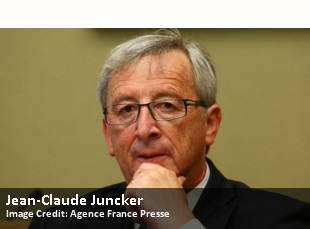
Jean-Claude JunckerBy IAN ALLEN | intelNews.org
►►Russian spy agency seeks to expand internet surveillance. Under an order drafted by Russia’s Communications Ministry, communications service providers would have to install equipment that would record and save all internet traffic for at least 12 hours and grant the security services exclusive access to the data. The draft order, made public on Monday, has been drafted with the help of the Federal Security Service (FSB), the successor to the Soviet-era KGB spy agency. It would take effect in July if it receives final government approval.
►►World War I spy Mata Hari’s birthplace gutted by fire. A fire in the Netherlands has gutted the birthplace of exotic dancer and World War I spy Mata Hari, Dutch media said on Sunday. Mata Hari was born as Margaretha Geertruida Zelle on August 7, 1876, the daughter of a local shopkeeper. She was arrested and executed by firing squad in October 1917, aged 41, after being accused of being a German spy during the First World War. The fire consumed the hair salon that now occupies the place of Mata Hari’s birth, the only remainder untouched by the flames was a small statuette of her dancing, erected outside the shop.
►►Luxembourg PM survives spy scandal in elections. Luxembourg’s Christian Democrat party of long-serving Prime Minister Jean-Claude Juncker easily remained the biggest party and the first choice to form a new coalition government following yesterday’s elections. Luxembourg was shocked into snap elections this summer after Juncker failed to contain a spying scandal centering on allegations of eavesdropping and wiretapping on politicians, and the keeping of files on ordinary citizens and leading figures dating back to the Cold War.

Russia ‘considering spy swap with Germany’

Andreas and Heidrun AnschlagBy JOSEPH FITSANAKIS | intelNews.org |
The Russian government has allegedly approached Germany with an offer to swap a number of jailed spies, including a couple of Russian sleeper agents sentenced for espionage earlier this month in Stuttgart. Russia’s Kommersant newspaper alleged on Monday that that the Russian intelligence services are pressing the Kremlin for the repatriation of Andreas and Heidrun Anschlag, a married couple who were arrested in Germany in October of 2011. The two were convicted on July 2, 2013, of having spied on Germany since at least 1990 for the Soviet KGB’s First Chief Directorate and its post-Soviet successor organization, the Foreign Intelligence Service (SVR). German federal prosecutors also accuse the couple of document forgery, since their Austrian passports, which they used to enter West Germany from Mexico in 1988 (Andreas) and 1990 (Heidrun) were shown to be counterfeit. In return for the Anschlags, Moscow would be prepared to hand over “at least one spy” convicted in Russia for spying for the West, said Kommersant. Possible candidates would be Andrei Dumenkov, who is currently serving a 12-year sentence for allegedly giving German military intelligence blueprints of Russian missile designs, and Valery Mikhailov, a Russian counterintelligence officer said to be one of the United States Central Intelligence Agency’s “most successful agents [in Russia] in recent years”.   Read more of this post

Are Russian spies switching to typewriters to avoid interception?

Dmitri Medvedev and Vladimir PutinBy JOSEPH FITSANAKIS | intelNews.org |
For the first time in over a decade, a Russian government department has decided to purchase typewriters, allegedly in order to safeguard classified documents against electronic interception. Russia’s Federal Protective Service has reportedly placed an order for the purchase of an estimated 20 typewriters, for 486,000 rubles –roughly US$15,000. The agency, known in Russia by its initials, FSO, is responsible for protecting high-ranking government officials, including the President of the Russian Federation, and is also tasked with operating federal emergency communications systems. It is the institutional descendant of the Soviet KGB’s Ninth Chief Directorate, which ceased to exist in 1992. According to the daily Russian broadsheet Izvestia, the FSO initially considered purchasing the typewriters in 2010, in response to a series of massive leaks of United States government classified documents by whistleblower website WikiLeaks. An unnamed source inside the FSO told the paper that the final decision to purchase the typewriters was made shortly after revelations made last month by former Central Intelligence Agency computer expert Edward Snowden. The self-styled whistleblower told Britain’s Guardian newspaper that British and American intelligence agencies targeted the electronic communications of heads of state and other senior officials during a G20 summit held in London in 2009. A principal target of the alleged spy operation was the then-Russian President Dmitri Medvedev, who headed the Russian delegation at the G20 summit. Interestingly, the FSO source told Izvestia that the initial purchase 20 typewriters will be followed by more orders, as large segments of Russia’s security establishment appear to be switching to typewriters as a means of producing classified documents. Read more of this post