Further evidence shows Litvinenko worked for MI6 when killed
November 29, 2013 1 Comment
 By JOSEPH FITSANAKIS | intelNews.org
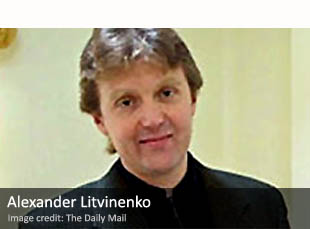
In 2012, a court in the United Kingdom was told that former KGB officer Alexander Litvinenko, who died of poisoning in 2006, had been working for British and Spanish intelligence when he was killed. Now British newspaper The Independent says it has proof that the late Russian spy provided “expert analysis” on Russian politics for British intelligence, shortly before his death. Litvinenko was an employee of the Soviet KGB and one of its successor organizations, the FSB, until 2000, when he defected with his family to the UK. He soon became known as a vocal critic of the administration of Russian President Vladimir Putin. In 2006, Litvinenko came down with radioactive poisoning soon after meeting a former KGB/FSB colleague, Andrey Lugovoy, at a London restaurant. Many suspect that the Russian government is behind Litvinenko’s murder. But the dead spy’s family has argued for years that his killers did not only kill an intelligence defector, but also an officer of British intelligence. On Thursday, The Independent said it had seen a diplomatic memo that was given to Litvnenko for analysis by British external intelligence agency MI6. The document, known in the British Foreign Office lingo as a “diptel” (diplomatic telegram), was dispatched to several British embassies around the world in 2000. It includes a descriptive analysis of a confidential meeting in London between British intelligence officials and Sergei Ivanov. Currently a political powerhouse in Putin’s administration, Ivanon was at the time an unknown quantity in Western circles. He had entered politics after having spent nearly two decades working for Soviet and Russian external intelligence. The diptel seen by The Independent outlines the exchange of views between Ivanov and the British officials during the meeting, and evaluates his stance on a broad range of issues, ranging from the rise of Islamic militancy, to China, the Middle East, and the role of the North Atlantic Treaty Organization. Read more of this post














 intelNews.org
Communist-era spy allegations surface in Czech political wrangling
December 2, 2013 by Ian Allen Leave a comment
Allegations that a senior Czech political figure was a government informant during the country’s communist period may disrupt the emergence of a national governing coalition. The Social Democratic Party won 20.5 percent in last October’s parliamentary election, emerging as the leading party in the Czech Republic’s fragmented political scene. The center-left party has said it is planning to form a governing coalition by reaching out to the centrist Christian Democratic Union, as well as a new center-right party calling itself ANO 2011 (Ano stands for ‘yes’ in Czech). The new party says it aims to end corruption in the country, abolish immunity from prosecution for elected parliamentarians, tackle unemployment, and improve the Czech Republic’s crumbling infrastructure. The party has also said it is willing on principle to join a wider government coalition, providing it is offered control of the country’s finance ministry. A leading contender for the ministerial position is ANO’s founder and main financial backer, Andrej Babiš. A business tycoon, who made his fortune importing and exporting fertilizers, Babiš is the Czech Republic’s second richest man, with an estimated fortune of $2 billion. His spectacular entrance into Czech politics was confirmed when ANO, which he founded in 2011, came in second in last October’s elections, receiving 18 percent of the national vote and gaining 47 seats in parliament. However, plans for a three-party coalition have been halted by allegations that Babiš may have been an informant for Czechoslovakia’s StB secret police during the 1980s. The claims first emerged in a Slovak newspaper shortly before last October’s elections, but failed to prevent ANO and Babiš from making a spectacular entry into Czech national politics. Later, however, the media allegations were substantiated by Slovakia’s Institute of National Memory, which provides public access to previously classified records of the StB and other Czechoslovak intelligence agencies during the country’s communist period. The Institute says that Babiš, who was a card-carrying member of the Communist Party of Czechoslovakia, had regular contact with the StB in the 1980s. At that time he was living in North Africa working for Petrimex, a Czechoslovakian government-owned international trade company. Read more of this post
Filed under Expert news and commentary on intelligence, espionage, spies and spying Tagged with Andrej Babiš, ANO 2011, Cold War, Czech Republic, Czechoslovakia, history, Institute of National Memory (Slovakia), News, Petrimex, Slovakia, StB (Czechoslovakia)