Irish police uncover Real IRA surveillance ring

Real IRA paradeBy JOSEPH FITSANAKIS | intelNews.org |
Police in the Republic of Ireland have arrested two men suspected of spying on the operational headquarters of the Garda Siochana (Irish Police) in Dublin. The two men, aged 41 and 32, who have not been named, were arrested after one of them was recognized by police officers as a known member of the Real Irish Republic Army. The Real IRA, or RIRA, is an Irish republican paramilitary organization formed in 1997, following a split in the Provisional IRA — the armed wing of Sin Fein. It seeks to bring about a united Ireland, but is considered a terrorist group by the United Kingdom and the United States, among other countries. Gardai officers discovered that the Real IRA suspect had used a false name to book a room in a hotel directly overlooking the regional headquarters of the Gardai on Harcourt Street. The building houses, among other police units, the Gardai’s Special Branch and the Criminal Assets Bureau, both of which are used to investigate paramilitary activity in the Republic. Upon searching the room, Gardai officers reportedly found “hi-tech surveillance equipment”, including parabolic microphones and digital cameras. Anonymous Gardai sources claim the equipment was used to eavesdrop on conversations held inside the Gardai building across the street, and to record the license tags of private vehicles belonging to Gardai personnel. Read more of this post

Decision to evacuate eastern Libya divides US Intelligence Community

US consulate in Benghazi, LibyaBy JOSEPH FITSANAKIS | intelNews.org |
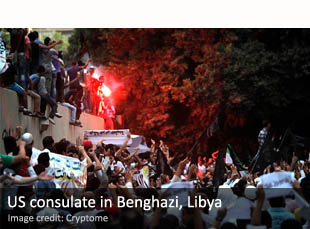
On September 12, just hours after heavily armed militia groups stormed the United States consulate in Benghazi, Libya, Washington made the decision to pull out its diplomats and intelligence officers from Eastern Libya. As US government envoys, spies and contractors started arriving at the Benina International Airport in Benghazi, many Libyans noted the “surprisingly large number” of Americans that came out of the woodwork. According to reports, at least a dozen of the American evacuees were in fact Central Intelligence Agency personnel. Their evacuation, which has essentially ended the presence of the CIA in eastern Libya’s most important city, is dividing the US Intelligence Community. On the one hand, some US intelligence insiders argue that the attack on the US consulate, which killed four US personnel, including Ambassador J. Christopher Stevens, necessitated the decision to evacuate. A number of former US government officials told The Los Angeles Times this week that the evacuation was “justified, given the dangers in Benghazi” for US personnel. Another current official told The New York Times that the evacuation of the CIA station in Benghazi does not necessarily mean that the US has lost its intelligence collection capabilities in eastern Libya. Washington can still intercept telephone calls and emails and conduct satellite reconnaissance in the North African region, said the official. Others, however, leveled sharp criticism against the decision of the White House to evacuate its diplomats and spies from Benghazi, arguing that the move marked “a major setback in [US] intelligence-gathering efforts” in the country. Robert Baer, a retired CIA officer with decades of experience in the Middle East, called the move “disastrous for US intelligence-gathering capabilities”. Writing in Time magazine, Baer said that shutting down the CIA station in Benghazi would make it “almost impossible to collect good human intelligence” in the region, and described the move as a sign of “America’s declining position” there. Read more of this post

News you may have missed #798

Alexander LitvinenkoBy IAN ALLEN | intelNews.org |
►►Britain to hold inquest over death of ex-KGB officer. Britain and Russia appear to be on a collision course over the death of Alexander Litvinenko, a former Russian intelligence officer who died in 2006 after ingesting polonium-210, a rare radioactive isotope. Britain’s Crown Prosecution Service has accused Andrei Lugovoi and Dmitry Kovtun, both former KGB agents, for the death of Litvinenko. Russia has refused British requests to extradite the two, leading to a row with Moscow and the tit-for-tat expulsion of Russian and British diplomats. Until now, the British Foreign Office had attempted to limit the scope of an inquest into the death of Litvinenko, fearing further diplomatic fallout. But coroner Sir Robert Owen said last week that he endorsed a previous ruling by his predecessor in the case, Andrew Reid, that there should be an “open and fearless” investigation into the matter.
►►Ex-CIA operative who illegally sold arms to Libya dies. Edwin P. Wilson, a former CIA officer who was convicted in 1983 for illegally shipping 20 tons of C4 plastc explosives to Libya, has died aged 84. In his trial he claimed he had shipped the weapons to Libya at the request of the CIA, because, as he said, the agency was trying to establish good relations with the Libyan government. But the court did not buy his story, so he spent over 20 years in prison, mostly in solitary confinement, until his release in 2004. He maintained his innocence to the very end.
►►Analysis: Libya an opportunity for CIA if it sticks around. The attack in Benghazi, Libya, that killed four Americans, including a US ambassador and two former Navy SEALs, has led Americans to vacate Benghazi for their safety, even though various militant groups continue their operations. It is a disaster for US intelligence efforts in the region, especially since the attack has made brutally clear how real the jihadi threat in eastern Libya remains. But there may be the smallest of silver linings to this black cloud, if American operatives are able to capitalize on it. The aftermath of the attack shows widespread displeasure with Benghazi’s jihadist groups, with thousands marching in protest. That is an opportunity the CIA could use to rebuild its intelligence gathering.

News you may have missed #797

Mohamed MorsiBy IAN ALLEN | intelNews.org |
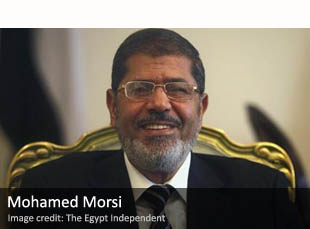
►►Egypt names new intelligence chief. Egyptian President Mohamed Morsi last week issued a decree naming Mohammed Raafat Shehata the country’s new head of intelligence, after the former spy chief was forced into retirement. Shehata had been acting director of the Egyptian General Intelligence Services Directorate since August 8, when his predecessor Murad Muwafi was sacked, after after gunmen killed 16 Egyptian border guards in Sinai.
►►Ex-Blackwater firm to teach US spies survival skills. The Defense Intelligence Agency announced on Thursday evening it would award six private security companies a share of a $20 million contract to provide “individual protective measures training courses” for its operatives. Among them is Academi, the 3.0 version of Blackwater, now under new ownership and management. The US military’s intelligence service is hiring the firm, along with five others, to train its operatives to defend themselves as they collect information in dangerous places.
►►Turkey court convicts 326 of coup plotting. A Turkish court on Friday convicted 326 military officers, including the former air force and navy chiefs, of plotting to overthrow the nation’s Islamic-based government in 2003, in a case that has helped curtail the military’s hold on politics. A panel of three judges at the court on Istanbul’s outskirts initially sentenced former air force chief Ibrahim Firtina, former navy chief Ozden Ornek, and former army commander Cetin Dogan, to life imprisonment but later reduced the sentence to a 20-year jail term because the plot had been unsuccessful. The trial of the high-ranking officers —inconceivable in Turkey a decade ago— has helped significantly to tip the balance of power in the country in favor of civilian authorities.

Court papers reveal Australian official’s affair with Vietnamese spy

Elizabeth MasamuneBy IAN ALLEN | intelNews.org |
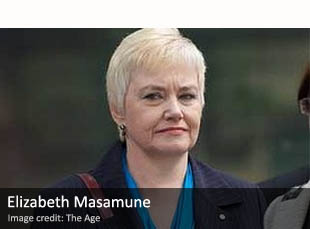
A statement filed with a federal court in Australia reveals that a Vietnamese intelligence officer, who is accused of having received millions of dollars in bribes to secure an international business contract, had an affair with an Australian government official involved in the deal. Australian federal authorities allege that the officer, Anh Ngoc Luong, a Colonel with Vietnam’s General Department of Military Intelligence, received AU$20 million (US$20.8 million) from Securency, a subsidiary of the government-owned Reserve Bank of Australia. According to Australian government prosecutors, who are suing eight Reserve Bank executives for bribing Anh, the Vietnamese intelligence officer was secretly paid to help secure a contract for the provision of banknote technology services between Securency and the State Bank of Vietnam. But it now appears that, while helping secure the lucrative deal, Anh had at least “two isolated sexual encounters” with Elizabeth Masamune, who at the time was a senior official with the Australian Trade Commission. Known informally as Austrade, the Commission operates under the country’s Department of Foreign Affairs and Trade and has offices in most Australian embassies and consulates around the world. It is tasked with representing Australia’s business interests abroad and helping Australian companies secure international business contracts. In a statement filed in court on Monday, Masamune said Anh had asked her out to dinner in the spring of 2002, while she was stationed in Vietnam. At the end of the dinner, the Vietnamese intelligence officer suggested that Masamune “go upstairs with him to a room in the hotel”. According to her statement, the Australian trade official agreed to do so “on the spur of the moment”. She added that her decision was motivated by her attraction to Anh and problems she was having in her marriage at the time. Read more of this post

News you may have missed #796

Richard FaddenBy IAN ALLEN | intelNews.org |
►►Iranian spy scandal sparks outrage in Turkey. After a nearly yearlong investigation into an alleged Iranian spy ring in Turkey, seven people were charged in early September with “providing information related to state security and establishing an [illegal] organization”. The charges against five Turkish citizens and two Iranian nationals followed a raid on the suspects’ residences and workplaces on August 29, in which videos and pictures of border security, documents, correspondence with Iranian intelligence and weapons were found, according to the investigation materials. Tehran denied any connections to those arrested, while officials in Ankara revealed more alleged evidence showing that Iran is providing support to the PKK.
►►British SIGINT agency ‘helps US drone attacks’. Britain’s former Director of Public Prosecutions, Lord Macdonald, has said there is “pretty compelling” evidence that the British government’s signals intelligence agency, GCHQ, is passing information to the United States to help it locate targets for controversial drone attacks in Pakistan. Earlier this year David Anderson, the British state’s independent reviewer of terrorism-related legislation, warned that the British government faced “a raft of civil cases” over possible complicity in the CIA drone attacks.
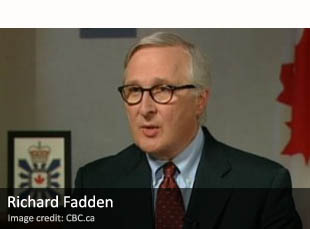
►►Canada’s top spy dismisses call for human rights scrutiny. In a newly declassified memo, CSIS director Richard Fadden appears to dismiss the Canadian Human Rights Commission’s recommendation that national security agencies do more to ensure they are not taking part in racial profiling or other objectionable practices. “I am confident in the service’s existing human rights policies and procedures, as well as our accountability and review structures”, Fadden says in the January 2012 memo, which is addressed to Canada’s Public Safety Minister Vic Toews. The memo —initially classified secret— was discovered by Mike Larsen, a criminology instructor in British Columbia, who obtained it under the Access to Information Act.

News you may have missed #795

Shakil AfridiBy IAN ALLEN | intelNews.org |
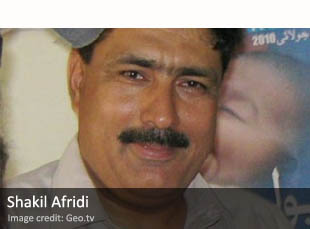
►►US ‘cannot verify authenticity’ of Afridi interview. The US says it cannot verify an alleged interview by Shakeel Afridi, a Pakistani medical doctor who helped the CIA find Osama bin Laden. In May, a Pakistani court sentenced Afridi to 33 years in jail after he was arrested following the killing by US troops of bin Laden in May 2011 at his compound in the town of Abbottabad. US television channel Fox News said Tuesday it had obtained an exclusive phone interview with Afridi from behind bars, in which he detailed months of torture by Pakistan’s shadowy Inter-Services Intelligence.
►►Evidence suggests US covered up Soviet massacre in Poland. New evidence appears to back the idea that the US administration of President F.D. Roosevelt helped cover up Soviet guilt for the 1940 Katyn massacre, in which more than 22,000 Poles were killed by the Soviets on Stalin’s orders. Historians said documents, released by the US National Archives, supported the suspicion that the US did not want to anger its wartime ally, Joseph Stalin. The documents show that American prisoners of war sent coded messages to Washington in 1943 saying that the killings must have been carried out by the Soviets, rather than the Nazis. Information about the massacre was suppressed at the highest levels in Washington, say historians.
►►Yemen President sacks intel agency heads. Yemeni President Abd-Rabbu Mansour Hadi has sacked the heads of the National Security Agency and  Military Intelligence, just a few hours after two suicide car bombs targeted the country’s Defense Minister in the capital Sana’a killing at least 12 people. The National Security Agency’s Ali Mohammed al-Anisi has been replaced with Ali Hassan al-Ahmadi, while the head of Military Intelligence, Mujahid Ali Ghuthaim, has been replaced with Ahmed Muhsin al-Yafiee. Hadi took office in February this year after year-long street protests forced former President Ali Abdullah Saleh to step down as part of an UN-backed power transfer deal in return for immunity from prosecution.

Situation Report: China’s Huawei Going Mobile? (Exclusive)

Huawei TechnologiesBy TIMOTHY W. COLEMAN | intelNews.org |
The Chinese firm, Huawei Technologies, a provider of information and communications technology, has been constantly under fire in the United States and around for the world for its supposed deep ties to China’s military and intelligence establishment. It is not without some justifiable concern either. Prior to starting Huawei Technologies, the company’s founder and CEO, Ren Zhengfei, served for more than 10-years in China’s People’s Liberation Army’s engineering corps. This reality, rightly or wrongly, has added fodder for concerns that Chinese government interests are intertwined with those of Huawei. On September 13, Huawei Technologies and another Chinese firm, ZTE, were the subject of a Congressional hearing titled “Investigation of the Security Threat Posed by Chinese Telecommunications Companies Huawei and ZTE”. The purpose of the hearing, as explained by the US House Permanent Select Committee on Intelligence, was to assess the potential danger of “telecommunications equipment manufactured by companies with believed ties to the Chinese government”. Read more of this post

Magazine publishes CIA-trained burglar’s fascinating story

David WiseBy JOSEPH FITSANAKIS | intelNews.org |
A captivating article about a break-in specialist for the United States Central Intelligence Agency, who turned against the Agency in the 1990s, appears in the October issue of The Smithsonian magazine. Written by David Wise (The Invisible Government, The Spy Who Got Away), the article contains some new information about “The Shop”, a secretive unit under the CIA’s Special Operations Division, which conducts what the agency describes as “surreptitious entries”. Based on “more than 80 interviews with 25 people”, including over a dozen former CIA officers, Wise says the unit features highly specialized teams of lock pickers, safecrackers, photographers, experts in disabling alarm systems, and others. Their mission, he says, is to break into foreign embassies around the world in order to steal classified documents and —most of all— codebooks used by foreign diplomats to communicate securely with their colleagues back home. Unlike most CIA personnel stationed abroad, the Agency’s non-destructive entry specialists do not enjoy the protection of diplomatic cover, says Wise, which means they cannot claim diplomatic immunity if caught red-handed. The author’s main source for the article appears to be Douglas Groat, a former US Special Forces captain, underwater explosives expert and Mandarin-Chinese speaker, who joined the CIA in 1980. Wise claims that Groat, who started working for The Shop in 1982, eventually became the Agency’s “top burglar and premier lock picker”. He designed or participated in approximately 60 different CIA- or National Security Agency-sponsored operations in dozens of countries in the Middle East, Africa, South America and Europe, which earned him several commendations, medals and awards from the NSA and the CIA. The article describes one joint CIA/NSA operation that took place in 1989 at the embassy of the German Democratic Republic in Katmandu, Nepal, which Groat’s team burgled in order to steal a code machine. The operation failed, as did another a few years later in “a Middle Eastern capital”, due to sloppy preparation on behalf of the CIA, says Groat. Read more of this post

News you may have missed #794

GCHQ center in Cheltenham, EnglandBy IAN ALLEN | intelNews.org |
►►Racism charge against GCHQ settled out of court. The British government’s SIGINT agency, GCHQ has been spared having its inner workings broadcast in public after a potentially embarrassing racism case was settled out of court at the last minute. The racial harassment and constructive dismissal lawsuit had been filed by Alfred Bacchus, a 42-year-old former employee. There are unconfirmed reports that, as part of the settlement, the plaintiff has signed a non-disclosure agreement banning him from revealing any more details about his complaints.
►►US spy agencies renew call for electronic surveillance rights. US intelligence officials had made a public plea on Tuesday, the 11th anniversary of the September 11, 2001, attacks, for quick Congressional action to extend a sweeping but controversial US electronic surveillance law. If the law, which expires at the end of 2012, is not extended, US spy agencies say they would lose access to what they describe as a “very, very important source of valuable intelligence information”. But at least one congressional critic of the surveillance law, Democratic Senator Ron Wyden, says he is willing to use legislative tactics to stall the bill, which has been passed by the House, unless the administration and other legislators agree to include stronger provisions to protect Americans’ civil liberties.
►►Yemen claims arrest of ‘Mossad agent’. Al-Nas, a Yemeni weekly associated with the Islamist Yemeni Reform Party, reported last weekend that an Israeli citizen, identified only by his initials and year of birth, 1982, was arrested in the southwestern city of Taizz. He reportedly admitted to smuggling children out of Yemen to neighboring countries and from there to Israel “through Zionist organizations”. Bizarrely, the man reportedly told his Yemeni interrogators that he “spent three years in a Greek prison for researching the biographies of well-known computer hackers”.

Nuclear smugglers to get reduced prison sentences ‘for helping CIA’

Urs TInnerBy JOSEPH FITSANAKIS | intelNews.org |
Three Swiss engineers imprisoned for participating in an international nuclear smuggling ring are about to have their prison sentences significantly reduced, allegedly for having acted as agents for the United States Central Intelligence Agency. Friedrich Tinner and his two sons, Urs and Marco, were arrested in 2004 in connection with a multinational investigation into the nuclear smuggling network of Dr. Abdul Qadeer Khan. The father of Pakistan’s nuclear weapons program, who is widely known as A.Q. Khan, had for years subcontracted his nuclear services to North Korea, Iran and Libya, until 2004, when he was placed under house arrest by the Pakistani government, following pressure from Washington. Since then, the Tinners have been under “investigative custody”, a peculiar state of pre-trial detention prescribed by Swiss law. In 2009, Urs Tinner gave an interview to Swiss television, in which he claimed than he, along with his brother and father, had for years informed the CIA on Khan’s activities and assisted the US intelligence agency terminate the Libyan nuclear weapons program. It later emerged that the Swiss government had “inadvertently” shredded some crucial documents required in the prosecution case against the three engineers. Late last year there was apparently concern at Langley that some CIA secrets could surface in court, after Swiss government prosecutors announced that a trial for the Tinners would go ahead. However, new prosecution documents released on Tuesday show that a plea bargain agreement has been struck between the Swiss government and the three defendants in this highly sensitive case. Read more of this post

Belgian intelligence chief says Brussels is world’s spy capital

Alain WinantsBy JOSEPH FITSANAKIS | intelNews.org |
The head of Belgium’s counterintelligence service has said in an interview that Brussels, which hosts the head offices of several international organizations, is home to more spies than any other city in the world. Alain Winants, Director of Belgium’s State Security Service (SV/SE), made the comment during a rare public interview to the Brussels-based English-language newspaper EU Observer. Winants told the paper that Belgium hosts “an enormous concentration” of diplomats, members of international non-governmental organizations, as well as employees of transnational institutions, including the European Union and the North Atlantic Treaty Organization. Because of this, he said, Belgium “is like a kindergarten” for spies, “the place to be” for intelligence operatives. The latter often operate under diplomatic cover or pretend to be students, lobbyists or business executives, he added. When asked how many case officers and spies operate in the Belgian capital, Winants, whose organization is responsible for counterterrorism and counterespionage, said “we are not speaking in the dozens; we are speaking in the hundreds, several hundreds”. He added that the numbers of intelligence operatives currently active in Belgium are “at the same level as the Cold War”. These intelligence operatives, he added represent countries such as Russia, China, and many others. When asked whether nations allied with the European Union also conduct espionage in the Belgian capital, Winants responded diplomatically that intelligence “is one field where the difference between neutral, friendly and unfriendly services tends to disappear”, as “every service is in competition with the others”. And he added that “it would be naïve to think that only countries like Russia, China, Iran are spying” in the Belgian capital. Read more of this post

News you may have missed #793

Yasser ArafatBy IAN ALLEN | intelNews.org |
►►Britain recruits tech start-ups for spy gadgets. British security services seem to have decided to widen the net for suppliers of state-of-the-art spyware for “covert surveillance”. Traditionally, British intelligence organizations including MI5 and GCHQ, have relied on a network of trusted contractors. But the change in approach represents an opportunity for burgeoning technology companies. According to a senior Whitehall official, who spoke to The Financial Times, these agencies “are appealing to a wide range of innovators, small and large, and saying: ‘Here are some problems we encounter. Can you solve them?’”.
►►French investigators to exhume Arafat’s remains. Three French investigating magistrates will travel to Ramallah in the West Bank to exhume the remains of the late Palestinian President Yasser Arafat so they can take tissue samples to determine what killed him. New evidence emerged from an investigation in July by the Al Jazeera television network when the Institut de Radiophysique, in Lausanne, Switzerland, said it had discovered significant traces of the rare radioactive element polonium-210 on the late leader’s clothing and toothbrush.
►►Panetta speaks out against book on bin Laden killing. As former US Navy SEAL Matt Bissonnette continues to make headlines about his book, No Easy Day, about the killing of al-Qaeda founder Osama bin Laden, US Defense Secretary Leon Panetta has spoken out publicly on the subject for the first time. The former Director of the CIA said “the American people have a right to know about this operation”. But, he added, “people who are a part of that operation, who commit themselves to the promise that they will not reveal the sensitive operations and not public anything […] when they fail to do that, we have got to make sure that they stand by the promise that they made to this country”.

CBS re-broadcasts Iran comments by former Mossad chief

Meir DaganBy JOSEPH FITSANAKIS | intelNews.org |
One of the few certainties in the spiraling crisis between Iran, Israel and the United States, is that Tel Aviv and Washington do not agree on how to respond to Tehran’s nuclear program. Nowhere is this lack of unity more noticeable than in the difference of opinion between the Office of the Israeli Prime Minister, Benjamin Netanyahu, and the White House. Netanyahu, a leading hawk in Israeli political circles, has made it clear that, unlike United States President Barack Obama, he believes that the time for diplomacy has run out, and that Israel has no option but to consider direct military strikes on Iran. Last weekend he even took the unprecedented step of advising American voters to elect a leader willing “to draw a red line” on the issue of Iran. It is worth noting, however, that senior figures in Israel’s intelligence community seem to be siding with the US on this dispute. Leading the wave of dissention within the ranks is Meir Dagan, former Director of the Mossad, Israel’s most revered intelligence agency. In November of 2010, Meir Dagan stepped down from his post as the head of the Mossad after having led the agency for over eight years —the longest tenure of any Mossad director in history. Soon afterwards, he admonished calls by Netanyahu’s people to bomb Iran as “the stupidest idea” he had ever heard. On Sunday, September 16, the CBS flagship investigative program 60 Minutes aired again an important interview with Dagan, which was first broadcast on March 11 of this year. The timing of the re-broadcast is critical, as observers in the Middle East appear increasingly certain that an Israeli military attack on Iran is imminent. Read more of this post

News you may have missed #792 (US diplomatic attacks edition)

US consulate in Benghazi, LibyaBy IAN ALLEN | intelNews.org |
►►Attack on US diplomats ‘was intelligence failure’. James Corum, an American military historian and the author of several books on military history and counter-insurgency, argues that the mob attacks on US diplomatic facilities in Cairo, Benghazi and Sana’a marked “one of the worst intelligence failures in American history”. Either, he says, US intelligence agencies had no warnings of mass action against the embassies, or senior intelligence officers disregarded or downplayed the information received from field agents. Finally, he suggests that “the real explanation is probably the latter”.
►►Attack on consulate in Libya ‘may have been planned’. Senior US officials and Middle East analysts raised questions Wednesday about the motivation for the Benghazi attack, noting that it involved the use of a rocket-propelled grenade and followed an al-Qaeda call to avenge the death of a senior Libyan member of the terrorist network. Libyan officials and a witness said the attackers took advantage of a protest over the film to launch their assault. Libyan Deputy Interior Minister Wanis al-Sharif said the security force was outgunned by the attackers, who joined a demonstration of “hundreds” of people outside the consulate
►►What happened in Benghazi was a battle. “It was not a simple mob that attacked the US consulate in Benghazi on Tuesday, killing four Americans. Benghazi was the scene of a pitched battle, one in which unknown Libyan assailants besieged American diplomats with small-arms fire for over four hours, repelling several attempts by US personnel to regain control of it. Nor was what happened in Benghazi a simple story of Americans assaulted by the Libyans they helped to liberate from Muammar Gaddafi last year. Libyan security forces and a sympathetic local militia helped the Americans to suppress the attack and get the diplomats inside to safety”.