Russia targeted by unprecedented wave of cyber-attacks, experts say
May 3, 2022 1 Comment
 RUSSIAN STATE COMPANIES, BUSINESSES and individuals are being targeted in an unprecedented wave of attacks by digital assailants, according to observers, who say they are surprised by its ferocity. Since February of this year, hackers have accessed the personal financial data of pro-Kremlin oligarchs, stolen millions of internal emails stored on Russian government severs, and defaced high-profile websites across the nation. The Washington Post, which summarized the wave of attacks last Sunday, said they are being waged by hacker collectives, as well as common criminals. The paper claimed that the assailants are not connected to foreign governments.
According to observers, Russia currently tops the global list of targeted attacks by hackers for the first time since records began. Major targets include Russia’s media regulator, the Federal Service for Supervision of Communications, Information Technology and Mass Media, which anti-government activists blame for implementing Soviet-style censorship. Hackers have also attacked Russia’s state-owned broadcaster, known as VGTRK, as well the Russian intelligence and defense establishments. Tens of thousands of emails exchanged by senior VGTRK officials since 2013 were recently stolen and leaked in a massive data dump. Additionally, lengthy lists containing the names of alleged Russian intelligence officers, as well as of soldiers, have been leaked online by unknown hackers.
The attacks are led by political hacker collectives, including Network Battalion 65 (NB65), which announced its existence on Twitter just hours after Russian troops began to march toward Kyiv. The group is believed to have links to the international hacktivist collective Anonymous, and claims to have no ties to governments. Another hacker collective that is behind the attacks on Russia is a group calling itself AgainstTheWest. Despite its name, it is led by a group of pro-Western, “English-speaking hackers […] with intelligence backgrounds”, according to The Post. Attacks are also being perpetrated by smaller groups of hackers, some of them based in Ukraine, and by criminal groups, whose members are motivated by profit and are attacking Russian state targets at a time when the Kremlin appears vulnerable.
According to the paper, the Ukrainian government is not directly involved in these cyber-attacks. However, it has repeatedly endorsed attacks by hackers aimed at weakening the Russian state. Back in February, Ukraine’s Deputy Prime Minister and Digital Transformation Minister issued an open call for the formation of a “volunteer cyber army” to fight for Ukraine. As intelNews reported at the time, the Ukrainian government claimed that nearly 200,000 people had shown interest in joining the initiative. However, little has been mentioned since. The government of Ukraine maintains an “IT Army” channel on Telegram, where it frequently suggests Russian targets that pro-Ukrainian hackers should attack. However, any evidence of links between it and the wave of cyber-attacks that Russia has been experiencing remains speculative.
► Author: Ian Allen | Date: 03 May 2022 | Permalink
 The Islamic Revolutionary Guard Corps (IRGC) is still recovering from the damage it suffered by an offensive American cyber campaign against it that took place in June, according to sources. The attack allegedly degraded the IRGC’s ability to strike at oil tankers and other ships in the Persian Gulf. The New York Times
  For the first time in its history, the United Kingdom has launched its first-ever military-style cyber campaign against an adversary, according to the director of the country’s primary cyber security agency. The target of the campaign was the Islamic State, the militant Sunni Muslim group that is also known as the Islamic State of Iraq and Syria (ISIS). The existence of the all-out cyber war was announced last week by Jeremy Fleming, the newly appointed director of the Government Communications Headquarters (GCHQ), Britain’s signals intelligence organization. Fleming, a former Security Service (MI5) officer, was
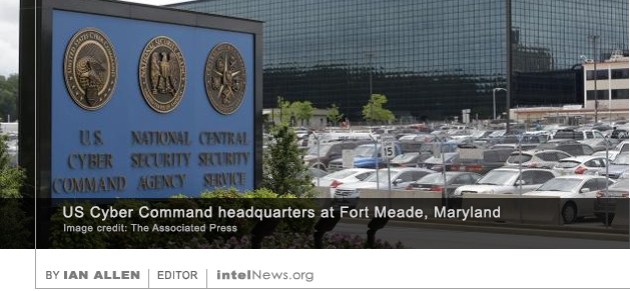
 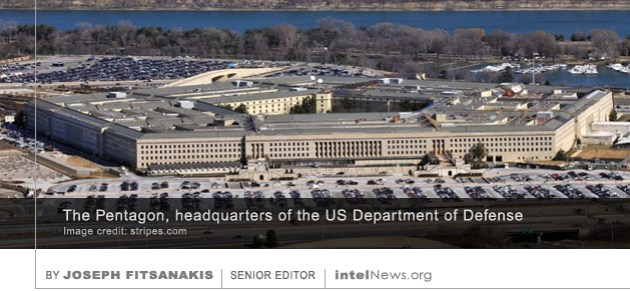 The White House will soon announce its decision to strengthen the United States Cyber Command and separate cyber war operations from intelligence functions, according to insider reports. For many decades, the National Security Agency has been in charge of protecting America’s cyber network and combating online threats. But in 2009, the Administration of US President Barack Obama established a brand new Cyber Command, proposing that the online environment represented a new theater of war. Since that time, the US Department of Defense has been campaigning in favor of strengthening the new Cyber Command and completely removing it from the patronage of the NSA –despite the fact that the latter is also a Pentagon agency.
 The global reach of the Islamic State through the use of the internet remains “largely intact” despite relentless efforts by some of America’s most advanced cyber warfare experts to neutralize the group’s online presence. It is now over a year since the United States Department of Defense announced that it had launched a cyber war against the Islamic State —the militant Sunni Muslim group that today controls large parts of Syria and Iraq.
 Following a request from the White House, the United States Department of Defense is putting together options to launch offensive cyber operations of an unprecedented scale against the Islamic State. The White House












 intelNews.org
Despite expectations, a cyber-blitz has not occurred in Ukraine. Experts explain why
July 1, 2022 by Joseph Fitsanakis 1 Comment
Why is that? According to two experts, Nadiya Kostyuk, assistant professor at Georgia Tech’s School of Cybersecurity and Privacy, and Aaron Brantly, assistant professor and director of Virginia Tech’s Tech4Humanity Lab, the reasons partly relate to how nation-states form cyber-alliances, as well as to Russia’s overall approach to this war. The two experts attempt to forensically analyze this topic in their article entitled “War in the Borderland Through Cyberspace: Limits of Defending Ukraine Through Interstate Cooperation”, which was published on June 29 in Contemporary Security Policy.
Does the Improved Cyber-Defense Argument Stand to Reason?
In their article, Kostyuk and Brantly systematically scrutinize a number of reasons that other experts have proposed to explain the absence of a major cyber-war campaign by Russia. Among them is the view that Ukraine significantly improved its cyber-defenses after 2015, when it began collaborating closely with Western countries —notably the United States and the United Kingdom. Specially designated “cyber-warfare teams” from these countries have been helping Ukraine in tasks ranging from “the synchronization of [its] cyber- related legislation” with Western standards, as well as aligning them with NATO standards, so that Ukrainian cyber-warfare units can make use of advanced technologies and systems. Could it be, therefore, that Ukraine has improved its cyber-security posture enough to be able to defend itself against relentless Russian cyber-attacks?
That is unlikely, say the authors, given that “Ukraine’s cyber capabilities are still organizationally and operationally under- developed” in comparison to Russia’s. That is exacerbated by the endemic corruption and clientelism (the creation of patronage networks) in Ukraine, as well as by the bitter in-fighting between government agencies —notably the Ministry of Defense and the Security Service of Ukraine. It should not go without notice, Kostyuk and Brantly note, that the Ukrainian government sought frantically to develop a “volunteer cyber-army” on an ad hoc basis to defend the nation in the first days of the Russian invasion. That did not exactly instill trust in the country’s level of preparation to withstand a cyber-campaign by Moscow. Read more of this post
Filed under Expert news and commentary on intelligence, espionage, spies and spying Tagged with 2022 Russian invasion of Ukraine, Analysis, cyber security, cyberwar, Newstex, Russia, Ukraine