News you may have missed #661

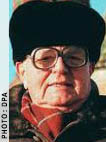
Reza KahliliBy IAN ALLEN | intelNews.org |
►►Britain increases pay for key intelligence staff. Having seen many of its key intelligence staff lured away by tech heavyweights like Google and Microsoft, the UK government is apparently offering bonuses and payouts to key intelligence staff to ensure they don’t leave their jobs at the Government Communication Headquarters (GCHQ). The UK Cabinet Office has stated that the bonuses to be paid to its key staff have been already given the green light.
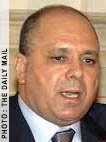
►►Ex-CIA spy sees split in Iran’s Revolutionary Guards. Reza Kahlili (codenamy WALLY) is the pseudonym used by an Iranian defector to the US, who claims to have worked as a CIA agent in the 1980s and early 1990s. Kahlili (pictured), who says he was a member of the Islamic Revolutionary Guard Corps (IRGC), the ideological protectors of Iran’s 1979 Islamic Revolution, argues that a serious split is developing within the IRGC, with one faction favoring the overthrow of the government.
►►A rare look at Fort Bragg’s Special Warfare Center. The US Special Warfare Center at Fort Bragg is a CIA-approved paramilitary training facility, aimed at members of the US Army Green Berets, Navy SEALs and Marine Corps special operators. The piece claims –rather unconvincingly– that the Center is “an illustration of how special operations and intelligence forces have reached an easier coexistence, after early clashes where CIA officers accused the military operators of ineptly trying to run their own spy rings overseas without State Department or CIA knowledge”.

News you may have missed #656: Outed spies edition

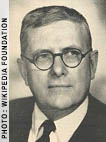
Alexander LennikovBy IAN ALLEN | intelNews.org |
►►Iran seeks death penalty for alleged CIA spy. Iran is seeking the death penalty for an American man accused of working for the U.S. Central Intelligence Agency, officials said. At his trial Tuesday, Amir Mizraei Hekmati said the CIA sent him to Iran to infiltrate Iran’s intelligence systems, Iran’s Fars News Agency reported. Sources in America deny Hekmati’s intelligence connections and say the confession was coerced. Washington has also accused Iran of denying Hekmati access to Swiss consular officials.
►►North Korean alleged spy ‘kills self’ in South. A man who claimed to be a North Korean defector has reportedly committed suicide after allegedly confessing that he was sent to spy on the South. During questioning, the unnamed man, who was in his 30s, said he had received orders from Pyongyang to report on a South Korean organization that helps defectors from the North.
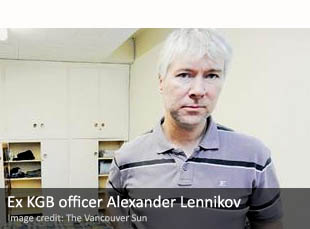
►►Ex-KGB spy spends third Christmas in Vancouver church. Ex-KGB spy Alexander Lennikov (pictured) has been living in Canada with his wife and teenage son since 1992. But in 2009, the Canadian government ordered him to leave the country, under a law which dictates that any former member of a spy agency that spies on democratic governments is inadmissible to Canada. Since then, he has taken sanctuary at the First Lutheran Church in Vancouver, and has not left the building. For previous intelNews coverage of this story see here.

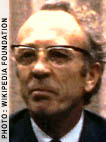
New book on British double spy Kim Philby published in Russia

Kim Philby

Kim Philby

By JOSEPH FITSANAKIS | intelNews.org |
An important new biography of H.A.R. “Kim” Philby, the British MI6 officer who defected to Russia during the Cold War, has been published in Moscow. It is based on candid interviews with his surviving fourth wife, Rufina Pukhova-Philby, as well as on an array of declassified documents from Russian state archives. The book, titled just Kim Philby, is authored by Nikolai Dolgopolov, editor of Moscow-based daily Rossiiskaya Gazeta, which acts as the official organ of the Russian state. Aside from Pukhova-Philby, the book, whose publication is set to coincide with the 100th anniversary of Kim Philby’s birth, on January 1, enjoyes the official blessing of Russia’s Foreign Intelligence Service (SVR), the successor organization to the KGB’s external intelligence directorate. The SVR allowed Dolgopolov access to previously secret documents on Philby, including a newly declassified Russian translation of the British double spy’s personal account of the events that led to his 1963 defection, as well as a description of his escape to Russia through Lebanon. Dolgopolov’s books describes Philby as “one of the greatest Soviet spies”, thus siding with the mainstream view in intelligence research literature, which recognizes Philby as one of the most successful double spies in history. While working as a senior member of British intelligence, Philby spied on behalf of the Soviet NKVD and its successor, the KGB, from the early 1930s until his 1963 defection. Two years later, he was awarded the Order of the Red Banner. The Soviet authorities buried him with honors when he died in 1988. Read more of this post

News you may have missed #631

Tommy Douglas

Tommy Douglas

►►Some spy files on Canadian prominent politician released. Newly declassified records from the early 1960s show that the Royal Canadian Mounted Police spied on Saskatchewan Premier Tommy Douglas (pictured), suspecting him of communist sympathies. Douglas, a popular leftwing politician, led the first social democratic government in North America.
►►Aussie diplomats urged to welcome defectors in 1980s. The Australian government urged its spies and diplomats to encourage foreign officials to defect to Australia and welcome intelligence they might bring with them, according to internal documents from the 1980s, released this week. The directives noted that applications from defectors were not expected to be numerous “but failure on our part to handle them deftly could result in the loss of intelligence relevant to Australia’s security and other interests”. One observer notes that the 1980s policy towards defectors still applies today in Australia’s diplomatic community.
►►Iran arrests two Kuwaitis on suspicion of espionage. Iran’s semiofficial Fars news agency says Iranian security has detained two Kuwaiti citizens in southwestern Iran for suspected espionage activities. Fars quoted Bahram Ilkhaszadeh, governor of Abadan, a town close to Kuwait, as saying that Iran’s security agents detained the two on possession of “spying equipment”. Kuwait has denied the charges.

News you may have missed #630

Riad Al Assad

Riad al-Assad

►►Senior Syrian military defector in Turkey denies training troops. Colonel Riad al-Assad, who acts as head of Syria’s military defectors, has denied a news report that he crossed the border from Turkey to Syria to command troops loyal to the opposition force called the Free Syrian Army. “News reports that appeared on a number of Internet sites that I had crossed into Syria to command troops there are false. I am in Turkey at the moment, in a safe place,” he told the Turkey’s Anadolu Agency on Tuesday.
►►Iran says missile base blast was not caused by Mossad. Iran has insisted that last weekend’s huge blast at the Alghadir missile base at Bid Ganeh, 30 miles to the west of Tehran, was not carried out by Israel or the US, despite widespread reports that it was the work of the Israeli secret service, the Mossad. The explosion killed 17 of the country’s elite revolutionary guards, including Major General Hassan Moqqadam, a senior commander described as the pioneer of the regime’s missile programme.
►►British official says MI6 foiled Libyan assassination plan. British intelligence foiled a plot by Colonel Muammar al-Gaddafi’s forces to assassinate Western diplomats and Libya’s revolutionary leadership, Britain’s Foreign Secretary has disclosed. In a rare speech about the secret services, William Hague said the Libyan intelligence service launched a “sustained effort” to conduct suicide and car bomb attacks against the National Transitional Council, but that “the attacks were prevented”.

Seoul arrests N. Korean defector for ‘planning assassination’

Park Sang-hak

Park Sang-hak

By JOSEPH FITSANAKIS | intelNews.org |
South Korean authorities have announced the arrest of a North Korean defector, who is accused of planning to assassinate another defector involved in intensive propaganda operations against the North. A man identified only as “Ahn” was reportedly detained earlier this month after arranging a meeting with Park Sang-hak. Park is a high-profile North Korean defector, known for spearheading an imaginative —and often controversial— propaganda campaign directed against the government of North Korea. In one recent example, Park, his wife and children, used dozens of inflatable helium balloons to smuggle thousands of leaflets, dollar bills, solar-powered radios, and DVDs into North Korea. The nature of Park’s operations, which tend to be designed to attract worldwide media attention, is often the cause of diplomatic rifts between Pyongyang and Seoul, which does not formally endorse Park’s actions. The Associated Press spoke to two South Korean officials, who refused to be named; although they confirmed news of Ahn’s arrest, they refused to discuss a report by South Korea’s Yonhap News Agency, and now the BBC, according to which Ahn “had a poison-tipped needle on him” when he was detained by South Korean counterintelligence officers. This is the second time in recent months that South Korea has arrested North Korean defectors on suspicion of planning assassination operations. In April of 2010, Seoul announced that two North Koreans, who had defected to the South a few months earlier, had admitted to being intelligence officers on a Pyongyang-sponsored mission to assassinate a North Korean former senior official. The official, Hwang Jang-yop, is a former secretary of the Korean Workers’ Party and the ideological architect of juche, the philosophy of self-reliance, which is North Korea’s officially sanctioned state dogma. Read more of this post

Video of Chinese general’s espionage lecture leaked onto YouTube

Jin Yinan

Jin Yinan

By JOSEPH FITSANAKIS | intelNews.org |
Video footage of a lecture on recent espionage incidents against China, delivered before a vetted audience by a senior Chinese military official, has been leaked to online video sites, including YouTube. The lecturer has been identified as Major General Jin Yinan, and the location appears to be one of the main lecture halls at China’s National Defense University (NDU) in Beijing. Administered by the Central Committee of the Chinese People’s Liberation Army (PLA), NDU is China’s equivalent of the United States’ West Point Military Academy. The precise date of the venue cannot be verified, though it appears to have been intended as a cautionary lesson for NDU students, on the fate that awaits Chinese officials spying against their country. In the video, General Jin laments the fact that too many Chinese Communist Party members have “become decadent” and have succumbed to selling classified national secrets to foreign adversaries. He also discusses several recent cases of espionage against China, including that of Xu Junping, a senior colonel in the PLA, who defected to the United States in December of 2000. The speaker also mentions the case of Tong Daning, a Social Security Department economist who was executed in 2006 for sharing classified Chinese economic data with Taiwanese intelligence operatives. But the primary revelations of the speech concern the cases of Li Bin and Kang Rixin, which General Jin addresses in detail. Li Bin was arrested during his tenure as China’s Ambassador to South Korea, and was eventually sentenced to a seven-year prison term for corruption. But General Jin discloses in his speech that the Ambassador was arrested for selling classified information to South Korean intelligence, and that the Chinese prosecutors decided to bring him up on corruption charges, to “avoid embarrassing [our] country”. Read more of this post

US misused our intel to justify Iraq War, says German ex-spy chief

August Hanning

August Hanning

By JOSEPH FITSANAKIS | intelNews.org |
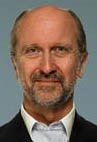
The former Director of Germany’s foreign intelligence service has accused the Bush administration of consciously falsifying intelligence supplied by Germany in order to justify going to war in Iraq. August Hanning, who served as Director of Germany’s Bundesnachrichtendienst (known as BND) from 1998 to 2005, said that the BND had no part in the deception, and that “the responsibility for the war lies solely with the Americans”. In an interview to the Sunday edition of German national newspaper Die Welt, Hanning explained that the administration of US President George W. Bush was especially interested in intelligence collected by the BND from an Iraqi defector codenamed ‘Curveball’. The defector, whose real name is Rafid Ahmed Alwan al-Janabi, arrived in Germany in 1999 and applied for political asylum, saying he had been employed as a senior scientist in Iraq’s biological weapons program. Among other things, he told his BND debriefing team that Saddam Hussein had built a fleet of biological weapons labs on wheels, in order to avoid detection from America and other countries. After consulting with biological weapons experts, the BND expressed serious doubts about Curveball’s reliability, but kept him in Germany nonetheless. Several years later, al-Janabi confirmed the BND’s suspicions, by admitting that he had invented his allegations in order to help bring down the regime of Saddam Hussein. He also admitted that he was in reality a taxi driver from Baghdad, who had used his undergraduate knowledge of engineering to get asylum in Germany. At the time, said Hanning, the BND strongly and repeatedly communicated to the CIA its doubts about Curveball’s claims, something which is known. What is not known, however, is that Hanning personally wrote to then CIA Director George Tenet and urged him to adopt a skeptical approach to the defector’s allegations. The former BND chief told Die Welt that he was “assured by the Americans that our intelligence would not be used in Powell’s speech”. Read more of this post

News you may have missed #570

Nassr al-Mabrouk Abdullah

Abdullah Nassr

►►Libya internal security chief defects. Egyptian airport officials said Nassr al-Mabrouk Abdullah, Muammar al-Gaddafi’s interior minister, landed in a private plane in Cairo with nine family members traveling on tourist visas. Nassr was the minister responsible for police, civil defense, domestic intelligence, and some border security units.
►►S. Korea admits 1962 death occurred in spy training camp. A special committee is reviewing whether the family of a South Korean man who died half a century ago while being trained as a spy for elite missions into North Korea is eligible for compensation. South Korea’s military intelligence command admitted in a July 14 letter that “Mr. Jeon Gwang-su died during training on Sept. 30 of 1962 ahead of being dispatched for a mission in the North”.
►►NSA announces ‘hiring blitz’. The National Security Agency, America’s largest cryptologic intelligence agency, has announced its intention to hire as many as 3,000 people over the next two years, many of them cybersecurity experts. In fact, NSA recruiters even took a trip to Las Vegas in the last few weeks to look for potential hires at DefCon, a high-profile hacker conference there.

US government wants to use secret witnesses in CIA leak trial

James Risen

James Risen

By JOSEPH FITSANAKIS | intelNews.org |
Prosecutors in the case of an ex-CIA officer accused of disclosing classified information to a journalist have asked the court for permission to introduce evidence in secret and to use privacy screens to shield the identities of witnesses. Jeffrey Sterling, who worked for the CIA’s Iran Task Force,  faces 10 felony counts and up to 120 years in prison for sharing information about the CIA’s operations in Iran. Court documents do not name the recipient of Sterling’s information, but it is common knowledge that Sterling spoke to James Risen, a Pulitzer Prize-winning journalist for The New York Times. In chapter 9 of his 2006 book State of War: The Secret History of the CIA and the Bush Administration, Risen details a botched operation by the Iran Task Force, which tried to pass to the Iranians a series of faulty nuclear bomb design documents. To do this, the CIA apparently recruited a Russian former nuclear scientist, who had defected to the United States. The unnamed scientist was told to travel to Vienna, Austria, in early 2000, and offer to sell the documents to the Iranians. But the documents contained a deliberate technical flaw, which, Risen alleges, the Russian CIA operative thought was so obvious that it could make him look untrustworthy in the eyes of the Iranians, thus endangering the entire mission. The Russian scientist ended up letting the Iranians know about the flaw, reveals Risen. He further alleges that the CIA operation may have actually helped the Iranian nuclear weapons program, as Iranian scientists would have been able to “extract valuable information from the blueprints while ignoring the flaws”. Read more of this post

News you may have missed #530

  • Another spy ring reportedly busted in Kuwait. Kuwait has allegedly busted another spy ring, working for the intelligence services “of an Arab country [that] is currently embroiled in political turmoil”, reports Al-Jaridah daily. The paper also said that information gathered by the spy ring was sent to a liaison officer in the embassy of that country. Last April, two Iranians and a Kuwaiti national, all serving in Kuwait’s army, were sentenced to death for belonging to an Iranian spy ring.
  • How defectors come in from the cold. Interesting historical account of how defectors adjust to their new lives, from the BBC’s News Magazine. Sadly, much of the article is about –you guessed it– the Cambridge Five, which the British seem unable to get over, half a century later.
  • UK report says hackers should fight cyber spies. Britain faces losing its position at the leading edge of technology unless new ideas are developed to fight cyber attacks, including recruiting computer hackers to help fight organized cyber crime and espionage by foreign powers. This is the conclusion of a new report by the University College London’s Institute for Security and Resilience Studies.

Analysis: Arab revolutions cause blind spot for US spies

Christopher Dickey

Dickey

By JOSEPH FITSANAKIS | intelNews.org
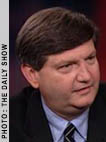
An unusually blunt piece published in Newsweek magazine describes the Arab democratic revolutions in Egypt, Tunisia, Libya and elsewhere as serious detriments to US intelligence collection in the Muslim world. Written by Newsweek’s Middle East Regional Editor Christopher Dickey, the lengthy article argues that the ongoing political changes in several Arab countries make US counterterrorism professionals long for the days “when thuggish tyrants, however ugly, were at least predictable”. It even quotes an unnamed senior intelligence officer who denounces the celebration of democracy in the Arab world as “just bullshit”, and sees “disaster […] lurking” in the region. The reason for such vehement reaction is plain: US intelligence professionals are witnessing an elaborate network of informants across the Arab world, which they painstakingly built and cultivated since the late 1960s, crumble before their very eyes. These informants, who had senior government positions in secularist Arab dictatorships, “are either gone or going”, says Christopher Boucek, of the Carnegie Endowment for International Peace. Read more of this post

Spy defectors claim Iran had foreknowledge of 9/11

9/11 attack

9/11 attack

By IAN ALLEN | intelNews.org |
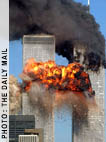
A new filing in a nine-year court case in Manhattan contains testimony by two defectors from Iran’s intelligence service, who claim that Tehran had “foreknowledge of the 9/11 attacks”. According to The New York Times, the two unnamed defectors also claimed that the Iranian intelligence services helped al-Qaeda in planning the attacks, and that operatives of the Iranian government funded and helped train the 9/11 hijackers. The filing also claims that Hezbollah, the Iranian-linked militant group that controls large parts of Lebanon, helped shelter al-Qaeda members in the months and years following the American invasion of Afghanistan. The filing was submitted to a US federal court on last week, in support of a lawsuit seeking damages from the government of Iran for its alleged “direct support for, and sponsorship of, the most deadly act of terrorism in American history”. The lawsuit was initiated 2002 on behalf of families of people who died in the 9/11 attacks. But neither the names of the Iranian defectors nor the precise content of their testimony has been revealed to the public, as their assertions were submitted to the presiding judge under seal. Read more of this post

West German defector dies in Moscow

Hans-Joachim Tiedge

Tiedge

By JOSEPH FITSANAKIS | intelNews.org |
A senior West German counterintelligence official, whose 1985 defection to the Soviet bloc shocked Western intelligence, has died in Moscow. Hans-Joachim Tiedge headed the Cologne office of West Germany’s now-defunct Federal Office for the Protection of the Constitution (BfV). He was also involved in the BfV’s counterintelligence work against East German spy operations on West German soil. But on August 19, 1985, Tiedge boarded a train to East Germany. Once there, he walked over to a branch of the Ministry for State Security (commonly known as the Stasi) and declared his intent to defect. His defection caused disarray in West German intelligence circles, prompting the recall of dozens of West German officers and agents operating in East Germany. It eventually led to the resignation of the Director of the BfV, Heribert Hellenbroich. In his autobiography, published in 1998, Tiedge said he decided to defect “due to personal problems” relating to chronic alcoholism and financial debt. He also said his decision to flee to East Germany was prompted by the fear that he was about to be reassigned to a less desirable post inside the BfV. Read more of this post

Australian Labour Party leader worked for Soviets, claims historian

H.V. Evatt

H.V. Evatt

By IAN ALLEN | intelNews.org |
One of Australia’s leading intelligence historians has said that Herbert V. Evatt, who led the Australian Labour Party in the 1950s, operated as a secret agent for the Soviet Union. Dr Desmond Ball, professor at the Australian National University’s Strategic and Defence Studies Centre, made the claim following last week’s release in London of previously classified documents relating to Australian intelligence. The documents, which came from the archives of MI5, Britain’s domestic intelligence agency, reveal that Australian Prime Minister Robert Menzies was convinced that Evatt was a Soviet agent. His fear appears to have culminated two days before the national election of November 22, 1958, when he privately expressed the fear that Evatt would destroy Australian counterintelligence documents on the Soviet Union if the Labour Party was elected to power. With this in mind, he ordered the Australian Security Intelligence Organization (ASIO) to share top-secret documents on the Soviet Union with London and Washington. Following Menzies’ directive, the ASIO provided Britain’s MI5 and MI6, as well as America’s CIA with two sets each of a number of intelligence reports acquired through KGB defector Vladimir Petrov. Read more of this post