Snowden flees to Russia despite US passport revocation

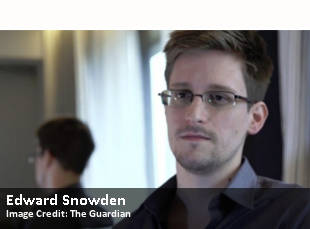
Edward SnowdenBy JOSEPH FITSANAKIS | intelNews.org |
An American former intelligence contractor, who leaked classified information about intelligence operations, was able to leave Hong Kong for Russia on Sunday, despite having his United States passport revoked. Earlier this month, Edward Snowden, a former technical assistant for the Central Intelligence Agency, disclosed the existence of PRISM, a clandestine electronic surveillance program operated by the US National Security Agency (NSA). Shortly before leaking information about US intelligence operations to the world’s media, Snowden traveled to Hong Kong, a territory under the control of the People’s Republic of China. Last week, Washington charged Snowden, a self-described whistleblower, under the Espionage Act, and revoked his American passport, in an attempt to prevent him from leaving Hong Kong. But reports emerged on Sunday that Snowden had boarded an Aeroflot flight from Honk Kong to Russian capital Moscow, despite the revocation of his American passport. US authorities claim that Snowden’s transfer to Moscow occurred after Washington revoked his American passport, which raises the question of how the former CIA employee was able to exit Chinese territory. Several reports suggest that Snowden was accompanied by “unidentified diplomats” as he left Hong Kong for Moscow. Previously, the US had applied considerable diplomatic pressure on China, requesting Snowden’s extradition. But Hong Kong allowed the American fugitive to board a plane to Moscow, saying it had been given “no legal basis to restrict Mr. Snowden from leaving”. Read more of this post

UK/US spy agencies targeted heads of state at London G20 meeting

NSA/GCHQ listening station in Menwith HillBy JOSEPH FITSANAKIS | intelNews.org |
British and American intelligence agencies targeted the communications of heads of state and other senior officials during a G20 summit held in London in 2009, according to documents. The summit was hosted by the then British Prime Minister Gordon Brown and was attended by delegates from 20 major world economies, including then Russian President Dmitry Medvedev, who was specifically targeted in the spy operation. British newspaper The Guardian, which published the information, said that delegates had their personal computers and cellular telephones monitored during a joint effort by the US National Security Agency (NSA) and Britain’s General Communications Headquarters (GCHQ). The two agencies, which are tasked with intercepting communications signals on behalf of their respective governments, maintain a jointly administered listening base inside the Royal Air Force station in Menwith Hill near Harrogate, North Yorkshire. According to one of the documents, entitled “Russian Leadership Communications in support of President Dmitry Medvedev at the G20 summit in London —Intercept at Menwith Hill station”, the listening facility was utilized to spy on the communications of the Russian President during his stay in London. The targeting began as soon as President Medvedev and the Russian delegation arrived in the British capital on April 1, and continued for several days. The top-secret document, which was shared between British, American, Australian, Canadian, and New Zealand intelligence services, noted “a change in the way Russian leadership signals have been normally transmitted” through satellite links from the Russian embassy in London. Another set of documents, also published by The Guardian, indicate that some G20 summit delegates were “tricked into using Internet cafes [that] had been set up by British intelligence agencies” in order to intercept their email communications. Read more of this post

News you may have missed #842 (world reaction to Snowden leak)

Edward SnowdenBy IAN ALLEN | intelNews.org |

►►Chinese media focus on Snowden leaks. The front pages of Chinese state media were covered Thursday with the allegations of ex-CIA employee Edward Snowden, who says the US government has been hacking computers in China for years. Speaking to media in Hong Kong, where he is currently staying, Snowden said the US has been hacking computers in Hong Kong and mainland China since 2009. He said targets include public officials, businesses and the Chinese University of Hong Kong. Those claims by Snowden were the top story on most of China’s major news portals on Thursday
►►Switzerland furious about Snowden’s charge that CIA spies on Swiss banks. One of the many lurid details in The Guardian’s remarkable interview with NSA whistleblower Edward Snowden was his account of what initially prompted him to leak: namely a CIA tour in Switzerland, where CIA officers recruited Swiss banking officials. The Snowden disclosure could not come at a worse time for the Swiss government, which is trying to convince parliament to back its emergency plan that would allow Swiss banks to turn over data on tax evaders to the US government.
►►Is Russia considering giving asylum to Snowden? Asked if the 29-year-old could claim asylum from Russia, a spokesman for President Vladimir Putin told the newspaper Kommersant: “If such a request is received, it will be considered”. Any attempt by the Kremlin to give refuge to Mr Snowden, amid calls for his prosecution under the US Espionage Act, is likely to infuriate the White House and provoke a major diplomatic standoff.

News you may have missed #838 (analysis edition)

Predator droneBy IAN ALLEN | intelNews.org |

►►Delisle spy case barely caused ripples between Canada and Russia. The arrest of Jeffrey Delisle, a Canadian naval officer spying for Russia, did little to discourage Canada from welcoming that country’s defense chief to a Newfoundland meeting of Arctic nations last year. The visit underscored the puzzling lengths to which the Canadian government went to carry on a business-as-usual relationship with the one-time Cold War adversary. Most other planned military contacts between the two nations last year —including participation in the anti-terrorism exercise Operation Vigilant Eagle— also remained curiously normal.
►►Don’t believe the hype on Chinese cyberespionage. Within a day of each other, The Washington Post published a shocking list of US defense programs whose designs have reportedly been stolen by Chinese cyberattacks, and ABC news said the plans for Australia’s spy headquarters were also stolen by Chinese hackers. It makes China sound like a secret-sucking cyber espionage machine, but is that really the case? The knee-jerk interpretation to this disclosure (and others) is that China is a powerhouse of cyber espionage capable of stealing whatever secrets they want and that the US is powerless to stop them. This seems very unlikely.
►►US Predator drone program quietly shifted from CIA to DoD. The White House has quietly shifted lead responsibility for its controversial armed drone program from the CIA to the Defense Department. In a landmark speech last week at National Defense University in Washington, US President Barack Obama offered some clues into the status of the program, opaquely signaling it will now primarily be conducted by the United States military.

Canada spy agency refused to notify Mounties about Russian agent

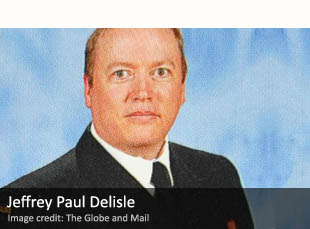
Jeffrey Paul DelisleBy JOSEPH FITSANAKIS | intelNews.org |
Canada’s main counterintelligence agency opted to keep secret from the Royal Canadian Mounted Police (RCMP) vital information about a Canadian naval officer who spied for Russia. Regular readers of this blog will be familiar with the case of Jeffrey Paul Delisle, a Sub-Lieutenant in the Royal Canadian Navy, who until 2011 was employed at Canada’s ultra-secure TRINITY communications center in Halifax. Delisle was arrested in January 2012 for passing information gathered from radio and radar signal interceptions to a foreign power, most likely Russia. In May of last year, it emerged that it was in fact the United States that alerted the Canadian Security Intelligence Service (CSIS) about Delisle’s espionage activities. What was supposed to happen next was that the CSIS —which is not a law enforcement agency— should have notified the RCMP of Delisle’s activities and requested his prompt arrest. Remarkably, however, the CSIS chose to keep the Delisle file concealed from the RCMP, ostensibly to prevent the possible exposure of intelligence sources and methods in open-court proceedings. The Canadian Press, which broke the story on Sunday, cited “numerous sources familiar with the Delisle case” in claiming that the CSIS’ refusal to request Delisle’s arrest “frustrated Washington”, which feared that the spy was routinely compromising United States secrets shared by America with its Canadian allies. So frustrated were the Americans, that the Federal Bureau of Investigation (FBI) sketched out a plan to lure Delisle onto US soil and arrest him there. Read more of this post

News you may have missed #837

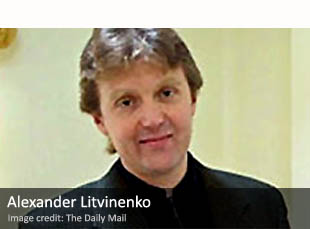
Alexander LitvinenkoBy IAN ALLEN | intelNews.org |

►►Russian ex-spy ‘would testify’ in Litvinenko inquiry. The 2006 murder of former Russian spy Alexander Litvinenko has never been solved and remains the subject of conflicting narratives and still-deepening intrigue over who may have killed him and why. Now a key witness, a US-based former Russian spy who worked with Litvinenko in the months leading up to his death, says he is willing to give evidence at a public inquiry. British police considered him such a vital witness that they visited the US three times to persuade him to give evidence at the inquest.
►►Assange reveals GCHQ messages discussing extradition. Authorities at GCHQ, Britain’s eavesdropping agency, face embarrassing revelations about internal correspondence in which WikiLeaks founder Julian Assange is discussed, apparently including speculation that he is being framed by Swedish authorities seeking his extradition on rape allegations. The records were revealed by Assange himself in a Sunday night interview with Spanish television. A message from September 2012, apparently says: “They are trying to arrest him on suspicion of XYZ. It is definitely a fit-up. Their timings are too convenient right after Cablegate“.
►►North Korean defector accused of spying by his sister. Earlier this year, Yoo Woo-sung, one of the most prominent North Korean defectors living in South Korea, was arrested on charges of espionage. Now court documents have shown that Yoo was arrested after testimony from his sister, who said he had been sent on a mission by North Korea’s secret police to infiltrate the defector community and pass back information about the people he met. The Washington Post reports that defectors from the North are increasingly facing the brunt of this suspicion.
►►Iran hangs two men for spying for Israel and US. Mohammad Heydari was found guilty of passing intelligence on “security issues and national secrets” to Israeli Mossad agents in exchange for cash. Kourosh Ahmadi was convicted of providing intelligence to the CIA, Tehran’s prosecutor’s office said. It is not clear when Heydari and Ahmadi were arrested or where they were tried. Their execution was handed down by Tehran’s Revolutionary Court and confirmed by the Supreme Court, Iran’s Fars news agency reported.

Russia expelled ex-US embassy official who rebuffed spy advances

US embassy in MoscowBy JOSEPH FITSANAKIS | intelNews.org |
Russian authorities expelled a former American diplomat living in Moscow earlier in May, less than two months after he allegedly rebuffed an offer to spy on the United States for Russia. The former official, Thomas Firestone, served two tours of duty as a Resident Legal Adviser at the American embassy in Moscow. He later joined the Moscow office of Baker & McKenzie, a US-based law firm with offices worldwide. Firestone had frequent and direct dealings with the Russian government in his capacity as a specialist in the Foreign Corrupt Practices Act. This US law permits the prosecution of bribery cases in American courts. According to The New York Times, Firestone was approached in March of this year by operatives of the Russian Federal Security Service, the FSB, one of the main successor agencies of the Soviet KGB. Citing “people familiar with the case”, The Times claims that the American lawyer turned down an offer to spy for Moscow on behalf of the FSB. On May 5, however, while returning to Moscow from a trip abroad, Firestone was detained at Sheremetyevo International Airport, 18 miles outside of the Russian capital. After a 16-hour detention, the former Justice Department official was told that he had been declared persona non grata (undesirable) and was to be denied entrance into Russia; he was promptly placed on a flight to the US, which departed shortly afterwards. The Times says that it remains unclear at this point whether Firestone’s expulsion was directly connected to his alleged refusal to give in to the FSB’s espionage advances. However, the paper claims that the matter has been raised with the Russian government by the administration of US President Barack Obama. Read more of this post

Russian news agency reveals name of CIA station chief in Moscow

US embassy in MoscowBy JOSEPH FITSANAKIS | intelNews.org |
A Russian news agency revealed the name of the alleged station chief of the United States Central Intelligence Agency (CIA) in Moscow, but then deleted the information from its website. Russia Today, a multilingual Moscow-based television network funded by the Russian government, hosted an interview on May 17 with an anonymous representative of the FSB, the Russian Federal Security Service. The FSB official was commenting on the case of Ryan Fogle, an alleged CIA case officer who was detained in downtown Moscow by the FSB on the evening of Monday, April 13. The Russians claim that Fogle, who held the post of Third Secretary of the Political Department of the United States embassy in Moscow, was trying to recruit a Russian intelligence officer. Russia Today quoted the FSB official as saying that Fogle’s operations “crossed the red line and [the FSB] had no choice but to react [by] observing official procedures”. He added that Fogle had been detected trying to recruit Russian government employees in as early as 2011. At that time, the anonymous source told Russia Today the FSB had “decided to warn [its] American colleagues and ask them to stop these activities”. The warning, he said, had been delivered by the FSB directly to the CIA station chief in Moscow; the article then proceeded to name the American official. International media are not bound by the 1982 US Intelligence Identities Protection Act, which makes it a federal crime to intentionally reveal the identity of individuals engaged in covert roles with US intelligence agencies. However, publicly revealing the identity of senior intelligence officials during peacetime is highly irregular and frowned upon, even among adversaries. The BBC, which reported on the revelation, described the move as a “breach of diplomatic protocol”. Read more of this post

Analysis: Is US diplomat arrested in Russia a CIA case officer?

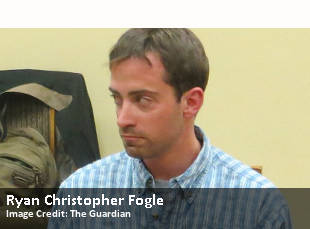
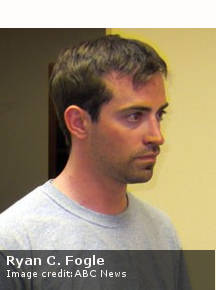
Ryan Christopher FogleBy JOSEPH FITSANAKIS | intelNews.org |
The Russian Ministry of Foreign Affairs lodged an official complaint yesterday with the United States Ambassador to Russia over the alleged espionage activities of Ryan Christopher Fogle. The Third Secretary in the Political Section of the US embassy was arrested with great media fanfare on Monday night, allegedly as he was trying to recruit a Russian intelligence officer. As can be expected, the Russian media had a field day with Fogle’s arrest; after all, it has been nearly a decade since the last time an American intelligence operative was publicly uncovered on Russian soil. Many Western observers, however, have questioned if Fogle could really be an officer of the Central Intelligence Agency, and whether the Russian Federal Security Service (FSB) simply framed an unsuspecting junior American diplomat. Much of the skepticism expressed by Western commentators focuses on the articles that were allegedly found by the FSB in Fogle’s backpack. They included several pairs of sunglasses, recording devices, as well as two wigs. Would a CIA officer be foolish enough to be carrying with him surreptitious recording devices in downtown Moscow? And do modern case officers still employ wigs when walking the streets of foreign capitals recruiting spies? The answer is, of course, yes. Read more of this post

Alleged CIA officer arrested in Moscow in Russian sting operation

Ryan Christopher FogleBy JOSEPH FITSANAKIS | intelNews.org |
Russia has accused an American diplomat of secretly working for the Central Intelligence Agency (CIA) following his arrest during a sting operation in Moscow. The diplomat, who was expelled from Russia on Tuesday, is Ryan Christopher Fogle; he held the post of Third Secretary of the Political Department of the United States embassy in the Russian capital. He was detained on Monday evening by counterintelligence officers of Russia’s Federal Security Service (FSB). Fogle’s arrest marked the first time in nearly a decade that espionage charges were leveled against an American government employee in Russia. Fogle, a 29-year-old native of St. Lous, Missouri, who graduated from Colgate University in New York in 2006, was arrested by the FSB in Moscow’s Akademika Pilyugina Street, allegedly right in front of an apartment complex reserved for foreign diplomatic personnel. He is accused by the FSB of conspiring to recruit a member of the Russian intelligence services, who is allegedly an antiterrorist expert working in Russia’s North Caucasus region. The FSB told Russian media that Fogle had communicated with his would-be recruit on the phone at least twice in the days prior to the sting operation. The FSB even took the extremely unusual step of airing footage of Fogle’s arrest on Russian state-run television. The American diplomat was shown pinned on the ground, wearing a blonde wig and baseball cap, while FSB officers handcuffed him. A second video released by the FSB, shows Fogle sitting quietly in a government office, in the presence of three other American government officials, including Michael Klecheski, Chief Political Officer at the US embassy in Moscow. All four of them are shown staring in silence, while an FSB official is expressing his strong displeasure over Fogle’s alleged espionage activities. According to the FSB, when Fogle was arrested, he was found to be carrying a backpack containing —among other things— his diplomatic identification card, two wigs, three pairs of sunglasses, recording devices, an RFID shield, a compass and a knife. He was also carrying three Ziploc bags filled with $100,000 in €500 notes, as well as a letter, written in Russian, addressed to his would-be recruit. Read more of this post

News you may have missed #831 (Boston Marathon bombings)

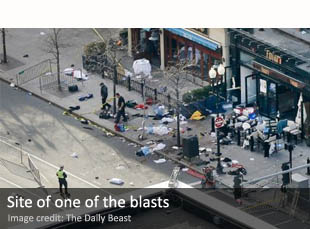
Site of one of the Boston Marathon blastsBy IAN ALLEN | intelNews.org |
►►Russia had warned FBI Tsarnaev had radical links. The Russian FSB intelligence security service shared with the FBI in early 2011 information that Tamerlan Tsarnaev, one of the brothers suspected in the Boston marathon bombings, was a follower of radical Islam. The Russians allegedly told the FBI that Tsarnaev, 26,  had changed drastically since 2010 as he prepared to leave the US to join unspecified underground groups.
►►FBI interviewed dead Boston bombing suspect years ago. The FBI admitted Friday they interviewed the now-deceased Boston Marathon bombing suspect Tamerlan Tsarnaev two years ago but failed to find any incriminating information about him. The FBI probe culminated in a sit-down interview where they probably asked him a lot of questions about his life, his contacts, his surroundings. All of this was then written in a report.
►►Ex-CIA/FBI official says Boston bombings were not terrorism. Counterterrorism expert Philip Mudd, with experience in the CIA and the FBI, told Fox News: “What I fear is that people too quickly categorize this as terrorism. This looks more to me like Columbine than it does like al Qaeda. Two kids who radicalized between themselves in a closed circle and go out and commit murder. I would charge these guys as murderers, not terrorists”.
►►Ex-US Attorney General says Boston bombings were terrorism. Michael Mukasey, Attorney General of the United States from 2007 to 2009, says that the Boston attack “was obviously a suicide operation –not in the direct way of a bomber who kills all his victims and himself at the same time by blowing himself up, but in the way of someone who conducts a spree, holding the stage for as long as possible, before he is cut down in a blaze of what he believes is glory. Here, think Mumbai”.

Spy equipment discovered near Russian military base in Syria

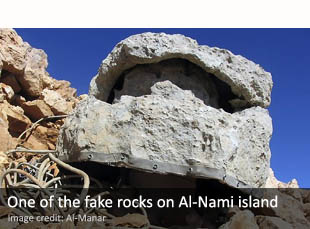
One of the fake rocks on Al-Nami islandBy JOSEPH FITSANAKIS | intelNews.org |
Sophisticated intelligence-collection devices hidden inside faux boulders have been discovered on an island situated across from a Russian naval base in Syria. The devices were found on Al-Naml, an uninhabited islet of only 150 square meters, which overlooks the Syrian port of Tartus, site of a major Russian naval military facility. According to Al-Manar, a satellite television station affiliated with the Lebanese Shiite militant group Hezbollah, the fake boulders were carefully placed on Al-Naml by Israeli commandos during a nighttime operation. Television images showed a system of satellite dishes and cameras, which appear to be connected to custom-made batteries via a series of cables. The imitation boulders, which conceal the electronic surveillance devices, seem to have been carefully designed in order to blend in with the surrounding rocks and brushes on Al-Nami. Al-Manar said on its website that at least three such devices were “discovered by local fishermen”. It added that the camouflaged contraptions appear to be aimed at tracking the movements of Russian vessels sailing to and from Tartus. Moreover, the devices appear to be capable of transmitting pictures of vessels to Israel in real time, via satellite. The naval base at Tartus was first leased to the Soviet Navy by the Syrian government in 1971. In response, the Kremlin forgave a multi-billion dollar debt owed by Damascus. Today, Tartus constitutes Russia’s sole military facility situated outside the regions of the former Soviet Union. It is also Russia’s only naval base in the Mediterranean, and many strategic analysts consider it as the primary geopolitical justification behind Moscow’s support for the regime of Syrian President Bashar al-Assad. Read more of this post

News you may have missed #826 (suspicious deaths edition)

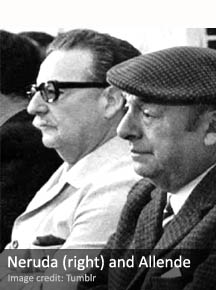
Pablo Neruda (right) and Salvador AllendeBy IAN ALLEN | intelNews.org |
►►Key suspect in Russian spy murder refuses to cooperate. Andrey Lugovoi, who is now an elected official in Russia, says he will not talk even by video to British investigators about the poisoning of Alexander Litvinenko in London just over six years ago. The murder of former Russian spy Alexander Litvinenko in London in 2006, has never been solved and remains the subject of conflicting narratives and still-deepening intrigue over who may have killed him and why.
►►Exhumation of Neruda’s remains set for April. A court in Chile has set April 8 as the date for the exhumation of the remains of the Nobel Prize-winning poet Pablo Neruda, as part of an inquest into his death. The poet and leftwing activist died 12 days after a military coup replaced the socialist President Salvador Allende with General Augusto Pinochet. The poet’s family maintains that he died at 69 of advanced prostate cancer. But in 2011, Chile started investigating allegations by his former driver, Manuel Araya Osorio, that the poet had been poisoned.
►►Venezuela to investigate Chavez murder allegations. Venezuelan officials have said they will set up an inquiry to investigate suspicions that President Hugo Chavez was “murdered by foreign agencies”. Venezuelan Oil Minister Rafael Ramirez told the BBC the United States and Israel were to blame for Chavez’s death, and that he had no doubt that Chavez’s death was an act “similar to Yasser Arafat’s“. Earlier this week, the US expelled two Venezuelan diplomats following the expulsion of two American officials from Caracas.

Spy claims against diplomat cast shadow over Anglo-Russian relations

Denis KeefeBy JOSEPH FITSANAKIS | intelNews.org |
Widespread allegations of espionage against Britain’s deputy ambassador to Russia threaten to derail the ongoing diplomatic rapprochement between Russia and the United Kingdom, according to a leading British newspaper. Painstaking efforts to rebuild Anglo-Russian relations, which crumbled after the 2006 assassination of Russian defector Alexander Litvinenko in London, are scheduled to culminate later this week, when senior Russian cabinet officials will be visiting London for a “strategic dialogue” with their British counterparts. But British newspaper The Sunday Telegraph reports that Whitehall is increasingly annoyed by persistent attacks in the Russian media against Denis Keefe, the UK’s deputy ambassador to Moscow. Keefe, a career diplomat with over 30 years in the Foreign Office, much of it during the Cold War, is a Cambridge University graduate who speaks six languages, including fluent Russian. Prior to arriving in Moscow, he served as British ambassador to Georgia, where he was stationed during the 2008 Russia-Georgia war. Almost as soon as he arrived in Russia, Keefe found himself at the center of persistent allegations in the Russian media that he is “an undercover spy, with his diplomatic position serving as a smokescreen”. Several Russian news reports have indirectly accused him of contacting dissident groups inside Russia in an effort to undermine the government of Russian President Vladimir Putin. The Telegraph, which published for the first time an account of the Russian media claims in the West, said that Russian reporters appear to hound Keefe every time he makes a public appearance in the country. In one recent instance, two journalists asked him whether he was “a spy for MI6”, Britain’s primary external intelligence agency, insisting that he give a “straightforward answer to this question”. Keefe reportedly responded that this was “not a serious question” and had “nothing to do” with him. Read more of this post