S. Korea parliament probes spy agency’s elections meddling
July 29, 2013 6 Comments
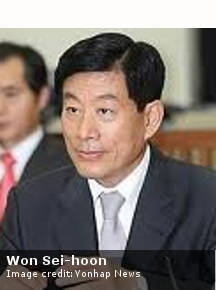 By JOSEPH FITSANAKIS | intelNews.org |
A parliamentary probe began last week into whether South Korea’s main intelligence agency tried to steer voters away from the liberal candidate during the 2012 presidential election. The country’s National Intelligence Service (NIS) is accused of having deliberately leaked a classified document in order to embarrass the late South Korean President Roh Moo-hyun, who was also a member of the liberal Uri Party (now Democratic Party) of South Korea. IntelNews readers will recall that Won Sei-hoon, who headed NIS from 2008 to 2013, was recently indicted for meddling in the 2012 Presidential Election. According to the indictment, Won ordered a group of NIS officers to “flood the Internet” with messages accusing DP candidates of being “North Korean sympathizers”. Prosecutors allege that Won initiated the Internet-based psychological operation because he was convinced that “leftist adherents of North Korea” were on their way to “regaining power” in the South. The NIS affair has gripped South Korea’s media headlines for months, but fuel was added to the fire in June, when the NIS “mistakenly” declassified an internal document describing a series of secret North-South Korean negotiations. The document, from 2007, shows that the then-President of Korea, Roh Moo-hyun, from the Uri Party, had proposed to North Korean officials the establishment of a “maritime peace zone” along the disputed border between the two nations. Liberal politicians allege that, according to South Korean declassification laws, the document should have remained secret for many decades, and accuse the NIS of deliberately leaking it in order to promote the image of South Korean liberals as “North Korean sympathizers”. Meanwhile, another senior South Korean security official, former Seoul metropolitan police chief Kim Yong-pan, has also been indicted for allegedly hampering a police investigation into Won’s internet campaign. This series of apparently interlinked events is now at center stage in the parliamentary probe, as rival parties prepare to clash over the allegations. Read more of this post
 By IAN ALLEN | intelNews.org |
 By IAN ALLEN | intelNews.org |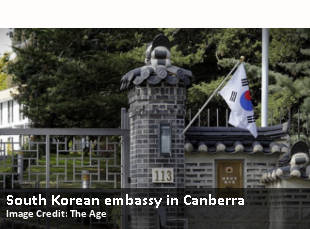







 intelNews.org
Australian civil servant accused of spying denied access to evidence
September 11, 2013 by Ian Allen
Australia’s Federal Court has rejected a bid by a senior civil servant to view the evidence the government is using to accuse him of espionage. Until September of 2011, Dr. Yeon Kim was a career civil servant with the Australian Bureau of Agricultural and Resource Economics and Sciences (ABARES). His specialization in international trade policy required a security clearance, which Kim had possessed since 2001. But in 2011, he was sacked and had his security clearance revoked for allegedly holding clandestine meetings with officers of South Korea’s National Intelligence Service (NIS). The Australian government accuses Kim of meeting repeatedly with Hoo-Young Park, an employee of the South Korean embassy in Canberra, who had been declared to the Australian government as an NIS liaison officer. According to court documents, three other NIS officers serving under diplomatic cover in Australia, Bum-Yeon Lee, Sa-Yong Hong, and a third man named Kim, were involved in collecting intelligence on Australian trade secrets. The Australian Security Intelligence Organisation (ASIO), which detained Kim, said that he willingly participated in the “foreign interference” operation by the NIS. For several months now, Kim has been contesting the Australian government’s legal case against him in the Federal Court. His legal team recently requested that the Court annul two certificates issued by the Australian attorney general, designed to bar the defense from accessing evidence against Kim. The certificates were originally submitted by government prosecutors during an earlier Administrative Appeals Tribunal hearing. But the Court declined the request, saying the defense waited too long to challenge the certificates. In issuing the ruling, Justice Lindsay Foster said Kim’s legal team should have requested that the certificates be declined during the original hearing. The judge censured Kim’s defense lawyers for “stand[ing] by and watch[ing] while the certificates were [originally] deployed”, adding that it would undermine the integrity of the legal process to allow the certificates to be challenged at this late stage. Read more of this post
Filed under Expert news and commentary on intelligence, espionage, spies and spying Tagged with News, Australia, South Korea, ASIO, Australian Security Intelligence Organisation, National Intelligence Service (South Korea), Yeon Kim, Hoo-Young Park, Bum-Yeon Lee, Sa-Yong Hong, South Korean embassy in Australia, Australian Bureau of Agricultural and Resource Economics and Sciences, Lindsay Foster