German authorities had monitored Turkish bomber of US embassy
February 5, 2013 3 Comments
 By JOSEPH FITSANAKIS | intelNews.org |
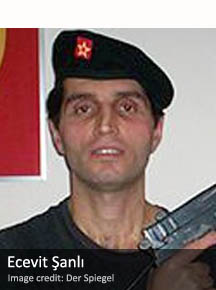
Some observers were surprised by news last week that the suicide attack at the US embassy in Turkish capital Ankara was perpetrated by secular Marxists, instead of religious extremists. But students of terrorism know that modern suicide bombings have historically been employed by secular separatist groups. These include the Liberation Tigers of Tamil Eelam (LTTE) in Sri Lanka, as well as the Kurdistan Workers Party (PKK) in Turkey. The Revolutionary People’s Liberation Party/Front (DHKP/C), which assumed responsibility for last Friday’s attack in Ankara, is a Marxist-Leninist splinter group, which has carried out suicide operations against its ideological enemies since at least 2001. Last week’s attack, which killed two and injured over a dozen people, was perpetrated by Ecevit Şanlı, a 40-year-old Turk from the city of Gölköy in northeastern Turkey. A member of DHKP/C for at least 20 years, in 2000 Şanlı became a cause célèbre among far-leftists in Turkey. During that year, he played a leading role in a hunger strike organized by self-described political prisoners in Turkey, in protest over prison conditions. The protest was brutally suppressed by Turkish security forces, and Şanlı barely survived it. He was eventually released on probation after serving a lengthy prison sentence. According to German sources, upon his release from prison, Şanlı moved to Germany, home to the world’s largest Turkish expatriate community. While there, he joined local leftist causes and appears to have been active in DHKP/C’s network of supporters among the Turkish community there. In 2009, German authorities briefly detained Şanlı after he was found in possession of propaganda literature belonging to DHKP/C, which is a designated foreign terrorist organization by the German government. Read more of this post
















First interview in 57 years for chief of Germany’s most secretive spy agency
February 19, 2013 by Ian Allen 5 Comments
The head of the German military’s counterintelligence service, which is widely seen as the country’s most secretive intelligence organization, has given the first public media interview in the agency’s 57-year history. Most readers of this blog will be aware of the Federal Republic of Germany’s two best-known intelligence agencies: the Federal Office for the Protection of the Constitution (BfV), tasked with domestic intelligence, and the Bundesnachrichtendienst (BND), the country’s primary external intelligence agency. Relatively little is known, however, about the Military Counterintelligence Service (MAD), which has historically been much smaller and quieter than its sister agencies. As part of the Bundeswehr, the German armed forces, the MAD is tasked with conducting counterintelligence and detecting what it terms “anti-constitutional activities” within the German armed forces. It is currently thought to consist of around 1,200 staff located throughout Germany and in at least seven countries around the world, including Kosovo, Afghanistan, and Djibouti. Until recently, the MAD was so secret that its headquarters, located in the west German city of Cologne, bore no sign on the door. For generations, its senior leadership remained unnamed in the public domain. This changed on Monday, when Ulrich Birkenheier became the first Director of MAD to speak publicly in the nearly six decades of the agency’s existence. Birkenheier, who assumed the leadership of MAD in July of 2012, told German newspaper Die Welt that it was time for a “paradigm shift” and that the agency felt the need “to explain [its] task and work to the outside world”. In his interview, Birkenheier explained that members of the German armed forces are routinely targeted by foreign intelligence agencies, while far-right extremist groups are represented in the ranks of the German military. Read more of this post
Filed under Expert news and commentary on intelligence, espionage, spies and spying Tagged with counterintelligence, Germany, interviews, MAD (Germany), military counterintelligence, Military Counterintelligence Service (Germany), News, Ulrich Birkenheier